Continue to Reduce Energy Usage and Help Prevent Power Outages - Warning Issued for Today, 8/18
City of Goleta sent this bulletin at 08/18/2020 02:52 PM PDT
Continue to Reduce Energy Usage and Help Prevent Power Outages
California Independent System Operator Issues Warning for Today, August 18
Over this week, California and the rest of the West Coast will face a historic heatwave that will put pressure on our energy grid. In order to avoid electricity shortages, states like California are asking businesses and residents to reduce energy usage in order to prevent service interruptions. It’s especially important to limit energy usage from 3:00 p.m. to 10:00 p.m., especially air conditioning, electric car charging and other energy intensive technology. Over cool your home overnight and in the morning in order to stay cool all day. Sign up to receive Flex Alert notifications to help California conserve energy during times of grid stress.
The California Independent System Operator (CAISO) has declared a WARNING for today, August 18 through 11:59 p.m., due to low power reserves and high demand for electricity on the California electric grid. At this time, CAISO rotating outages have not been declared but could be later. Rotating outages may begin if the CAISO declares a stage 3 emergency, most likely during peak hours from 6:00 pm to 8:00 pm. Rotating outages typically last one hour. To see the impacted jurisdictions and for additional information, please visit www.sce.com/rotatingoutage.
Easy Actions You Can Take at Home
Adjust Your Thermostat
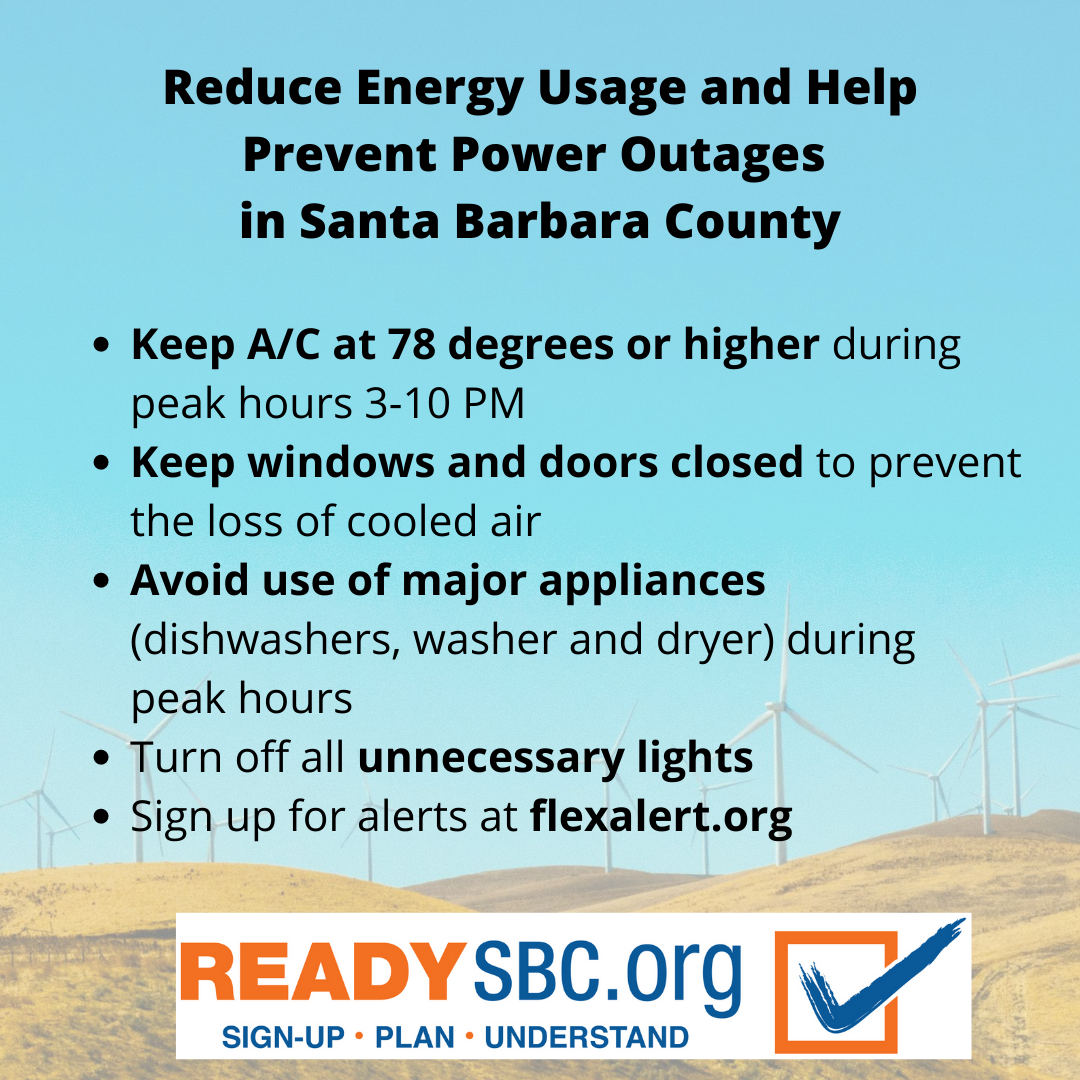
Set your thermostat at 78° or higher during 3-10 pm.
Pre-cool your home by setting thermostats to 72° in the early part of the day (when it is more efficient) and 78° or higher after 3 pm
Use smart or programmable features to help maintain energy savings when you’re not home.
Major Appliance Use
Postpone using major appliances like the oven, dishwasher, clothes washer, until cooler times of the day.
Run your dishwasher and clothes washer only when full.
Wash clothes in cold water.
Clean or replace dirty filters.
Turn your water heater down to 120° or the "normal" setting.
Close Windows and Doors
In the morning before the day starts to heat up, close windows and blinds to keep warm air out.
Keep windows and doors closed to prevent the loss of cooled air.
Smart Energy Use
Turn off unnecessary lights.
Use lamps with LEDs instead of overhead lights.
Enable "power management" on all computers and turn off when not in use.
Unplug phone charges, power strips (those without a switch) and other equipment when not in use.
Conservation Programs
Consider participating in your utility's demand response program. These voluntary programs are short, temporary measures to reduce energy consumption when power supplies are critically low and a Flex Alert has been issued. Contact your local electric utility to learn about your utility's program and incentives they may offer to participate.
Save Energy at Work
Lighting
Turn off unnecessary office lights, and use natural lighting where possible.
Thermostat
In the summer, set your zone thermostat to 78º or higher, when possible.
Prevent Leaks
Check window vents to make sure they are clear of paper and other debris.
Adjust the blinds on windows that receive direct sunlight.
Keep exterior windows and doors closed to prevent the loss of cooled or heated air.
Equipment
Turn off any office equipment that is not currently in use. Alternately, look for sleep or power-saving modes in-between uses during the day.
Enable power management settings on all computers, so that they go to sleep and turn off screens when not in use.
Break room
Unplug electronics such as coffee-makers and microwaves when not in use and when the day is done.
End-of-the-Day
As you leave the office, get in the habit of checking to make sure computers, printers/copiers, and other office equipment is fully shut down. If possible, switch them off at the power strip to ensure they are no longer draining energy.
Conservation Programs
Consider enrolling in your utility's voluntary conservation program. These types of measures–also known as demand response programs–are short, temporary ways for your utility to reduce energy consumption when power supplies are critically low. Contact your electric utility to learn more about your utility's program and incentives they may offer to participate.