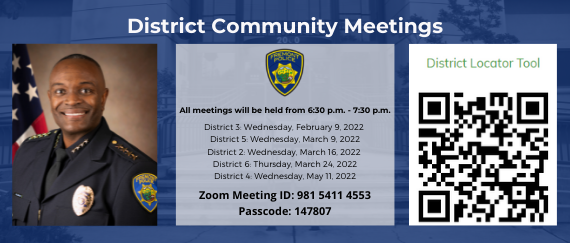
 Fremont Police District Community Meetings
Join your Councilmember to learn about crime trends in your area and get to know Police Chief Sean Washington. Scan the QR code or visit our district locator tool if you need help determining your district. The remaining upcoming District meetings will be held on Zoom from 6:30 pm to 7:30 pm and will be closed captioned and recorded for future viewing.
- District 2: Wednesday, March 16, 2022
- District 6: Thursday, March 24, 2022
- District 4: Wednesday, May 11, 2022
The 2022 Youth Wellness Ambassadors are Fremont high school students who have been selected to participate in our annual community service project to raise awareness and reduce stigma around mental health and wellness. This year the students are studying the role that technology and mobile apps play in mental health and wellness. Please help our Youth Ambassadors by providing feedback anonymously. Results and other information about the Role of Technology in Mental Health and Wellness will be presented at an upcoming virtual community forum at the end of March. For more information about the Youth Wellness Ambassadors, their project, and for updates on the virtual community forum, please visit our website.
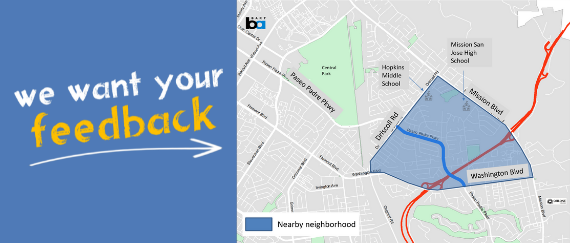
The City of Fremont is seeking input from the community on transportation improvements to Paseo Padre Parkway between Driscoll Road and Washington Boulevard. Paseo Padre Parkway is an important route used by a variety of users, including residents who live along the street, residents who live in nearby neighborhoods, and people who travel through this section of roadway. This section of Paseo Padre Parkway is characterized by residential land uses along the street and is frequently crossed by students traveling to nearby middle and high schools; it is also an important thoroughfare connecting South Fremont, Central Fremont, and Interstate 680. The purpose of this survey is to understand issues faced by different users of Paseo Padre Parkway between Driscoll Road and Washington Boulevard and to solicit input on ideas to address a variety of transportation issues including safety, efficient traffic flow, and livability. The survey closes on March 18.
Join Alameda County Water District (ACWD) as they promote the Environmental Protection Agency (EPA) WaterSense program’s annual Fix a Leak Week, March 14 - 20. As a promotional partner, ACWD will host a weekday lunchtime webinar series of ‘how to’ video clips and provide resources for troubleshooting various types of indoor and outdoor leaks. ACWD’s Water Use Efficiency staff will be available to answer your questions related to leaks and conservation programs. Join ACWD at 12:00 pm Monday through Friday, from March 14 – March 18 via Zoom.

The Tri-Cities Senior Peer Counseling Program is seeking warm and compassionate volunteers to assist seniors in our community. They're looking for people at least 50 years of age and older to participate in a 20-hour training. No educational requirements - they believe life has been your teacher. Contact Ahmad Tarin, AMFT, by email to sign up now.

Alameda County is aligned with California K-12 and childcare guidance on masking. Effective 11:59 pm on March 11, masking requirements become strong recommendations in K-12 and childcare settings in Alameda County. This decision was made after careful consideration at a time when cases have reduced significantly from a peak in January. The County has heard from many communities and residents who welcome the mask policy changes, and have received concerns about risks from residents and families. Though the mask requirement has been lifted at this time, high quality, well-fitting masks are recommended to limit the spread of COVID-19 for individuals who are high risk. This is the right time to move face masking guidance from requirement to recommendation in most settings as cases are declining to near pre-surge levels. Mask policy changes do not signal an end to the COVID-19 pandemic; mask requirements may be needed again for future surges.
As of March 1, California no longer requires masking for vaccinated or unvaccinated individuals, and strongly recommends masks for all individuals in most indoor public settings. Alameda County mask policy is aligned with the State including mask requirements for high transmission settings for public transit, emergency shelters, health care settings, correctional facilities, homeless shelters and long-term care facilities. County case rates and hospitalizations continue to decline from their peak in January. While risk of exposure to COVID-19 is down, the State and Alameda County strongly recommends masks indoors for everyone and especially individuals with high risk. Businesses and workplaces can choose to maintain mask requirements for everyone 2 years of age and older.
The Centers for Disease Control and Prevention (CDC) recommends a layered approach to reduce the spread of COVID-19, and this includes strong ventilation indoors. Open outdoor air dampers beyond minimum settings to reduce or eliminate HVAC air recirculation. Open windows and doors, when weather conditions allow, to increase outdoor air flow. Do not open windows and doors if doing so poses a safety or health risk (e.g., risk of falling, triggering asthma symptoms) to occupants in the building. Use fans to increase the effectiveness of open window. For more information, please visit the CDC’s tips for improving ventilation in your home.
Following the California Department of Public Health’s release of new indoor masking guidance, Governor Newsom also signed an executive order updating the Cal/OSHA COVID-19 Emergency Temporary Standard in keeping with the current guidance. Masks are no longer required for unvaccinated workers indoors but are strongly recommended for all individuals in most indoor settings. CalOHSA requires employers to provide a face covering upon employee request. See workplace safety resources and information for employers and workers.
The Centers for Disease Control and Prevention (CDC) introduced new indicators to track low, medium, and high COVID community levels by county, along with updates in guidance. These indicators replace previous CDC community transmission levels to better capture the burden of severe disease in communities and shift focus away from preventing infection now that most Americans are vaccinated and/or have had COVID at least once. The metrics for these levels are based on three data points – COVID-19 hospitalizations, hospital capacity, and new COVID-19 cases – which will be updated weekly on Thursdays. Along with this change, CDC has modified its guidance including more broad masking policies to tie the strongest recommendations to times of high community levels and severe disease burden. Alameda County is currently classified by CDC in the medium community level due to a significant number of old lab results received from a single laboratory on February 24. This does not reflect current case burden and they expect to return to the low community level at CDC’s next update. For the most accurate and up-to-date local COVID-19 data, please see the Alameda County dashboard. The County continues to recommend that residents follow prevention strategies: stay up to date on vaccines including boosters, stay home when sick, and get tested if exposed as we modify approaches to masks and other response actions.
|