|
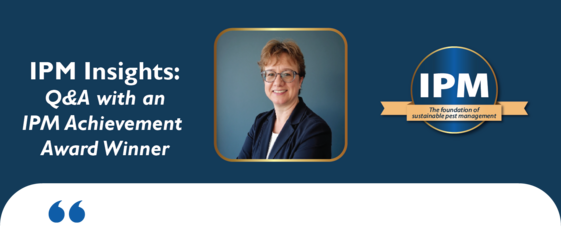
This year DPR is sharing seasonal IPM insights featuring a question and answer dialogue with previous IPM Achievement Award winners. This month's IPM Insights are from Dr. Michelle Brown, District Manager of the West Valley Mosquito & Vector Control District, which was awarded a DPR IPM Achievement Award in 2019 for their leadership in outreach, research, and integrated mosquito management. West Valley Mosquito & Vector Control District aims to reduce pesticide reliance for mosquito management through community education, collaboration with local agencies, and cutting-edge research. We asked Michelle about her perspectives on using IPM to prevent and manage mosquitos in urban settings.
 |
How do you use safer, more sustainable IPM practices to manage mosquitoes in municipalities?
We focus on physical reduction of sources that generate mosquitoes and utilize biological controls such as traps that use a fungus to kill mosquitoes and Sterile Insect Technique which uses X-ray irradiated male mosquitoes to reduce overall populations.
What is your top tip for addressing mosquitoes in urban settings?
I recommend eliminating standing water, wearing mosquito repellent and calling your local mosquito & vector control district if you are having mosquito issues.
What do you think is important for city managers to know about mosquito and vector prevention and management?
It’s important for everyone to understand that we wish to eliminate the sources generating mosquitoes through physical reduction of sources and outreach efforts to educate the public. That is the best way to control populations. Biological and chemical control play a part when physical reduction is not possible.
Why is using IPM and sustainable pest management important for managing pests in California?
Utilizing IPM techniques is the most effective and cost-effective way to eliminate mosquitoes.
Dr. Michelle Brown, District Manager,
West Valley Mosquito and Vector Control District,
2019 IPM Achievement Award Winner

Dr. Michelle Brown's Recommended IPM Resources
- To learn more about mosquito life cycles and the importance of breeding source reduction, check out DPR’s Mosquito IPM at Home
- To learn more about how West Valley Mosquito and Vector Control District uses IPM, check out the IPM page on their website: https://www.wvmvcd.org/ipm
- Visit the District’s “Frequently Asked Questions” page to learn more about reducing the risks associated with mosquitos: https://www.wvmvcd.org/faq
- The Mosquito and Vector Control Association of California provides leadership to mosquito and vector control agencies in California as well as hosts resources for municipalities and the public: https://www.mvcac.org/
- The American Mosquito Control Association is a resource for training, information, and events related to mosquito management: https://www.mosquito.org/
What is IPM?
 Integrated pest management, or IPM, is a sustainable pest management strategy you can use everyday. IPM focuses on a variety of pest prevention and non-toxic or least-toxic pest management techniques to effectively solve pest problems. IPM strategies use practices that exclude pests so they can’t cause problems and use pesticides only as a last resort. By using integrated pest management practices, it’s possible to effectively, safely, and more sustainably manage pests at your school or child care center while protecting staff, children, and the environment.
What is SPM?
 Sustainable Pest Management (SPM) is a holistic, whole-system approach applicable in agricultural and other managed ecosystems and urban and rural communities that builds on the concept of integrated pest management (IPM) to include the wider context of the three sustainability pillars: Human Health & Social Equality, Environmental Protections, and Economic Vitality.
|