|
Child Care IPM
Spring Newsletter
May 2025
|
|
|
More than 3,000 people like you subscribe to DPR's Child Care IPM news and updates! Thank you!
IPM for Child Care Play Yards
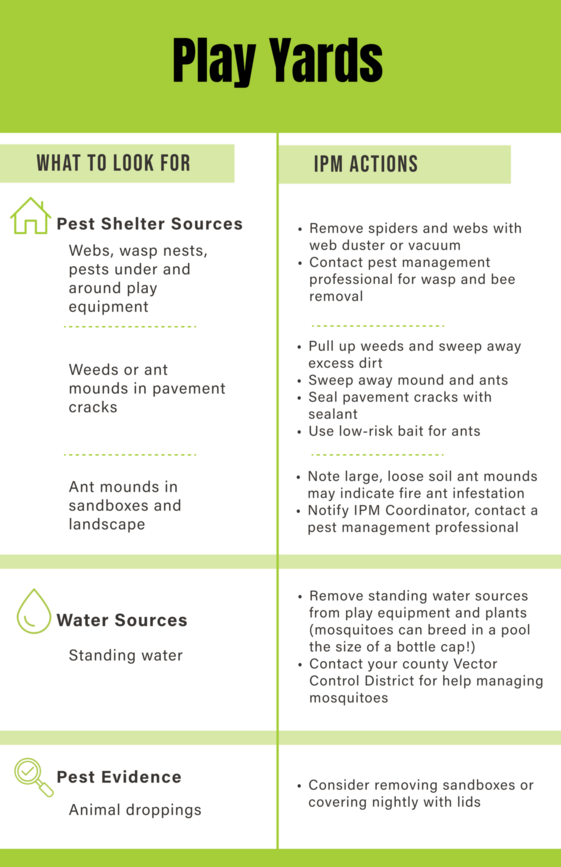
Play yards are prime places for pests! Play equipment, landscaping, and other outdoor areas make it easy for pests to move in. Use the chart below to inspect play yards for pests.
You will learn what to look for and steps you can take to choose integrated pest management (IPM). IPM will help you start sustainable pest management (SPM) practices at your center. SPM means managing pests in ways that protect all Californians and our environment.

|
|
 IPM Weekly Walkaround Guide for Play Yards
Select the button below to get the Weekly Walkaround Guide for Play Yards pdf.
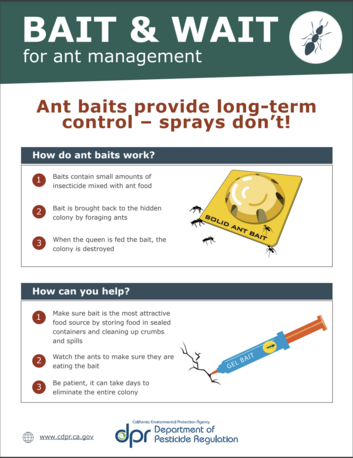
How to use low-risk ant bait:
Ants are pests indoors and outdoors. Select the button below to get the Bait and Wait for Ant Management pdf. You will learn what you can do to help manage ants using low-risk ant bait.
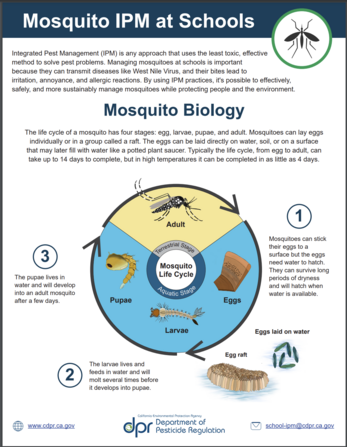
How to manage mosquitoes with IPM:
Mosquitoes are pests indoors and outdoors. Select the button below to get the Mosquito IPM at Schools pdf. You will learn about what you can do to help manage mosquitoes sustainably using IPM.
We want to hear your IPM success story!
Have you used IPM to manage pests safely and effectively at your child care center? We’d like to celebrate with you and share your IPM success in these newsletters! Select the button below to email us your story.

 |
|
For more IPM resources for child care centers visit the UC IPM website.
|
What is IPM?
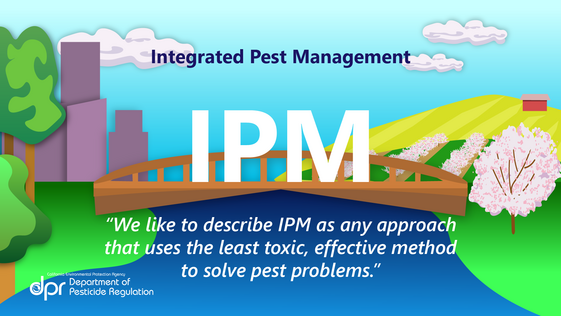 Integrated pest management, or IPM, is a sustainable pest management strategy you can use everyday. IPM focuses on a variety of pest prevention and non-toxic or least-toxic pest management techniques to effectively solve pest problems. IPM strategies use practices that exclude pests so they can’t cause problems and use pesticides only as a last resort. By using integrated pest management practices, it’s possible to effectively, safely, and more sustainably manage pests at your school or child care center while protecting staff, children, and the environment.
What is SPM?
Sustainable Pest Management (SPM) is a holistic, whole-system approach applicable in agricultural and other managed ecosystems and urban and rural communities that builds on the concept of integrated pest management (IPM) to include the wider context of the three sustainability pillars: Human Health & Social Equality, Environmental Protections, and Economic Vitality.
 Follow DPR's social media outlets throughout the year to learn more!
|
|
Questions? Contact Us:
Please contact the Department of Pesticide Regulation’s Child Care Integrated Pest Management Program by emailing ccipmlist@cdpr.ca.gov. For additional information about the Child Care Integrated Pest Management Program please visit DPR’s website.
|
|
Who We Are
The California Department of Pesticide Regulation protects human health and the environment by fostering safer and sustainable pest management practices and operating a robust regulatory system to monitor and manage the sale and use of pesticides across the state. DPR’s work includes registering all pesticides sold or used in California, conducting scientific evaluation of pesticides to assess and mitigate potential harm to human health or the environment, investing in innovative research to encourage the development and adoption of integrated pest management tools and practices, monitoring for pesticides in the air and water, conducting outreach to ensure pesticide workers, farmworkers and local communities have access to safety information, and enforcing pesticide regulations in coordination with 55 County Agricultural Commissioners and their 400 field inspectors.
|
|
|
|