|
Healthy Schools Act Requirements Reminder for Pest Control Businesses
May 2024
|
|
Healthy Schools Act Schoolsite Definitions
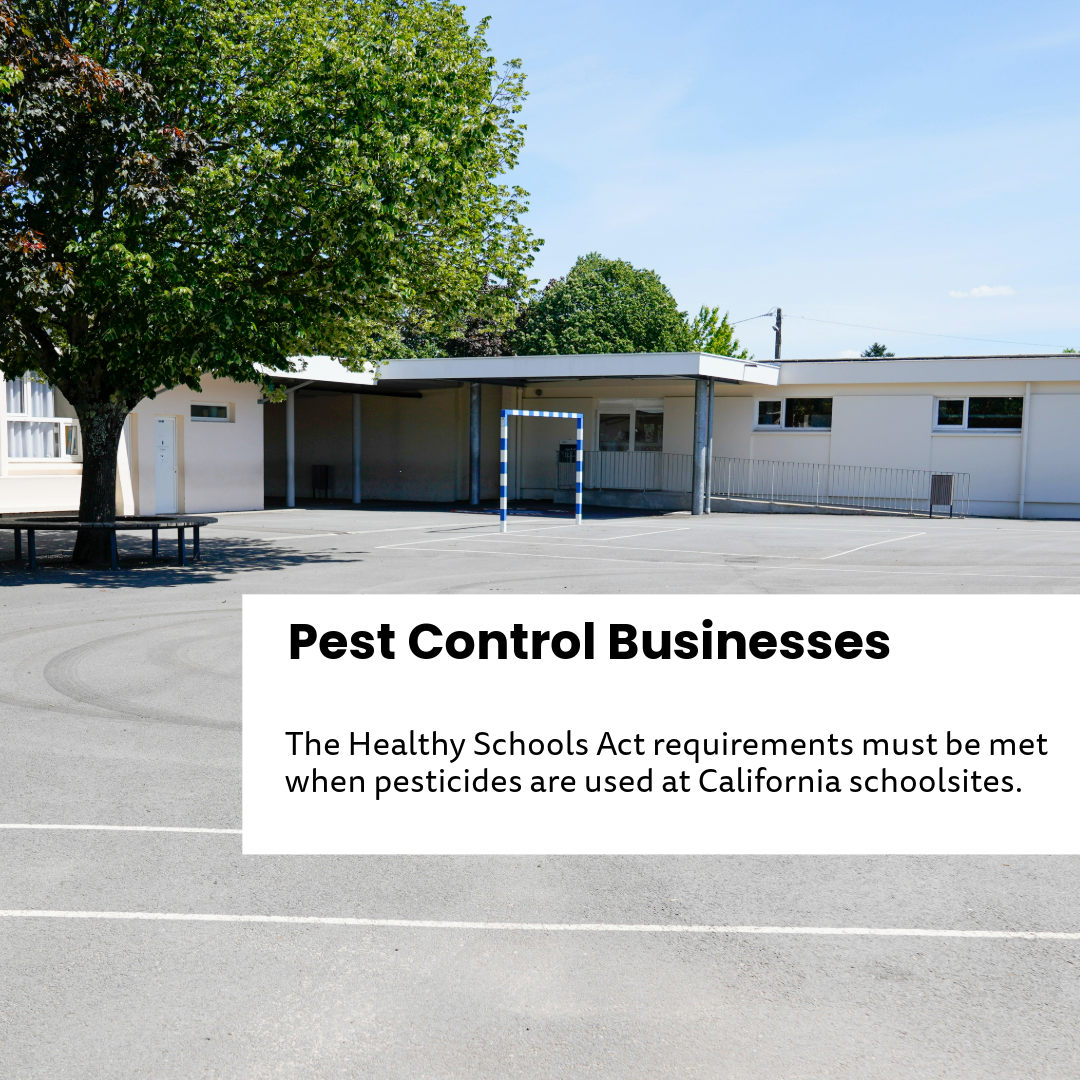
Pest control businesses (PCBs) must follow the Healthy Schools Act requirements if pesticides are used at:
- Public K-12 schools
- Public and private child care centers, excluding family child care homes
- Schoolsite properties such as buildings or structures, play areas, athletic fields, and vehicles
- Areas within 10 feet of the perimeter of a child care center
According to the Healthy Schools Act, safer, more sustainable integrated pest management (IPM) practices should be the preferred method for managing pests at California schools and child care centers.
|
|
Healthy Schools Act Requirements for PCBs
 Training
 |
|
Take a one-hour DPR-approved Healthy Schools Act training course before applying a pesticide and once every license renewal cycle thereafter.
Access a DPR-approved training courses from:
|
Individual Notification to Child Care Centers
 |
|
Notify the child care center 120 hours (5 days) before any pesticide application and provide the pesticide product information including:
- Product name
- Manufacturer
- Active Ingredient
- EPA registration number
- Intended date of application
- Areas of application
- Reason for application
|
Reporting
 |
|
Report all registered pesticides applied at schoolsites during the prior year to DPR by January 30th using form DPR-ENF-117.
|
Other Healthy Schools Act Best Practices
There are other Healthy Schools Act requirements that impact the work of pest control businesses at school and child care centers. Schoolsites are required to notify parents, guardians, and staff about pesticide use on their property. These notifications take place at the beginning of the school year and 72 hours before each pesticide application. Healthy Schools Act exempt pesticides are not included in either notification.
Pest control businesses should be prepared to provide the schoolsite:
- A list of all pesticides expected to be used during the year.
- Information about each individual pesticide application.
What is IPM?
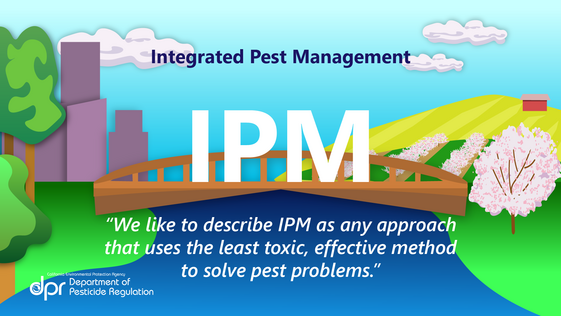 Integrated pest management, or IPM, is a safer, more sustainable strategy you can use everyday. IPM focuses on a variety of pest prevention and non-toxic or least-toxic pest management techniques to effectively solve pest problems. IPM strategies use practices that exclude pests so they can’t cause problems and use pesticides only as a last resort. By using integrated pest management practices, it’s possible to effectively, safely, and more sustainably manage pests at your school or child care center while protecting staff, children, and the environment.
Follow DPR's social media outlets throughout the year to learn more!
|
|
Questions? Contact Us:
Please contact the Department of Pesticide Regulation’s School & Child Care Integrated Pest Management Program by emailing school-ipm@cdpr.ca.gov. For additional information about the School & Child Care Integrated Pest Management Program please visit DPR’s website.
|
|
Who We Are
The California Department of Pesticide Regulation protects human health and the environment by fostering safer and sustainable pest management practices and operating a robust regulatory system to monitor and manage the sale and use of pesticides across the state. DPR’s work includes registering all pesticides sold or used in California, conducting scientific evaluation of pesticides to assess and mitigate potential harm to human health or the environment, investing in innovative research to encourage the development and adoption of integrated pest management tools and practices, monitoring for pesticides in the air and water, conducting outreach to ensure pesticide workers, farmworkers and local communities have access to safety information, and enforcing pesticide regulations in coordination with 55 County Agricultural Commissioners and their 400 field inspectors.
|
|
|
|