Council Actions Newsletter
City Council Meeting
Watch the May 17, 2022 Meeting (Part 1, Part 2) (Agenda)
City Council Actions:
Ceremonial Matters and Presentations
1. Proclamation Recognizing Silicon Valley Clean Energy Authority
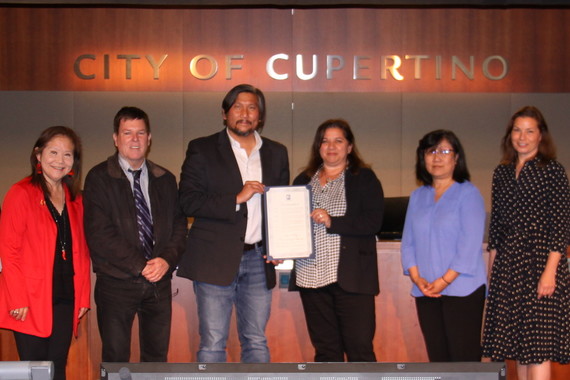
City Council presented a Proclamation to Silicon Valley Clean Energy Authority (SVCEA) to recognize the agency's fifth anniversary and its close connection to Cupertino. Monica Padilla, SVCEA's Chief Operating Officer, accepted the proclamation.
Pictured from left to right: Councilmember Hung Wei; Councilmember Jon Willey; Mayor Darcy Paul; Monica Padilla; Vice Mayor Liang Chao; Councilmember Kitty Moore
2. Proclamation Recognizing Public Works Week
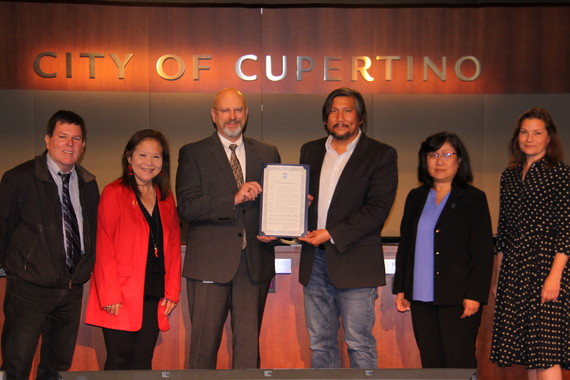
City Council presented a Proclamation to recognize May 15 to 21 as Public Works Week. City Manager Jim Throop accepted the proclamation on behalf of Matt Morley, the City's Public Works Director.
Pictured from left to right: Councilmember Jon Willey; Councilmember Hung Wei; City Manager Jim Throop; Mayor Darcy Paul; Vice Mayor Liang Chao; Councilmember Kitty Moore
Postponements and Orders of the Day
Items 3-17 were postponed to the June 7 meeting. Items 18 and 20-35 were postponed to the May 19 Special Meeting. Item 19 was continued to the August 16 meeting.
Reports by Council and Staff
36. Councilmembers provided brief reports and announcements on their public activities since the prior regular Council meeting.
37. Councilmembers provided updates on their Committee assignments.
38. Councilmembers provided updates on their Subcommittee assignments.
39. City Manager provided City business updates.
Ordinances and Action Items
1. Fiscal Year 2022-2023 City Work Program (CWP)
Council continued this item from the Special Meeting and moved it to be heard during the Regular Meeting before Item 40. Following staff presentation and discussion, Council voted to adopt the Fiscal Year 2022-2023 City Work Program (CWP) as amended:
- #26 Revert “Visitor Center” to original description, but strike out “and offline”
- Develop an online and offline visitor center/guide so that visitors to Cupertino know where to go.
- Ideally a (digital) map to identify locations to visit or for photo ops to post on social media.
- #32 Revert “Youth Who Work” to the original description
- Encourage more youth and young adults in schools to work and also help small businesses to reduce the burden caused higher minimum wages. City will work with partner organizations to create a 6-week fully paid internship program for 10 youth. This creates a win-win solution with not only helping youth gain valuable work experience while earning, but also support up to 10 small businesses as they won't have to pay for salaries at all and would be more incentivized to host youth during summer.
- For example, the City could provide $2/hour to compensate local small businesses.
- Mark items that are part of Capital Improvement Program (CIP)
- Form a Seismic Retrofits Council Subcommittee to work with the City Manager and Director of Public Works
- Councilmembers will return their rankings to staff by May 27, with a ranking system of five 5s, fifteen 3s, and ten 1s; and bring the item back to Council on June 7 when the budget is adopted
Study Session
8. Study Session on Capital Improvements Program (CIP)
Following staff presentation and discussion, Council moved to adopt the following modifications to the current proposed Capital Improvements Program (CIP):
- Replace Blackberry Splash pad with "Identify locations for splash pads so that water play features are geographically dispersed in the City
- "De Anza Boulevard Buffered Bike Lanes" => "De Anza Boulevard Bike Lanes" - include options, not just buffered
- "Restripe De Anza Blvd to include a painted buffered zone between the existing bike lane and the vehicle lanes." => "Provide buffers between the existing bike lane and the vehicle lanes, which could be painted buffered zone or other more visible options."
- Direction to staff for process to follow:
- Council provide ranking (8 fives, 8 threes, 9 ones) for the Category 1 items (in Attachment 1) and they will be presented when this item comes back
- Council provide ranking (8 fives, 8 threes, 8 ones) for the Category 3 items (in Attachment 1) and they will be presented when this item comes back
- Please add an estimate of staffing effort for each project to help with prioritization
- Stevens Creek Boulevard Separated Bikeway, Phase 3 - Design => how much staff time is needed?
- Bollinger Road Bike Improvements => how much staff time is needed?
- De Anza Boulevard Buffered Bike Lanes => how much staff time is needed?
- For any CIP project adopted, staff should still come to the Council to get approval for the conceptual design with public input before going ahead with the design and the construction
- For example, there is no approved conceptual design for both the pond and the amphitheater projects at Memorial Park
- There is no approved conceptual design for the City Hall Annex (Torre Avenue) building
- For next year, Council directed staff to refer CIP items to respective commissions to consider compliance with existing master plans.
9. Initial Study Session on Fiscal Year 2022-2023 Proposed Budget
Council continued this item to the May 19 Special Meeting.
Celebrating the Future Canyon Crossing
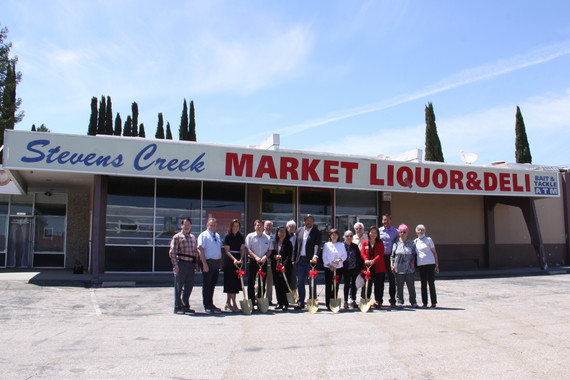
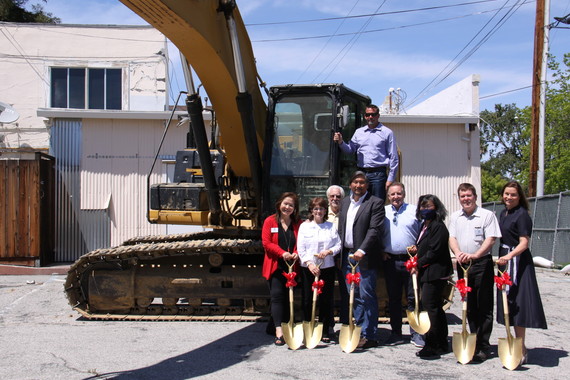
On Monday, May 16, the Cupertino City Council gathered to look back on a part of Cupertino’s history and to celebrate the future. The City Council was joined at the future Canyon Crossing development by those designing and building the project, in addition to the long-time previous owners and community members.
Located at 10625 South Foothill Boulevard, the 1.57-acre site has a long history in Cupertino as the family-owned Stevens Creek Market Liquor & Deli. Prior to that, in the 1930s and 1940s, orchards once stood in the space before buildings were constructed on the site.
The future Canyon Crossing site will be a mixed-use project of 18 units consisting of:
- five single-family homes
- eight townhomes
- five apartments
- a public plaza with areas for gathering
The living spaces will be built over a 4,536 square foot commercial building to allow for retail spaces on the first floor with underground parking. The living spaces will include Below Market Rate (BMR) housing units as well. The existing buildings are expected to be demolished in the fall.
To view details, plans, and more about the project, visit cupertino.org/canyoncrossing.
Mayor's Corner with Darcy Paul
As we near the end of our current fiscal year which ends on June 30th, the City Council has achieved an administrative synergy that should set the City of Cupertino on a path of stability, cooperation and success long into the foreseeable future. Why is this?
When I began my time on the Cupertino City Council in late 2014, I had been a seven-year member of the City’s Parks & Recreation Commission. Our activities were good ones, such as helping to design Franco Park, which at the time when I joined the Commission in 2007 was tennis-court space that was a part of the Villa Serra apartment complex that wrapped around the southeast corner of Stelling and Homestead. Part of the re-branding and re-development of this complex was the park dedication of the tennis courts into what became Franco Park. In fact, helping to design Franco Park was one of my first projects in the City.
At the same time, priorities in our City weren’t always focused on administrative integrity. The fact of the matter is, at that time in 2007, we were exactly in the middle of a 14-year episode of embezzlement from within our employee ranks. A staff accountant had created false entities and was funneling development money into those false entities. If you follow the news, you’ll know that the District Attorney’s office pursued criminal charges. We are also making sure that the City, now that the criminal case has been successfully concluded, pursues civil remedies to ensure not only that we are made whole, but that we send a strong message that we are taking measures to ensure that this corruption doesn’t happen again.
I’ve never been particularly focused upon priorities that stray from the substance of a task. I think it’s a matter of upbringing. When I see the plaque commemoration outside of Franco Park, and it’s a nice one, I still get bemused by how, right next to it, is the black low-level iron fence with a gate that I asked the consultant to place around the park so that kids from the apartment complex would be safe and not run out on to Homestead when playing. And it’s a popular park. In other places around the City, you’ll see Commissioners recognized, but not here. I once asked a friend of mine on Council at the time why that was, and he just sort of chuckled and said, “Well, you need to be on Council, right?”
Why are we, as I put it, in a situation now where administrative integrity has improved? It is largely because we are now organizing the work of our community to align with our City’s budgetary process. Our City’s Commissions and Committees on which residents sit span a significant range of our activities. They are, in alphabetical order, the Audit Committee, the Bicycle and Pedestrian Commission, the Design Review Committee, the Economic Development Committee, the Environmental Review Committee, the Fine Arts Commission, the Housing Commission, the Library Commission, the Parks & Recreation Commission, the Planning Commission, the Public Safety Commission, the Sustainability Commission, the Technology, Information & Communication Commission, and the Teen Commission.
Previously, each of the above Commissions and Committees operated on independent schedules, each with a separate process for bringing forward work to be done. As one can imagine, there was quite a bit of lack of clarity as to what the business of the City was as reflected in the work of the elected officials and their appointees. Three years ago, Council formed a subcommittee to fix this issue. It took a significant amount of work, but together with staff, we managed to define a protocol for a community-wide discussion process of how we were going to go about defining on a broad scale, and on a yearly basis in concert with the budgetary process, the work of the community. That process resulted in what we now call the Work Plan.
Then we had a world-wide pandemic occur. While the first couple of years’ worth of iterations of having a Work Plan went by reasonably well, with projects such as the Community Gardens in McClellan Ranch, the Library Expansion and the acquisition of significant new park space in the Rancho Rinconada neighborhood was helped along with the Work Plan, we were also confronted with the logistical challenge of how to put this system into effect when almost none of our work force was at City Hall. At the same time, we had to navigate the challenge of long-held practice and expectation, whether that was ingrained political entitlement held by some manifesting itself in attacks or simply a way of conducting business that did not recognize the basic fact that accountability to the public is paramount, not in name only, but in practice. Basic things like the subject of an Item on an Agenda being the consideration of an action, rather than the action itself, needed to be fixed. Public process is there to allow us to consider the action, in other words. It is not there to create a show and a means for some kind of paid scorecard.
In the midst of all of this, yes, there has been turnover, but let me tell you that that turnover not only is prevalent throughout jurisdictions, we in Cupertino have turned this to our strong advantage. It was our prior Interim City Manager Greg Larson who told us that he very clearly told our staff that they were not to keep score as to whether “their” Items on any particular Agenda “won” in a given Council meeting. You don’t hear about these details, because we have a Council that focuses on the work rather than the posturing, but these particular climbs, and there have been many, have added up to a vastly improved administration.
Does this entail a great deal of work? Of course it does. To arrive at a Work Plan that has the buy-in of the community and all of our advisory bodies, we have to start the process at the end of our prior calendar year. Commissions define their priorities. Public input is sought and taken. The draft proposals reach Council. We have had multiple discussions where we correctly consider the various aspects of the issues and projects in front of us. And why should this process, or the amount of time and work put into it, be taken as something negative? Don’t you want, for instance, a community that can conceptualize its own homeless jobs program, to think and talk about the details of how such a program is going to be delivered and successful? As some like to say, if we don’t do the work, then what can possibly go wrong?
Well, as it turns out, a lot. But our Council is doing that work, and we appreciate the support of the community for recognizing that fact. We considered the upcoming Fiscal Year 2022-2023 Work Plan and these considerations reached a near-culmination this week in our regular Tuesday meeting on May 17th when the content of the 38 final items on the Work Plan was finalized. Subsequent to that on the same evening, we discussed our City’s Capital Improvement Program, where our Public Works Department works closely with us to define the capital projects for our City in the upcoming year. And these two facets of our work, the Work Plan and the Capital Improvement Program, immediately preceded our work on the upcoming Fiscal Year 2022 to 2023 budget, when our initial study session on that budget took place this past Tuesday and continued to our Special Meeting that took place yesterday evening, on Thursday, May 19th.
And the discussions were frank, detailed and informed. We have turned a corner in Cupertino where it is clear that our Council will engage, and it will engage in a manner that will make a project improve and where people and processes will emerge and in reflection realize that the work done was done in an effective spirit of comprehension, cooperation and completeness. Granted, the work is never done. But I want to thank everyone for their work in getting us together to this point.
It has been a busy but worthy time here. Last week, most of Council attended the League of California Cities’ Conference in Sacramento, where for the first time that organization’s advocacy and leadership training were combined into one, and the time was well-spent. Cupertino Council was present at each and every of the parallel sessions, as we ensured that someone from our City was there for panels and discussions happening at the same time. We stood with our fellow municipalities throughout California to advocate for at least some part of our State’s record-breaking surplus to go back to localities so that we can work on the unfunded mandates, and not just be directed without a road map as to how to achieve such mandates.
This past weekend, we hosted the inaugural Cupertino Mayor’s Cup Challenge, where the intent is to take a multi-faceted social problem and examine it from various perspectives in the hopes and efforts of realizing a more complete future solution, not so much removed from advocacy and the adversarial, but again, with the intention that understanding and common efforts to address problems remain the focus. This year’s topic for the Mayor’s Cup Challenge is Plastics and Sustainability, and we conducted a well-attended event (with reasonable and voluntary social distancing and mask-wearing) that saw three panel discussions with representatives from industry, science & technology, and the policy sectors in the new Library Expansion space, lunch at Community Hall where we saw presentations by our students examining this issue, and finally professional artists hosted an exhibit that remains on the second floor of the Library Expansion through next Tuesday, May 24th. Please stop by there and take a look if you haven’t seen it yet. The art is all made from waste materials sourced from a local waste management facility. For this event, it will not end here, and so please stay tuned for the post-event content that we place on the City’s webpage for the event.
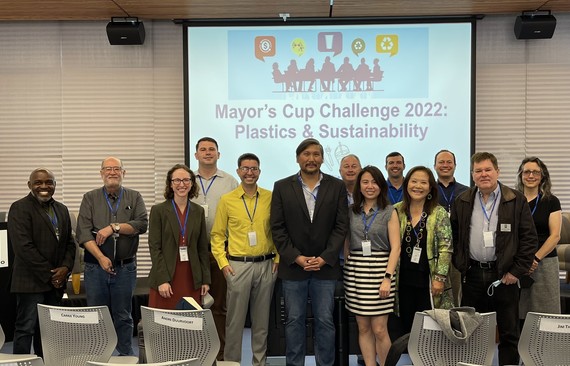 |
Panelists and Council at May 14 Plastics and Sustainability event. Pictured left to right: Dr. Lloyd Holmes, President of De Anza College; Professor Bruce Olszewsky, San Jose State University; Dr. Corinne Scown, Lawrence Livermore Labs; Nick Lapis, Californians Against Waste; Joey Schmitt, Action Research; Mayor Darcy Paul; Jeff Donlevy, General Manager, Ming's Recycling; Carrie Young, Cupertino Library Foundation; Jeff Dobert, Director of Operations, Bay Counties SMaRT; Councilmember Hung Wei; Andre Duurvoort, Sustainability Manager, City of Cupertino; Councilmember Jon Willey; Ursula Syrova, Environmental Programs Manager, City of Cupertino (Not pictured: Vice Mayor Liang Chao; Councilmember Kitty Moore; Sally Houghton, Executive Director, Plastic Recycling Corp of California; Obai Rambo, Director of Government Affairs, Recology)
There is much happening in Cupertino, as our now not-so-new City Manager Jim Throop stated in our meeting this past Tuesday, and as we look forward to the upcoming fiscal year starting on July 1, 2022, we round out the current fiscal year, which ends the prior day, on June 30th, a little more than a month from now, knowing that we have a community and Council that doesn’t always and perhaps mostly doesn’t agree with each other but we have done the work and cultivated the patience and understanding necessary to put us in a position where we are working with each other, our neighbors, our community, our region, our State and so forth in order to effectuate aspirational values. Indeed the work does not end, but it is a real privilege and pleasure to be on this journey with you.
Sincerely,
Darcy Paul
Mayor
|