A Message From the Supervisor
Greetings! As the summer begins to wind down, I
hope families are finding time to enjoy these longer days
together. I encourage residents to get out and take advantage of the
many recreational amenities of their beautiful and bountiful Alameda County communities. Please
continue to exercise additional caution on our roadways. As you’ve
likely noticed, there is a great deal of activity going on— projects are underway, children are out
and about playing, and more bicyclists and pedestrians are enjoying our rural
roadways.
While you’ve hopefully enjoyed a bit of down time this summer, your
Alameda County Board of Supervisors has continued to work hard for you. Learn about some of what we have been working on at the Board level, in addition to: the upcoming Niles Canyon Stroll and Roll, updates on transportation projects and legislation, youth leadership opportunities, and much more, in this end-of-summer edition of my newsletter.
It is my great privilege to serve you. As always,
please contact me regarding any County-related issues, or with comments or questions
you may have. You may reach me at 510-272-6691 or email me at district1@acgov.org. Visit District 1 on
the web at www.acgov.org/board/district1/.
I am honored to represent you and I hope to hear from you.
Sincerely,
Board of Supervisors Actions
Ever
wonder what your Supervisor does during the weekly Tuesday Board of Supervisors
Meeting? Here are some of the board actions from the last quarter
which impact the residents of District 1:
-
On June 27th, the Board of
Supervisors approved $1.5 million for the Countywide Plan to provide public
health services to older adults. The funds will go towards senior injury
prevention, home delivered meals, medication management and other public health
programs for older adults.
-
On August 1st, the Board of
Supervisors approved $100,000 in Measure A funding for Sunol Glen School to
provide a physical education teacher.
-
On August 1st, the Board
of Supervisors approved $7,500 to support the City of Fremont’s Annual Four
Seasons Health Expo.
-
On August 1st, the Board
of Supervisors approved $10 million for additional homeless services that will
address encampments, residential anti-displacement and other homeless programs
countywide.
For the
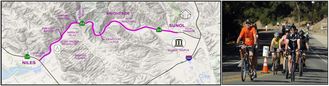
second time in three years, Alameda County in partnership with numerous other public agencies, will host the Niles Canyon Stroll and Roll. The event gives pedestrians and
bicyclists full access to the scenic roadway and raises public awareness about a proposal to build a
new public trail through the Canyon.
WHO: Hosts include Alameda County
Supervisors Scott Haggerty and Richard Valle, East Bay Regional Park District,
California Department of Transportation and others examining proposed public
trail through scenic, historic Niles Canyon
WHAT: A 6.4-mile stretch of Niles Canyon Road will be closed
to vehicle traffic between Old Canyon Road in Fremont and Main Street in Sunol for
seven hours on Saturday, September 30, to allow hikers, runners and
bicyclists full access to the road without automobile traffic. Staff from Alameda County and the
East Bay Regional Park District will also be on hand with visual displays and
other information to help the public understand a proposal to build a
recreational trail through the Canyon.
WHEN: Saturday, September 30, 2017 | 7 am - 2 pm
WHERE: Niles Canyon Road between Old Canyon Road, Fremont and Main
Street, Sunol
PARKING:
-
Quarry Lakes Regional Recreation Area, 2100 Isherwood Way, Fremont
-
Sunol Glen Elementary School, 11601 Main St, Sunol
-
SFPUC Parking Lot, 1600 Pleasanton
Sunol Road, Sunol
Participants are encouraged to use public
transportation. Free shuttle service will be provided to and from the Fremont
BART station during event hours.
Visit the event website, www.84strollroll.com
to learn more about the Niles Canyon Multi-Use Trail proposal and the September
30 roadway closure.

The Association of Bay Area
Governments (ABAG) and the Metropolitan Transportation Commission (MTC)
released the Draft Plan Bay Area 2040, and Draft Environmental Impact Report
(EIR), in April of this year. After two years of public discussion and
technical work, the draft Plan Bay Area 2040 is an updated long-range Regional
Transportation Plan and Sustainable Communities Strategy for the nine-county
San Francisco Bay Area. This document discusses how the Bay Area will grow over
the next two decades and identifies transportation and land-use strategies to
enable a more sustainable, equitable and economically vibrant future.
The effort grew out of the
California Sustainable Communities and Climate Protection Act of 2008 (California
Senate Bill 375, Steinberg), which requires each of the state's 18 metropolitan
areas – including the Bay Area – to reduce greenhouse gas emissions from cars
and light trucks. Plan Bay Area 2040 is a limited and focused update of the
region's previous integrated transportation and land use plan, Plan Bay Area,
adopted in 2013.
MTC and ABAG scheduled open houses
in each of the nine Bay Area counties for comment on the draft Plan Bay Area
2040. Supervisor Haggerty and staff attended
the open house in Fremont on May 4th, where residents were able to
view displays, ask questions, and offer comments on these documents.
Questions? Visit www.PlanBayArea.org, email
info@PlanBayArea.org, or call 415-778-6757.
The California Legislature passed Senate Bill 1 raising gas taxes and vehicle fees in hopes of generating tens of billions of dollars to fix the state's roads.
The tax increases will take effect November 1 and new vehicle registration fees will begin Jan. 1, 2018. Fees on zero-emission vehicles will take effect July 1, 2020, according to the text of the bill.
What does this bill really mean?
In essence, Senate Bill 1 will raise $52.4
billion over the next ten years, roughly 5.2 billion/year. The majority, $3 billion per year, is to be
split evenly between state and local governments for highway and road
maintenance.
Revenue breakdown:
- 12 cent increase in gas tax (November 2017);
- 20 cent increase in diesel excise tax (November
2017);
-
4% increase diesel sales tax Value-based car registration fee increase,
$25-175 depending upon car value (January 2018);
- Price-based excise tax on gas would also be
reset to 17.3 cents (July 2019); and
-
Zero-emission vehicle registration fee increase,
$100 (2020)
Alameda County, as a whole, should
receive an estimated increase of $49 million in local road funding for FY
2018-2019. Of that amount, District 1
(Dublin, Fremont, and Livermore) would receive an estimated increase of $6.9
million.
The Livermore Amador Valley Transit Authority (LAVTA) is expected to receive a net increase in State Transit
Assistance (STA) formula funds of approximately $110,000, a nearly 50% increase over
FY 2017 baseline, and nearly $70,000 in new STA Capital funding. The STA funding may be used for capital or
operating purposes.
|
 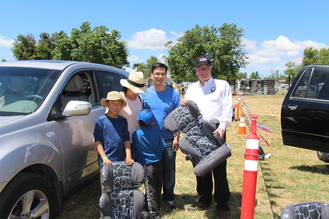
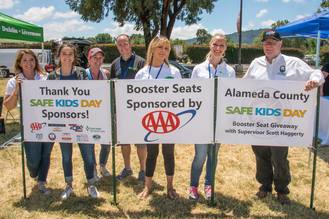
On June 10, 2017, Supervisor Scott Haggerty joined forces with Safe Kids Alameda County to host Alameda County Safe Kids Day, a free
booster seat and bicycle helmet distribution event. The event provided 500 booster seats, 500 bicycle helmets and 1,300 lunches to children and families across Alameda County. The day celebrated kids and provided information and resources to families, better equipping them to take action in protecting
their children on the roadway, at home, and while at play.
The event was made possible through
the generous support financial contributions from AAA of Northern California, Dublin & Fremont Chevrolet, Alameda
County Emergency Medical Services, Alameda County Fairgrounds, Sutter Health
Eden Medical Center, AEG Oakland and Bayco Vending.
Alameda County Taking
Applications for Youth Leadership Academy: High School Juniors and
Seniors Invited to Apply
Alameda County is accepting
applications for its 2017 Youth Leadership Academy (YLA), a free educational
program for local 11th and 12th grade students interested in learning about
local government, developing leadership skills and networking with peers from
throughout the County.
Youth from high schools across
Alameda County will participate in five Saturday morning sessions this fall
from September – December 2017. Sessions will allow young leaders to learn
about County programs, engage with County staff and elected officials, and
build leadership skills to help solve community problems.
Click here for more information, and/or to apply for the 2017 Youth
Leadership Academy.
The application period is from
August 30, 2017 to September 15, 2017.
To be eligible, applicants must
live in Alameda County and be a junior or senior at a school within the County.
Applications
are accepted on a first-come, first-served basis with consideration given to
geographic location to ensure representation of students from throughout
Alameda County. If you have any questions regarding the application process,
please call Hayley Laity or Esther Concepcion at (510) 272-6984.
|
 BART to Livermore Draft Environmental Impact Report Available for Public
Review
BART has issued a draft Environmental Impact Report (DEIR) for the proposed BART to
Livermore Extension Project, and is now accepting public
comments. Comments will be accepted beginning July 31. The deadline
for receipt of comments is 5:00 pm, October 16, 2017.
The proposed project,
being developed in partnership with the City of Livermore, consists of a 5.5
mile BART extension along I-580 to a new station near the Isabel Avenue/I-580
interchange. The project also includes new and modified bus services linking BART
to Altamont Corridor Express (ACE) stations and activity centers in Livermore.
The DEIR evaluates several alternatives, including a No Project alternative, a
Diesel Multiple Unit (DMU) alternative, an Express Bus/Bus Rapid Transit
alternative, and an Enhanced Bus alternative. Both the proposed project and DMU
alternative include storage and maintenance facilities for effective
operations.
To submit comments or add
your name to our mailing list, email barttolivermore@bart.gov
or write to:
Livermore Extension
Project
300 Lakeside Dr., 21st Fl.,
Oakland, CA 94612
You may also submit
comments and stay up-to-date via the website at www.bart.gov/livermore.
|
For the first time in
six years, AC Transit has increased the cost of its bus fares and passes.
Implementing the fare change now will
help the District cover rising inflationary costs and remain fiscally
sustainable.
What Did Not Change
The cost of a Day Pass
will not change. The pass gives riders unlimited rides in a day for a
flat $5 fare. The cost for youth, seniors and people with disabilities
will stay at $2.50.
What Changes Have Been Made
·
All Local and
Transbay Cash Fares
·
All Clipper Local
and Transbay Fares
·
All 31-Day and
Monthly Passes
Detailed information about
the July 1 fare change is available in English, Spanish, Chinese, Korean,
Vietnamese and Tagalog at www.actransit.org/rider-info/fares-tickets-passes. AC Transit Customer Service can also provide
additional assistance in multiple languages at (510) 891-4777.
|
Altamont Commuter Express
staff and consultants completed the ACEforward
Draft Environmental Impact Report (DEIR) – a significant step forward in
advancing expanded service and connections to better serve our burgeoning
inter-regional travel markets. Coordination and outreach efforts extended to
the Alameda San Joaquin Regional Rail Working Group throughout the development
of this DEIR.
The Alameda - San Joaquin Regional Rail Working Group was created in October 2015
to ensure that regional rail planning leads to project implementation that is
expedient, cost-effective, and responsive to community goals and objectives. A
primary goal of the Working Group is to deliver an interregional rail
connection between the San Joaquin Valley and BART in the Tri-Valley. In
addition, many of the Working Group member agencies have adopted resolutions in
support of this primary goal and include:
Alameda and San Joaquin County; the Cities of Livermore, Dublin,
Pleasanton, and Tracy; LAVTA and ACE; and Tri-Valley Innovation, the East Bay
Leadership and the San Joaquin Partnership.
The DEIR
considers a range of alternatives including extending BART to meet ACE and
extending ACE to meet BART at the proposed Isabel Avenue BART Station as well
as the existing Dublin/Pleasanton Station in the Tri-Valley. The DEIR does not,
however, include an EMU/EMU option that would extend through the Altamont Pass
primarily along Alameda County-owned railroad rights-of-way from the City of
Tracy to the terminus of BART in the Tri-Valley – the location to be determined
soon with the completion of the BART to Livermore environmental analysis. This
option is currently under consideration by the Alameda – San Joaquin Regional
Rail Working Group and will be examined further in conjunction with the DEIR
for the BART to Livermore Extension Project that is currently in public review.
The Bay Area
Council Northern California Megaregion Report (2016) identifies this
interregional connection as critical to the burgeoning economies of both the
Bay Area and San Joaquin County. It is
also identified in the MTC Bay Area Regional Rail Plan (2007) as a much needed
missing rail link to BART in the Tri-Valley. This vital rail connection
provides a highly-cost effective way to close a significant passenger rail gap
but in addition, it will improve the overall mobility in this key freight
movement corridor between the San Joaquin Valley and the Port of Oakland.
Supervisor Haggerty looks
forward to working with the ACEforward team
to further advance this important project.
The original Notice of Availability,
which provides a description of the project and a summary of its environmental
impacts, is available on the ACEforward website: www.aceforward.com. A more detailed description of the project and
its environmental impacts is provided in the DEIR.
|
|