Economic Development Newsletter
October 2026
 Albers Aerospace Holds Grand Opening
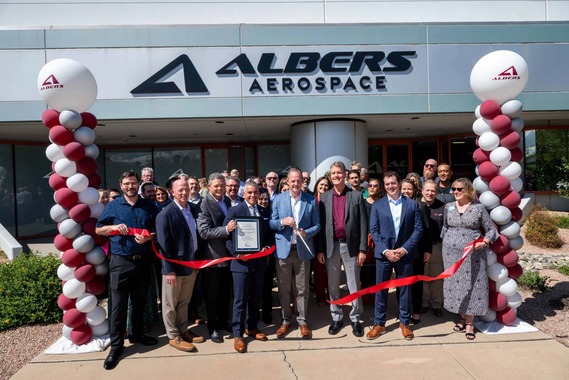
We were excited to attend the Albers Aerospace ribbon-cutting ceremony last month, which brings an additional aerospace and defense (A & D) contractor to Ward 5. Albers joins a strong ecosystem here, with Tucson ranked as a top 10 metropolitan area for aerospace manufacturing. (Lightcast, 2024).
Albers Aerospace began in 2015 and is headquartered in McKinney, Texas. The company offers a wide variety of services, including precision machining, CNC programming and simulation, tool and fixture design, sheet metal fabrication, complex assemblies, specialized containers, specialized surface treatments and welding.
Albers Aerospace entered the Tucson market in 2025 with the purchase of manufacturer and precision CNC machine shop Parallel Ventures. This summer, Albers leased the 30,000 square-feet of space at 3480 E. Brittania Drive.
The company expects to add 24 jobs, primarily in operations and manufacturing. The three-year expansion is estimated to have an economic impact of $36 million. Partners in the project include The Chamber of Southern Arizona, Arizona Commerce Authority, Pima County, PICOR, and Commercial Real Estate Group of Tucson.
Provident Industrial Invests in Distribution Center
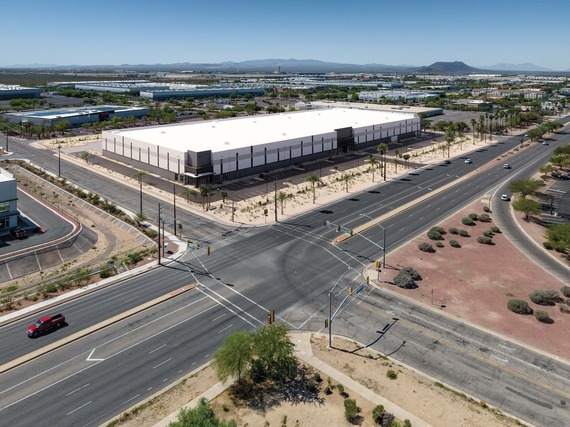 Valencia Airport Center is to be located at the southwest corner of Palo Verde and Valencia roads.
Growth continues in the Tucson International Airport (TIA) submarket with Provident Industrial purchasing 10 acres for the development of Valencia Airport Center, a 163,000-square-foot Class A distribution facility. Provident Industrial, a division of real estate development and investment company Provident, began construction on the more than $25 million development this summer. Valencia Airport Center will have trailer parking, a concrete truck court, and controlled access. Provident invited guests to a slab pour ceremony earlier this week at 3430 E. Valencia Road. Ward 5 Council member Selina Barajas was on hand at the event and gave welcoming remarks. The facility is expected to be ready for occupancy in the second quarter of 2027.
Valencia Airport Center is Provident’s first project in Tucson and follows a trend of activity in the local industrial market. Lincoln Properties completed phase I of I-10 International, with warehouse and distribution buildings totaling 373,811 square feet, also in the TIA submarket. Schnitzer Properties invested $73 million in industrial projects there, and its Drexel Commerce Center began leasing space this spring.
Mayor and Council Greenlight New Hotel and Retail Projects
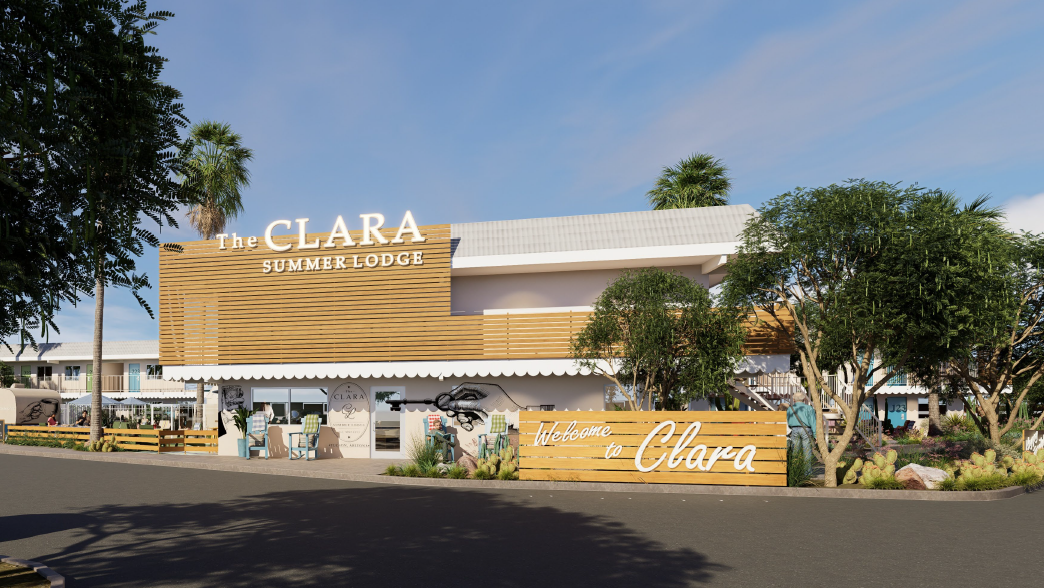 A rendering of the proposed Clara Hotel to be located on Benson Highway.
In October, Mayor Regina Romero and the City Council approved a series of new development projects.
A new hotel is coming downtown with the construction of a Marriott-branded Moxy Hotel at 45 N. Fifth Ave. The six-story Moxy will have approximately 137 hotel rooms. Common areas to the surrounding MLK Apartments and One North Fifth Apartments will also be upgraded and enhanced. Mayor and Council approved a Government Property Least Excise Tax (GPLET) with the developer, Depot Plaza Hotel. The GPLET provides up to eight years of property tax abatement and is used to encourage developers to build or renovate commercial buildings in the Central Business District. The value of the tax abatement is estimated at approximately $2.4 million. Revenues will be generated for the City of Tucson, Pima County, and the state, with more than $2.5 million in the construction phase, and more than $2.4 million annually from hotel operations. Construction is estimated to generate 190 jobs, with hotel operations supporting 193 jobs.
A mixed development of hotel, retail, and public space is on track to be built at 75 E. Broadway Blvd. Mayor and Council approved a Site-Specific Sales Tax agreement with Tucson Inn, LLC, which proposes a five-story, 125-room hotel with two restaurants/bars. The Marketplace, with retail and public spaces, will be located behind the hotel. The estimated value of the incentive to the developer is $2 million. Over the five years of the incentive agreement, the project is expected to generate $5.9 million in revenue to the City of Tucson. Moving forward, the development could generate taxable retail, food and beverage sales, lease revenues, and hotel room rentals estimated at $16.4 million per year. Approximately 280 jobs are estimated during the construction phase. Once completed, the hotel, retail, restaurants, and bars could directly support 125 full-time jobs and 75 part-time jobs.
Plans to renovate a hotel at 755 E. Benson Highway are also moving forward. The proposed Clara Hotel is a two-story property with 119 guest rooms. Developer Benson Hospitality Manager, LLC was approved for a Site-Specific Sales Tax agreement. Benson will be reimbursed a portion of city sales tax and hotel taxes over five years. The anticipated $1.3 million of city sales and hotel tax revenues exceeds the value of the sales tax reimbursement of $0.5 million. Once completed, the project could generate an annual economic impact of $2 million, or a total of $9.9 million over five years of operations. Mayor and Council directed City staff to return with a development agreement formalizing the incentive.
A 500,000 square-foot retail development on Old Vail Road and Distribution Way is being proposed by real estate developer SimonCRE. Located on approximately 56 acres, the retail center would be anchored by a mix of national and regional retailers. Potential tenants include general merchandise, home improvement, grocery, sporting goods, apparel and discount retailers, as well as restaurants and service-oriented retail uses. Mayor and Council approved the next steps, which include procuring an independent financial and economic analysis of the project.
Tucson-Taiwan Ties Deepen Through Mutual Trade Missions and Collaboration
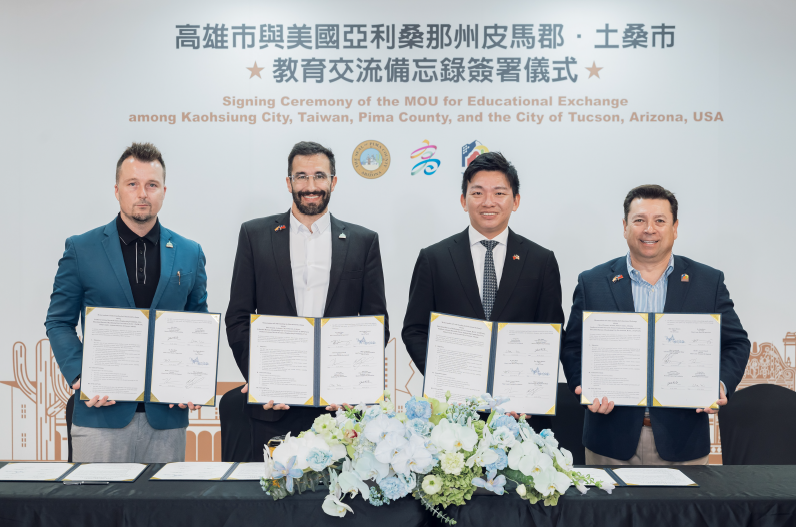 Left to right: Heath Vescovi-Chiordi, Pima County; Supervisor Dr. Matt Heinz, Pima County; Li-Sen Wu, Kaohsiung City; Mike Czechowski, City of Tucson
Following a Taiwanese delegation spring visit here, and our visit to Kaohsiung City in May, we were pleased to welcome leadership from the National Yang Ming Chiao Tung University (NYCU) in August. The delegation discussed several initiatives, including the joint Talent and Innovation Hub, academic programs, semiconductor research, and workforce development efforts. The visit was jointly coordinated with Pima County and the University of Arizona. Mayor Regina Romero, Pima County Board of Supervisors Vice Chair Dr. Matt Heinz and other regional leaders met with the delegation. Since the NYCU visit, Pima County and the University of Arizona have established the Arizona-Taiwan Talent and Innovation Hub to be housed at the Roy Place Building downtown.
Mike Czechowski returned to Taiwan in September with an Arizona delegation to attend SEMICON Taiwan, a trade event for the global semiconductor supply chain, and to further enhance collaboration in science and education. The City of Tucson signed a Memorandum of Understanding (MOU) with the Kaohsiung Education Bureau, the Southern Arizona Research, Science, and Engineering Foundation (SARSEF) and Pima County during the delegation visit. The MOU will help create more learning opportunities for U.S. and Taiwan students through school partnerships, curriculum development, and cultural exchanges.
Two additional highlights of the trade mission included “Meet Greater South” and the announcement event of the new Silicon Photonics at Arizona-Kaohsiung Center (SPARK).
“Meet Greater South” is a startup festival and business-to-business solutions expo. The Arizona delegation met with startups focused on AI, smart manufacturing, drones, and net-zero transformation, and discussed possible future technology and startup exchanges.
SPARK builds on the six-party MOU between the City of Tucson, Pima County, Arizona Commerce Authority, University of Arizona, Kaohsiung City, and National Sun Yat-sen University signed in March. The center will focus on developing new technologies to improve the performance and efficiency of systems that power AI and high-performance computing. SPARK will also offer academic programs for the next generation of semiconductor and photonics professionals in Southern Arizona and Taiwan.
Economic Development on the Road
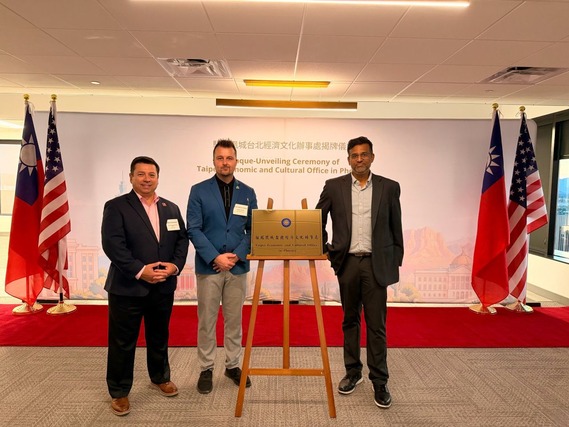 Left to right: Mike Czechowski, City of Tucson; Heath Vescovi-Chiordi, Pima County; Krishna Muralidharan, University of Arizona
In our efforts to build economic growth in Tucson, our business travels have taken us to Flagstaff and Phoenix in Arizona, along with Cleveland and San Francisco.
In September, Mike Czechowski attended the Site Selector conference in Cleveland. It was a great opportunity to market Tucson opportunities to site selectors, as they help companies choose the best geographic locations for new facilities, expansions, and relocations. One highlight was the Dialogue Series, a fast-paced, one-on-one networking event where Mike met with multiple site selectors.
Later in September, Mike and Jacquelyne Vega gathered with economic development professionals at the Arizona Association for Economic Development. Nearly 200 attendees learned about growth strategies, partnership models, sales techniques, Arizona’s semiconductor boom, and more.
Mike had back-to-back trips to Phoenix early this month. He attended the plaque-unveiling ceremony for the Taipei Economic and Cultural Office in Phoenix (photo above). Mike also gave a presentation at the Arizona Commerce Authority to a delegation of Taiwanese fastener manufacturing companies. Their businesses support the aerospace, defense, and drone industries, among others. Mike discussed the strengths and market opportunities in Southern Arizona.
Also this month, Jacquelyne joined Mike at the SEMICON West trade show in San Francisco. SEMICON brings together the world’s leading semiconductor companies, along with technology innovators, engineers, business leaders and others. It was great arena to showcase Tucson’s strength in photonics and optics, which are critical components of the semiconductor industry.
Tucson’s Entrepreneurial Spirit Is Strong at Fangamer
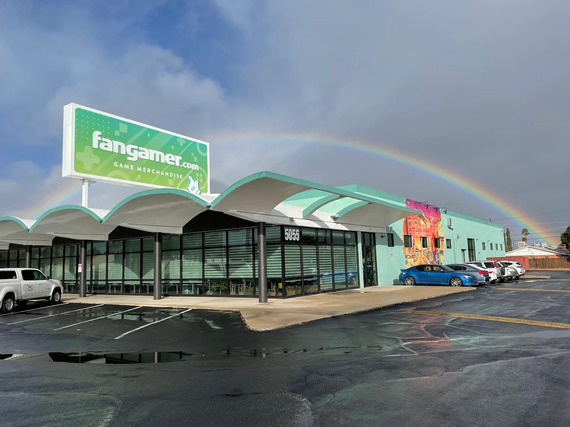
Photo courtesy: Fangamer
Tucson received some great press recently about our strong entrepreneurial ecosystem. TIME magazine recognized the University of Arizona Center for Innovation as one of the country’s Best Incubators and Accelerators in August. And it was reported that Tucson has the highest percentage of family-based businesses in the country (OnDeck, February 2026).
Local video game merchandiser Fangamer is a great example of a business born here and thriving. We visited the company this summer as part of our business retention and expansion efforts.
Fangamer was started by a group of friends running an EarthBound video game website. It launched in 2008 with four products sold online—two T-shirts, a pin set, and a mug. Today, Fangamer designs and sells a wide variety of video game merchandise, including apparel, books, home goods, plushes, posters, albums, and more.
Starting out in a second bedroom, Fangamer expanded to other properties, and in 2020, renovated a former antique mall property, which is now its headquarters. Fangamer also has regional operations in Europe and East Asia. The company surpassed $10 million in annual sales in 2018, according to the Arizona Daily Star.
Proclaiming “… there is no success at Fangamer that doesn’t involve the entire team …” the company continues to grow and has more than 100 employees worldwide. Fully independent and self-funded, Fangamer supports jobs in design, e-commerce, marketing, logistics, warehousing, customer service, technology, and business operations. Read their story and peruse merchandise at fangamer.com.
|