 Tucson's Haunting Water Tales
This October, Tucson Water once again delves into the eerie side of our desert oasis with two fictional, ghostly water stories.
La Llorona
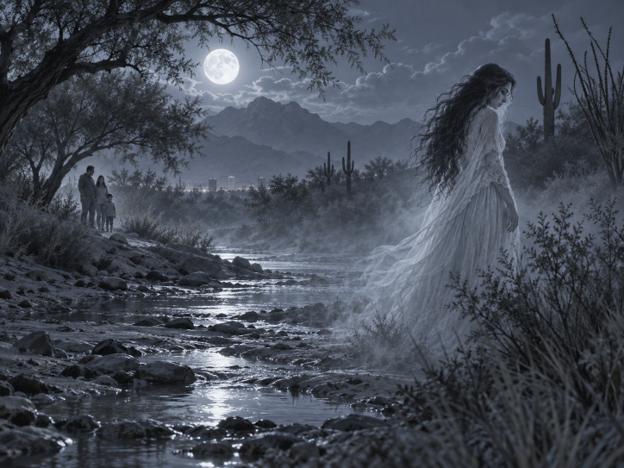
For generations, stories of La Llorona, or the Weeping Woman, have traveled across Mexico and the American Southwest. Tucson has its own versions of the legend, placing her along the Santa Cruz River and other local waterways.
One autumn evening, after a thunderstorm passed over the valley, a family traveling near the Santa Cruz River heard a woman crying beyond the mesquite trees. Thinking a traveler might need help, they stopped to listen.
A pale woman appeared along the riverbank, gliding over the earth, her long dress barely stirring beside the dark riverbed. She moved toward them, crying softly and calling into the night. Yet as she passed, she never turned to look at the family. She simply continued downstream, her cries fading into the wind.
Within moments, she disappeared among the trees and desert brush. The river fell silent, and the desert seemed to hold its breath. Still, her faint cries drifted through the darkness, calling for her lost family.
Some said it was only the wind. Others knew the old story.
El Ojito
Long before Tucson had a modern water system, El Ojito, or the “Little Eye,” was a spring near the Santa Cruz River. Its water supplied historic Sonoran Desert dwellers and soldiers at the Tucson Presidio. In 1887, an earthquake changed the spring’s flow. El Ojito eventually vanished.
Years later, on a crisp October night, an abuelo crossing the valley heard water trickling nearby, though the ground was dry and no rain had fallen. He stopped. The desert went silent.
Then the trickling began again. A wooden cart creaked somewhere in the darkness, followed by the steady fall of hooves on the desert floor. A strange glow appeared. A ghostly burro moved along the old trail, pulling a rickety cart. A shadowy rider sat atop it, carrying a lantern. In the flickering light, the abuelo realized the rider had no head.
The old man blinked in disbelief. His heart began to pound. He gripped his walking stick and shuffled toward home. He did not look back.
By morning, he returned, wondering whether what he had seen was real or merely a trick of the night.
There were no hoofprints. No cart tracks. No sound of water. The earth was dry.
El Ojito was gone.
Yet beneath the earth, groundwater still moved silently through the Sonoran Desert.
|