|
 A Critical Milestone for Advanced Metering
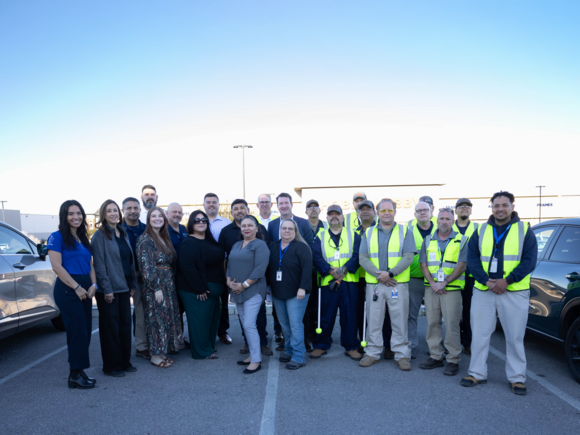
On March 2nd, Tucson Water staff and partners gathered around a single water meter to mark the launch of our Advanced Metering Infrastructure (AMI) rollout. It was a small ceremony for a big moment that signals a new chapter in how the City of Tucson manages our most vital resource.
The water meter being worked on was getting an upgrade to the ERT – the encoder receiver transmitter attached to each meter – as part of a wider effort to put customers in control of their own usage data. The new devices send readings directly over a cellular signal, replacing manual drive-by collection with automatic, frequent, reliable data. For the first time, customers will have real visibility into how their water is being used.
The rollout is starting with approximately 45,000 commercial, industrial, reclaimed water, construction, and city–owned accounts. This is a smaller slice of our customer base, but a high-impact one, particularly for customers who irrigate large landscapes. Deployment is handled by Utility Partners of America (UPA), and this first phase is designed to iron out any wrinkles before the system expands to residential customers.
We are also launching a customer portal in 2027 that will provide access to AMI data. Once live, customers will be able to monitor usage, set customizable alerts, receive notifications when consumption spikes, and compare current use against past periods.
|
|
 Water Awareness Month
As a desert dweller, you know that water is one of the most valuable resources. Every drop that flows from your faucet has a story – from mountain snowpack that runs off into the Colorado River, then flows through the CAP canal into recharge basins and is eventually stored as groundwater in our local aquifers.
How much do you know about the story behind the water that flows from your tap? If you’re a regular Water Matters reader, chances are you already know quite a bit. April is Water Awareness Month in Arizona, the perfect time to check your knowledge and learn even more about the water we rely on every day. Test your water awareness and see how water-wise you are!
- Where does the majority of Tucson’s water come from?
- The Colorado River Basin is divided in an Upper Basin and a Lower Basin. The Lower Basin includes California, Nevada, and Arizona. Which states are in the Upper Basin?
- Tucson Water’s diversified portfolio includes four water sources: surface water, groundwater, stormwater, and _______
- What standard color of pipe is used to signify reclaimed (or recycled) water in the distribution system?
- Where is most of Tucson’s water supply stored until it is needed to deliver to our community?
- Who is Tucson Water’s mascot?
- Who are the Tucson Water Zanjeros?
- Outdoor plants on irrigation systems should be given the same amount of water all year long. True or False?
- Which two options are known to waste the most water in a Tucson residential home?
- Which daily action will conserve the most water?
- How much water does the average Tucsonan use every day?
|
|
City of Tucson
Environmental Services
 Trash Fire Prevention!
Keep our community and operators safe! Avoid putting auto, rechargeable, small button, and lithium batteries in your trash and recycling bins. These batteries can ignite, damaging trucks and endangering drivers and recycling facility workers. Safely dispose of them at the Household Hazardous Waste collection event each second Saturday.
|
Pima County
Wastewater Reclamation
 Store these Important Numbers!
Need to contact your Pima County wastewater utility? Call 520–724–6500 for general information 8 a.m. to 5 p.m. weekdays.
Have a sewer emergency or want to report a sewer odor? Call the 24–hour emergency line at 520–724–3400.
Looking for billing assistance? Call us at 520–724–6609.
|
|
 Water Matters is a monthly newsletter brought to you by Tucson Water
|
|
|
|