 March 2, 2026
Staying Grounded in Our Core Mission
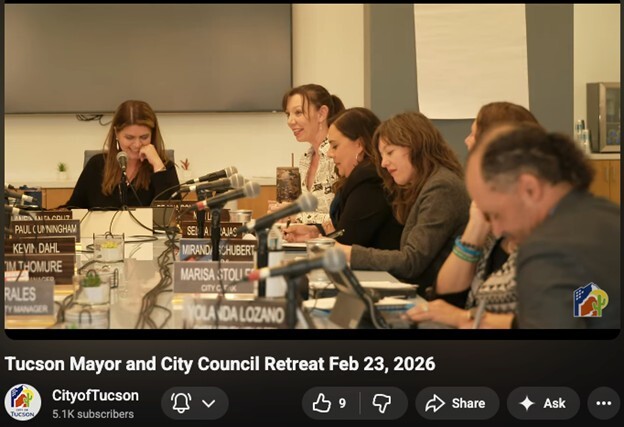
At our recent Mayor and Council retreat, we each shared our priorities for 2026 and 2027. As I reflected on where we are as a city, one theme stood out clearly: discipline.
For those who would like to see my full remarks during the Mayor and Council retreat, you can watch them here.
Since I first ran for office in 2019, I have consistently centered my platform on core services. That is why our city level of government exists, and our charter is clear. We are here to provide public safety, maintain our roads, care for our parks, and deliver essential municipal services. That is what our tax dollars are intended to support.
We have known for years that financial pressures were coming. Federal ARPA funds were temporary. Revenue shifts at the state level were foreseeable. Our five year projections have consistently shown structural imbalance ahead.
Deficits require focus, not panic. They require us to protect core services first, pursue efficiencies seriously, and align recurring expenses with recurring revenue. That means modernizing systems and processes, examining revenue left on the table, including transit fare recovery and other sustainable funding options, and improving how we deliver services before destabilizing our workforce.
At the most basic level, core services mean when someone calls 911, a trained professional answers in seconds. When police or fire respond, they arrive in a timely manner and are capable of handling the situation. When residents report infrastructure issues, there is a predictable and reasonable response. When families visit a park, pool, splashpad, or recreation center, the facility is safe and well maintained.
In addition to ensuring we have the resources to deliver those essential services, I also remain focused on improving how those services function. Within each core service area, there are specific operational changes and modernization efforts that can improve outcomes for residents.
Below are several specific examples of where I am concentrating my efforts this year.
Improving Operational Efficiency: Virtual Initial Appearances
As part of my ongoing work to improve outcomes around public drug use and accountability, I recently sat down with TPD’s Operations Division East team to better understand the step-by-step process officers follow when documenting felony cases and submitting them to the County Attorney for prosecution.
My goal was to understand what officers are required to complete in the field, where delays may occur, and how the system functions from their perspective.
During that conversation, we also discussed the current pilot program for virtual initial appearances and how it may impact patrol availability and case processing.
Here is what that means in practical terms.
If an officer arrests someone in the field for a felony level offense, that individual must be brought before a judge for what is called an initial appearance. This is the step where a judge reviews the charge, considers release conditions, and determines what happens next.
Under the traditional process, that means the officer must place the individual in a patrol vehicle and transport them to court. For areas further away from downtown like Ward 4, that drive alone can take up to 30 minutes each way. Once at court, there is additional waiting time while paperwork is processed and the individual is brought before a judge.
During that time, the officer is not available to respond to other calls for service.
The virtual initial appearance pilot is designed to reduce that gap. Instead of transporting the individual across town, the officer can open a secure laptop in the field and connect by webcam to a judge. The judge conducts the initial appearance remotely, reviews the charge, and sets conditions just as they would in person.
If structured properly, this process can:
- Reduce officer downtime
- Improve patrol availability
- Move cases through the system more efficiently
- Reduce logistical strain on both police and court staff
The concept is very promising. It is important to acknowledge that this is a pilot program designed to test whether virtual initial appearances improve efficiency and outcomes.
However, I learned that access to this service is currently limited to a small and inconsistent window each weekday. Because availability varies, officers cannot reliably use the system, which makes it difficult to collect meaningful data about whether the pilot is truly effective.
If we want to properly evaluate this idea, which I certainly do, we need to structure the pilot in a way that allows for consistent use. My recommendation is to maintain the same pilot area but expand access hours so that officers know they can use the virtual initial appearance system at any time during normal court hours.
With consistent availability, we can gather real data, evaluate performance, and determine whether this tool improves patrol availability and case processing. Without that consistency, we are not truly testing the concept.
Often, improving public safety outcomes is not about passing new laws. It is about carefully testing operational improvements, gathering reliable data, and removing bottlenecks so the system functions as intended.
Roads: From Reactive to Predictable Service Levels
During the retreat, I shared a vision that represents a real shift in approach: a Tucson where potholes do not exist.
First, I want to be clear. Our road crews are working hard. They are skilled, dedicated public servants who care deeply about this community.
The challenge is not effort. The challenge is structure.
Right now, our road maintenance model around potholes is largely reactive. Residents report potholes. Ward offices report potholes. Crews respond as capacity allows. Response times vary widely across the city, and in some areas, including parts of Ward 4, repairs can take months.
Unlike emergency services, we have not established and communicated a clear service level standard for pothole response. Police, fire, and 911 operate with defined response targets. Road maintenance does not. That needs to change.
We also need to acknowledge operational reality. Crews are frequently reassigned to other important work. Recently, teams were pulled to prepare areas around the rodeo grounds. They are also already engaged in ongoing wash preparation ahead of monsoon season, and that work will continue in the months ahead. Flood mitigation and event preparation are essential responsibilities.
These are just two examples of how our crews must continually respond to shifting priorities. When the same teams are responsible for everything from wash mitigation to event preparation to pothole repair, focus becomes fragmented and response times suffer.
If we want a different outcome, we need a different model.
Instead of asking what we can fix with the resources we happen to have, we should first define the service level our residents deserve. What is an acceptable response time for a pothole? Should response times vary based on risk level? Once we define that standard, we can determine what people, equipment, materials, and technology are required to meet it.
That may include:
- Dedicated crews focused specifically on pothole response
- Surge capacity contracts to fill potholes during peak times (after rain, etc.)
- New crack detection technology used in other major cities to prevent potholes from forming
- Transparent performance dashboards so residents and ward offices can see how we are performing
Preventive maintenance costs less than reconstruction. Data driven service standards improve predictability and accountability. This is not about criticizing the teams doing the work. It is about investing in the structure, tools, and standards that allow them to succeed.
We are not there today. We are far from it. But if we want potholes to become the exception rather than the expectation, we have to design the system intentionally, fund it responsibly, and manage it with discipline.
Parks and Recreation
Parks, recreation centers, pools, and splashpads are foundational community assets.
Even in deficit years, these spaces must remain safe, clean, and accessible. Residents should be able to use the amenities they pay for without safety concerns. Protecting and maintaining these facilities is part of protecting quality of life and must be resourced appropriately.
Supporting Functions: The Backbone of Service Delivery
Core services only function if supporting systems function.
Behind every officer, firefighter, road crew, and parks employee are teams in IT, HR, Finance, Payroll, Procurement, Contracts, Risk Management, and other departments. These teams may not be visible in the field, but they are essential to the field.
As we navigate challenging budget years, we must look for process efficiencies and modernization before shrinking capacity. Supporting functions are not overhead. They are service delivery enablers.
Cybersecurity and Critical Infrastructure
Another area I emphasized at the retreat is cybersecurity.
Since first stepping onto the Council in 2019, cybersecurity has been a consistent focus of mine. Given my professional background in technology and security, I have viewed this as both a responsibility and an area where I can add value at the governance level.
The importance of this work has only increased. Heightened geopolitical tensions, including recent developments involving Iran, have led federal agencies to advise increased vigilance across all levels of government. When global instability rises, so does the risk environment for critical infrastructure here at home.
As more of our operations rely on digital systems, cybersecurity is no longer simply an IT matter. It is a core service issue. If water systems, public safety systems, financial systems, or election systems are disrupted, our community feels it immediately.
Across the country, municipalities have experienced ransomware attacks, infrastructure disruptions, and targeted intrusions. The threat environment is real and evolving. We do not respond with panic, but we do respond with preparation.
My role as a Council member is not to manage technical systems directly. My role is to ensure awareness at the policy level, maintain cybersecurity as a priority, ask the right oversight questions, and make sure appropriate funding aligns with our exposure.
We must continue strengthening our cybersecurity posture. Some discussions appropriately occur in executive session for security reasons, but publicly I remain committed to fighting for responsible investment and sustained focus in protecting our systems and critical infrastructure.
At the national level, I am encouraged to see Nick Andersen named Acting Director of the Cybersecurity and Infrastructure Security Agency (CISA). CISA plays a critical role in protecting our nation’s cyber and physical infrastructure, including its partnership with state and local governments.
I first met Nick at the Harvard Kennedy School during a Cybersecurity: The Intersection of Policy and Technology course. Even then, it was clear he brought a rare combination of operational expertise, policy insight, and steady leadership to complex national challenges.
Nick has also served as a board member of the AZ Cyber Initiative, and he has strong ties to Tucson. His career reflects a sustained commitment to public service and national security.
I am hopeful that under his leadership, we will see strong collaboration between federal agencies and local communities like Tucson in the shared, nonpartisan mission of protecting critical infrastructure, including water and wastewater systems, power infrastructure, public safety communications, and other essential services that Tucsonans rely on every day.
National security does not begin and end in Washington. It is built city by city, system by system, and through disciplined governance at every level.
Community Cybersecurity Education and Resources
I am also pleased to share that the City now has a dedicated webpage providing cybersecurity education and resources for the community.
In October of last year, I requested a study session item focused on technology and data governance. As part of the motion I brought forward, which was unanimously approved by my colleagues, we committed to using our platform as a local government to share credible cybersecurity resources with the community.
It is not the City’s role to manage cybersecurity for residents or businesses. Our responsibility is to secure the City of Tucson’s systems and critical infrastructure. However, we can use our platform to connect the community with trusted tools, guidance, and best practices so individuals and businesses can better manage their own risk in this rapidly evolving digital environment.
The new webpage provides accessible information and links to resources that residents can use to strengthen their personal and organizational cybersecurity posture.
You can explore the page here: https://www.tucsonaz.gov/Government/City-Information/Cybersecurity
Aligning Water Stewardship with Economic Growth
Economic development directly impacts our ability to fund core services. Strong job growth supports families and strengthens city revenues.
Any economic growth strategy in Tucson must align with water stewardship and long term sustainability. Each year, approximately 4.5 billion gallons of reclaimed water that Tucson Water customers have already paid for flows out of our system because we have not yet developed sufficient reuse capacity for that volume.
That represents both a challenge and an opportunity.
If we can align appropriate industrial users, advanced purification, additional recharge opportunities, and other long term reuse options with this critical resource, we strengthen both our water security and our ability to generate high-wage, long-term jobs for Tucson families.
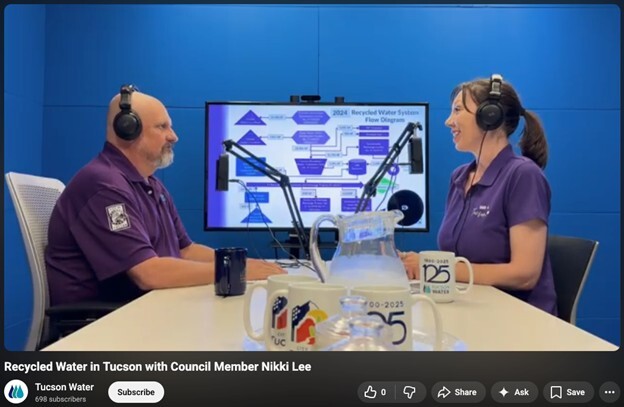
To better understand how our reclaimed water system works and where this volume comes into play, I sat down with Tucson Water Director John Kmiec for a recorded podcast conversation that walks through it in detail. I wanted to deepen my own understanding and share that learning opportunity with anyone in the community who is interested. You can listen here if you would like to take a deeper dive into how reclaimed water flows through our system and how it can support responsible economic development.
Moving Forward
There are several important conversations scheduled for March, particularly as we move toward budget adoption. These discussions are not easy, and they will require honest evaluation of where we are and where we are headed.
The structural deficit we have been discussing for years is not disappearing. In fact, projections show continued pressure in the years ahead. That reality requires discipline, clarity, and at times difficult decisions.
I want the community to know that I understand the weight of this moment. My focus remains steady and grounded in our charter responsibilities.
- Protect core services.
- Define clear service standards.
- Modernize systems that are not producing results.
- Strengthen our cybersecurity posture.
- Align economic growth with fiscal and water realities.
We cannot control every external factor, but we can control how we govern. If we remain disciplined, transparent, and focused on our core mission, we can navigate this period responsibly and position Tucson for long-term stability.
My commitment is to approach these decisions with seriousness, data, and the long-term strength and resilience of our community at the forefront.

|