Like many communities across the country, Tucson is grappling with the impacts of substance use disorder, particularly fentanyl. Our proximity to the border means these substances are more readily available here than in many other parts of the country. When supply is high, prices are low, and that reality makes dangerous drugs more accessible and harder to escape. This dynamic creates additional challenges for our region and contributes to the visible impacts we see in our neighborhoods every day.
Public drug use remains one of the top issues I hear about from residents across Tucson. People are seeing it in our parks, at bus stops, on public transit, and in other shared spaces. While this challenge is not unique to Tucson, our community faces additional headwinds due to the widespread availability of fentanyl and our proximity to the border. Substance use disorder is a national issue, but its impacts are being felt very locally.
In September, I brought forward the idea of exploring a city-level misdemeanor for public drug use. The intent was not to criminalize addiction, but to address a growing gap in accountability. Under state law, possession of substances like fentanyl is classified as a felony, which means those cases are referred by Tucson Police Department to the Pima County Attorney’s Office and prosecuted in Pima County Superior Court. What we have seen, however, is that many low-level possession or small-volume fentanyl cases have not been prosecuted, leaving a gap between enforcement and accountability that the community is feeling every day.
Since September, Mayor and Council have directed city staff to explore every available pathway through the Pima County Attorney’s Office and Pima County Superior Court before the City takes on additional responsibilities. Our goal has been to ensure these cases are handled at the level intended under state law whenever possible. Developing a city-level public drug use misdemeanor remains an option if those pathways do not produce the accountability our community expects, but it would require the city to assume significant new workload, staffing, and costs. That is not a step we should take without first exhausting all other viable options.
We revisited this issue in November, at which time I brought forward a motion that was unanimously approved by Mayor and Council. That motion directed continued coordination with the County Attorney’s Office, additional work between Tucson Police Department and county prosecutors to strengthen case preparation, further evaluation of what it would take to operationalize a city ordinance if needed, and review of the draft ordinance language by the Mayor’s Safe City Task Force.
Since then, we have received an update from the Police Chief and the City Attorney via memo, with an accompanying felony drug possession flowchart. Because there are active conversations underway and several pathways still being explored, I asked that we not bring an incomplete discussion back to the council table in January. We expect to have a more substantive update in March, once there is greater clarity on how these options are shaping up.
While a draft public drug use ordinance exists and remains an option, my preference is to see these cases handled in the venue that aligns with the seriousness of the offense under state law. At the same time, I want to be very clear about my values. Jail is not treatment. It is not effective for people struggling with addiction, and it is not sustainable or fiscally responsible for taxpayers.
Public drug use often reflects the intersection of substance use disorder, unsheltered homelessness, poverty, and co-occurring mental health conditions, all of which tend to surface in shared public spaces. Addressing something this complex requires a methodical approach. My focus has been, and continues to be, on creating pathways into treatment rather than incarceration. Every interaction should be an opportunity to connect someone to help, including through the Pima County Transition Center and other treatment-focused resources.
I also want to address some of the speculation that has circulated about this work. Receiving an update via memo from our Police Chief and City Attorney does not mean this issue has been set aside or deprioritized. It reflects where we are in the process. There are active conversations underway, and we want to bring a more complete and substantive discussion back to the council table once those pathways are more fully developed, consistent with the direction Mayor and Council provided.
The public drug use ordinance has not been abandoned. It remains an option, and it is one that I am prepared to pursue if we exhaust every viable pathway through the County and are still not seeing the outcomes our community expects. We also have identified potential funding mechanisms that would be required to scale City Court, staffing, and operational capacity if the City ultimately needs to step in. That option exists for a reason, and it remains on the table.
At the same time, we owe it to this process and to the community to fully explore every opportunity to have these cases handled at the appropriate level within Pima County, where state law intends them to be addressed. That remains the optimal pathway. If we reach the end of those options without progress, I believe that the city will have to act. Until then, this work continues, it remains a top priority for me, and I am committed to seeing it through in a way that delivers both accountability and meaningful pathways to treatment.
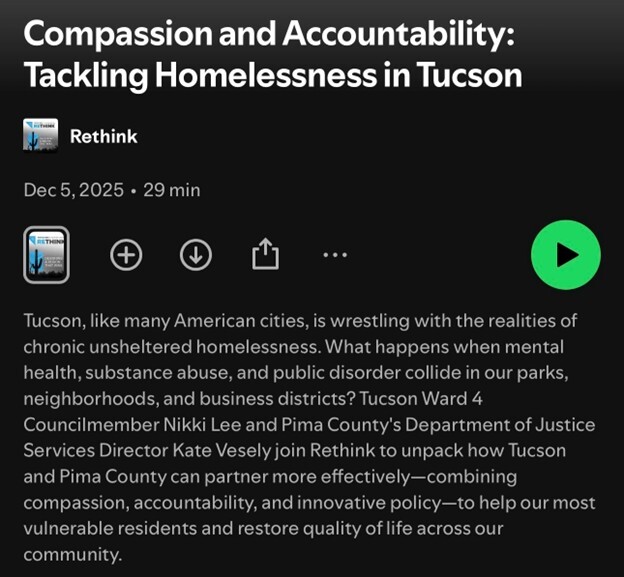
For those who would like to go deeper on this topic, I also want to share a podcast conversation from last fall where Kate Vesely, Director of Pima County’s Department of Justice Services, and I were guests on the Chamber of Southern Arizona’s Rethink podcast. We discussed how substance use disorder, mental health, homelessness, and public space concerns intersect, and explored potential paths forward that balance compassion, accountability, and effective policy.
We need your input! As a valued member of our dog park community, your feedback is essential as we work to improve Wagging Tails Dog Park for everyone and their four-legged friends.
We're currently facing ongoing challenges maintaining healthy grass due to heavy use and seasonal dormancy, and we want to hear your perspective on the best path forward. This brief survey focuses on current park usage, turf maintenance issues, and potential improvements.
Your responses will directly inform our decisions about park management, including section rotation schedules, surface options, and infrastructure investments.
If you can't make the January 28th meeting, there will be an in person Eastside RTA meeting with both Wards 4 and Ward 2 on February 9th from 5:30pm to 7:00pm at the Ward 2 Council office - 7820 E Broadway Blvd.
RTA Next will have a special election on Tuesday, March 10, 2026 with ballots going out to all registered voters on Wednesday, February 11th.