|
Over the past few months, I’ve been doing the research and sharing that work with our community because that’s what a project of this scale and complexity demands. I’ve been digging deep into the details of Project Blue to identify potential risks related to air quality, noise and light pollution, water use, energy demand, and the actual economic value to the community.
I’ve been asking tough questions and pushing for transparency so that we can all understand what it really means to say yes to this proposal. Many of those questions have already been answered, and I’ve made them public. I’m currently waiting on a new batch of written responses from the various teams to address the remaining questions in my Question Tracker spreadsheet, and I look forward to reviewing those as soon as they come in.
This process is about identifying risks, getting clear written answers on how those risks will be addressed, whether mitigated, avoided, transferred, or left unresolved, and fully understanding what we would be asking the community to accept.
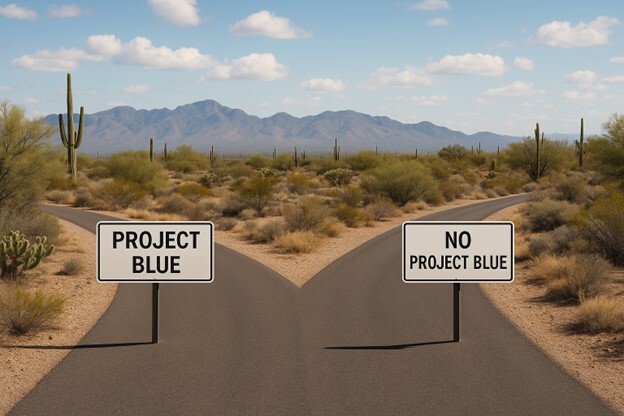
But a decision of this magnitude also requires us to look at the other side of the coin. What does it mean to say no? That’s the work I’ve leaned into deeply over the past few weeks.
Yesterday, I had an open and direct conversation with the Project Blue team. I asked the important question: what happens if the Mayor and Council say no? Or what if we say not yet, because we want to establish local ordinances first?
I learned something that surprised me. I know it may also be surprising or even unacceptable for many of you to hear. The reality is this: Project Blue will be built in the Tucson metropolitan area, regardless of what the City of Tucson decides.
How? While I do not have the list of backup sites, I was told directly that this company came into our community with multiple options already identified. Some of those sites are located on federal, state, or unincorporated county land within the Tucson metropolitan area and neighboring towns. Within our watershed. Within the TEP service area. With potable (drinking) water availability.
I want to be very clear that this information only came to light because I was asking direct and detailed questions. It was not presented to me as a threat, nor was it framed as a tactic to secure my support for the project. It came out through my own line of questioning and pressing for specifics. That is the only reason I know this today, and now you do too.
I also asked why we didn’t know this sooner. The answer was that they didn’t want to come across as threatening. I understand that, and at the same time, this is critical context that our community needs to have. We need to know that Project Blue has multiple paths to build here, and every intention to do so.
If the current proposed Phase One site does not move forward with annexation into the City of Tucson, plan B will move forward. And I have no idea what Plan B is. That was difficult for me to process, and it is important that we are honest with one another about what we’re looking at as a community.
At this point, we face a clear decision as a community.
Do we want the City of Tucson, through your Mayor and Council, to be in the driver’s seat, shaping how this project moves forward with oversight, standards, and a commitment to sustainability and community benefit?
Or would we rather step away, decline to move forward with annexation, and accept that the project will proceed just outside our jurisdiction, where we would have no formal role, no negotiating power, and no direct benefit?
It is a real choice. One path gives us the opportunity to influence how this is done, including how reclaimed water is used, how infrastructure is developed, and how the community is protected and supported. The other removes us from the process entirely and places that responsibility elsewhere.
Neither path is without tradeoffs. But the decision now is not whether Project Blue will exist. It is whether Tucson wants to be part of how it is done.
I want to be transparent with you. Everything above reflects new and significant information I learned yesterday, and was confirmed by the Project Blue team at last night’s public meeting, which is why I chose to lead with it. I understand that what I’m about to share may feel overshadowed by that, but I still believe it’s important to include.
What follows was written over the weekend as part of my continued effort to understand both the risks and potential benefits of saying yes, and just as importantly, the risks of saying no. This is not about leaning one way or the other. It’s about putting the full picture on the table, because our community needs to know the impacts of both outcomes.
Water Positivity
One of the most frequently raised concerns about Project Blue is water. The promise of being “water positive,” meaning the project would replace every drop of water it uses, has been met with understandable skepticism. This concept has not been demonstrated here in Tucson, and in a region as water-stressed as ours, asking the community to believe in something they have not yet seen in practice is a significant ask.
That’s why I appreciate the University of Arizona’s offer to provide scientific oversight and independent evaluation. The Drachman Institute has developed an early draft proposal for a Water Accounting and Tracking Platform that would bring transparency, credibility, and long-term accountability to this critical aspect of the project, should it move forward.
Importantly, this would not rely on the company to self-report its water usage or offsets. It would also keep the City of Tucson and Tucson Water out of the direct oversight role. Instead, it would place this responsibility in the hands of a truly neutral and trusted institution with deep expertise and scientific capacity.
The current draft outlines a phased approach:
-
Year 1: Model projected water use, including potable, reclaimed, and stormwater. Evaluate offset strategies such as aquifer storage and recovery, reclaimed water distribution, and advanced purification. This would establish a science-based baseline to assess the potential for achieving a net positive water outcome.
-
Years 2 and 3: Collect and compare actual post-construction water use data against the Year 1 model. This includes measuring whether offset commitments are being met and how effectively the strategies are functioning.
-
Ongoing: Build and maintain a transparent tracking and reporting platform to monitor the project’s water balance over time and share results with the public.
This framework would function similarly to a carbon accounting model, but focused on water. It would bring rigor, transparency, and independent validation to a promise that is otherwise hard to quantify.
While this is just an initial draft and subject to refinement, I believe it presents a thoughtful and science-based path forward. If Project Blue were to move forward, I would strongly advocate for this University-led platform to be included as a condition of approval. It would establish a model for how water-intensive developments can and should be evaluated in water-stressed regions like ours, and it would send a clear signal that Tucson takes water stewardship seriously.
Reclaimed Water 101
Also related to water, I requested a study session item on July 17 for our August 6 meeting to deepen our understanding of the Reclaimed Water System.
When I first learned about Project Blue, I realized there were gaps in my understanding of how the reclaimed water system works, what the current supply and demand look like, and how it connects to our One Water 2100 Plan.
This item was requested not just to educate myself but to ensure that my colleagues and I are all working from the same base of knowledge. Just as importantly, it creates a chance for the community to learn alongside us. Since reclaimed water plays a major role in the Project Blue proposal, having this shared understanding is critical as we navigate this decision.
Jobs
The benefits tied to long-term job creation are harder to quantify, in my mind. While Phase One is expected to generate around 180 permanent jobs at an average salary of $64,000 per year, I have seen firsthand over my 25 years in the information technology field how quickly roles can disappear as technology advances. Over the next 30 years, it is reasonable to assume that many of these positions will evolve or decline in number as automation and remote management become more common, particularly after the initial equipment is installed and operational. While $64,000 is a decent wage, it does not go very far today when factoring in housing costs and the overall cost of living. Because of that and the likely reduction in jobs over time, I am placing less weight on long-term employment when evaluating the overall value of this project.
The impact on construction jobs is more clear and certain. We know that Phase One would require a range of work across multiple trades to build out the infrastructure, and those jobs would provide meaningful opportunities for local workers. These opportunities are more immediate and tangible. At the same time, I also recognize that once construction is complete, those jobs would go away, so we need to weigh their value as part of the broader picture without overstating their long-term impact. We can also acknowledge that if Project Blue does not move forward, these construction jobs would not be created in Tucson, and there are no other projects of this scale currently in our economic development pipeline.
*Now that we know Project Blue will be built somewhere in the Tucson metropolitan area, this work will still happen, and it will happen close to home for the many unions and trades that have voiced strong support for this opportunity.
Revenue Potential
The most tangible long-term loss would be the property tax revenue. Phase One alone is estimated to generate nearly $10 million per year for the City of Tucson. If Phase Two and Site Two are developed, that number could grow to approximately $40 million annually. Saying no means that money would not come into Tucson’s General Fund, which supports essential services like public safety, road maintenance, and parks, and could instead go to another jurisdiction.
Tucson would also forgo development impact fees tied to this project. These are one-time fees paid by developers that are earmarked, by state law, for improvements to roads, public safety, and parks. If this project is built outside of city limits, those fees would support infrastructure elsewhere, not in our community.
In addition, saying no means walking away from over $100 million in reclaimed water infrastructure that the company would fund and that the City would own. That infrastructure would significantly expand Tucson’s ability to transition major users off drinking water and onto reclaimed water. A key example is the Los Reales Sustainability Campus, which currently uses roughly 100 million gallons of potable water each year for compaction and dust control. Without this investment, that transition may be delayed or never happen, and drinking water would continue to be used for industrial purposes.
These are real and measurable impacts to our water future, our financial outlook, and our local infrastructure. That is why I believe it is important to fully understand what saying no would actually mean, not just symbolically but practically.
As we discussed throughout the Prop 414 conversations earlier this year, Tucson is facing serious and ongoing budget challenges. State-level decisions under the Ducey administration, including the implementation of a flat income tax and corporate tax cuts, significantly reduced the revenue cities receive from the state.
Paired with economic uncertainty that affects sales tax collections, the rising cost of delivering services, and a notable decline in ongoing Business Privilege Taxes and Use Taxes, these factors have created a kind of perfect storm for reduced local revenue. On top of that, we are also seeing increasing demand for services across nearly every department, which adds more pressure to an already strained budget.
This convergence of challenges was a catalyst for Prop 414 and remains a very real issue that we must continue to navigate as we work to sustain essential services for our community.
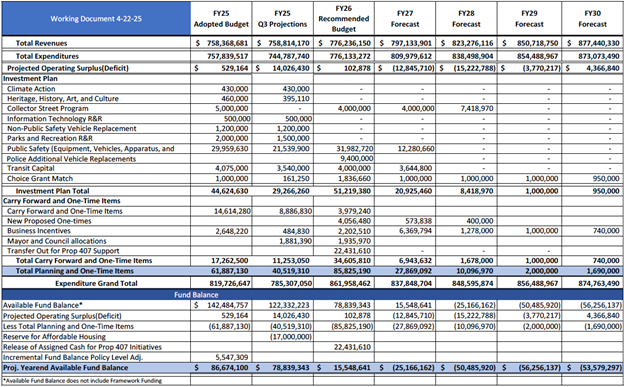
This most recent 5-Year General Financial Plan (from April 2025) shows us that we are on track to deplete the City’s savings account (the fund balance) and fall into a structural deficit by FY27. By FY28, we could be more than $50 million in the red.
This is why we are actively looking at both sides of the equation to explore where we can reduce spending or improve efficiency and where we can bring in more revenue.
These conversations are already happening. We’re considering options like reinstating bus fares and reevaluating the structure of city programs. At the same time, we are looking at long-term revenue strategies, including economic development projects like Project Blue.
This isn’t about scare tactics. It’s about being honest with the numbers. We need to explore every path available, because without new or growing sources of revenue, the only alternative will be difficult tradeoffs that impact core services, staffing, and the level of support our community expects.
Where I Stand
As I’ve said before, I’m doing my homework, and I’m continuing to show my work. I’ve been asking tough questions and digging into both the risks and potential benefits of this proposal. I’ve also been transparent about what I’m learning and how I’m thinking through the information.
I understand that some of what I’ve shared here may come across as supportive of the project. That’s because this portion of my work has focused specifically on evaluating what it would mean to say no, including the real challenges and risks that may come with that choice. This does not mean a decision has been made. It is one part of a broader effort to fully explore both options and understand the full picture.
This is a significant decision, and I take that responsibility seriously. I know my colleagues on the Mayor and Council do as well. I also know there are strong emotions surrounding this issue. Understandably so. But we must approach this with grounded thinking and clear-eyed analysis. The people of Tucson have entrusted us with making thoughtful, informed decisions, and that means we have to weigh this carefully from all angles.
I look forward to continuing this conversation together during our study session tomorrow. Our community deserves a well-informed and responsible decision.

|