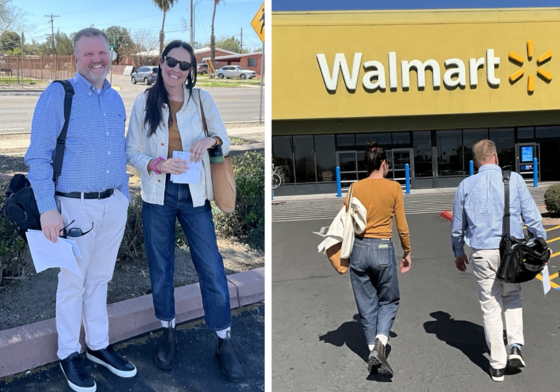
 Council Aide Marlene Avelino and land use attorney Rory Juneman at on-site meeting at Tucson Place Shopping Center.
In 1999 The Tucson Mayor and Council adopted the Large Retail Establishment (LRE) ordinance, better known as “The Big Box” ordinance. The LRE requires Mayor and Council approval, along with public notice and public hearings for all new retail establishments over 100,000 square feet. The ordinance also limits grocery space to ten percent of the total footprint.
In 2003 Walmart tried to sue to stop the ordinance from being enforced, but was thrown out by a Pima County judge.
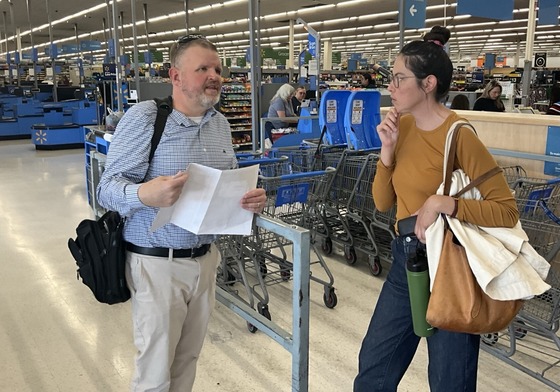 Land use attorney Rory Juneman and Ward 3 Council Aide Marlene Avelino discuss proposed expansion plans inside Wal-mart.
Recently, Vice Mayor Dahl’s office was approached by Walmart representatives with the desire to expand the footprint of one of their stores in Ward 3 located at the Tucson Place Shopping Center on Wetmore. The center was built in the 1980s and Walmart opened in the early 90s with a footprint of 95,101 sq. ft. Walmart would like to decrease the square footage by an additional 80% (171,344 sq. ft.) to remake their store into a “Super Center.”
Although this location was built before the ordinance was put in place, the proposed expansion qualifies as a Major Modification to the Development Plan and conditions, therefore requiring the Mayor and Council's approval for the changes.
The shopping center looks like any other large shopping center in Tucson - a strip of stores surrounded by a sea of asphalt; trees are sparse and shade is non-existent. Thirty years ago global warming, the urban heat island effect, and extreme heat were not part of the everyday vernacular.
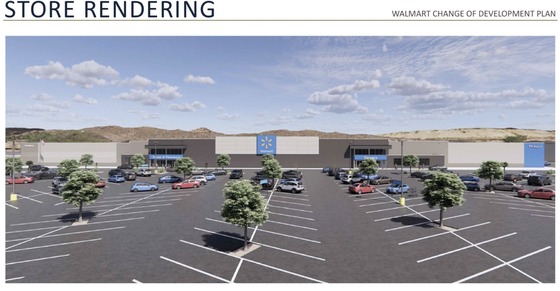 Store rendering showing minimal parking lot vegetation.
As part of their proposed expansion, the store is only required to add 24 trees to the location. Walmart representatives have been receptive to adding more vegetation and this is an ongoing conversation.
Walmart is asking to “improve and update” this particular location. At the same time, the Ward 3 office would like to improve and update the shopping center as well. Vice Mayor Dahl would like to see a large increase in the number of native and drought-tolerant landscaping being proposed, additional trees, water harvesting, and enhanced pedestrian and bicycle connectivity to the center.
A public hearing on the proposal will happen next week on Zoom. If you are interested in attending the meeting please follow this link. https://tinyurl.com/5n9akw7s
To view City staff recommendations click on the following link:
https://tinyurl.com/3eb6m36r
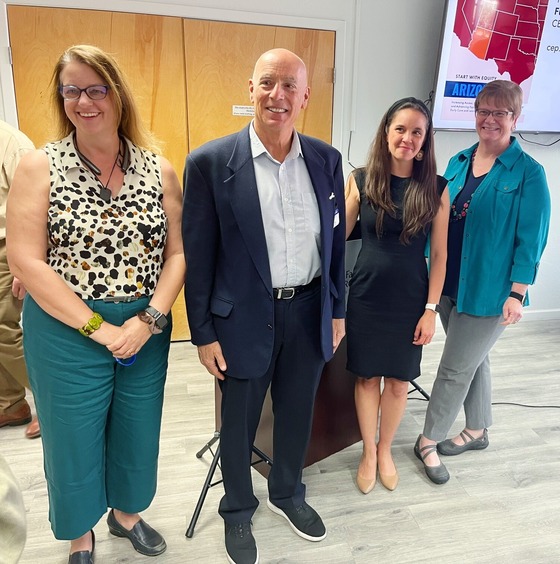 Michelle Crow - Southern Arizona Director of Children's Action Alliance, Dr. Eric Schindler - President and CEO of Children and Family Resources, Dr. Shantel Meek - Children's Equity Project at ASU, and Allison Titcomb Chief Impact Officer at United Way - working together towards equity!
It was a real eye-opening event last week as Dr. Shantel Meek, the Founding Executive Director of the Children’s Equity Project at Arizona State University, joined us in Tucson to present their
just-published, gut-wrenching report titled: “Start with Equity Arizona: Increasing Access, Improving Quality, and Advancing Equity in Arizona’s Early Care and Learning Systems”
The event was co-hosted by Children’s Action Alliance, Children & Family Resources, and United Way of Tucson and Southern Arizona. The audience was full of elected leaders, their staff, non-profits directors, teachers, and advocates - people who have dedicated their lives to the betterment of Arizona’s children, all 393,413 (under five years old!) of them.
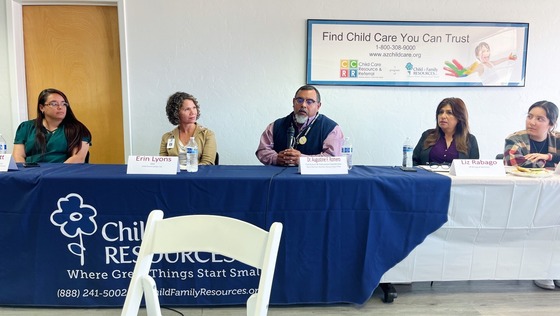 Nicole Scott - Director of PEEPs for Pima County, Erin Lyons - CEO of Child Parent Centers, Inc, Dr. Augustine F. Romero - Curriculum & Instruction Coordinator for Social Services Division, Pascua Yaqui Tribe, Liz Rabago of LR Bilingual Services, and Elia Bueno with Children's Action Alliance sharing their work and perspective on the Equity report.
The report examines Arizona’s early care and education (ECE) system through a lens of equity and includes ten facets. For the sake of time the event focused on three key policy areas: harsh discipline and its disproportionate application, the inclusion of children with disabilities, access to high quality bilingual learning for dual language learners.
Arizona is ranked last or close to last in most areas having anything to do with children. Turns out we spent the last two decades not investing in ECE while other states increased sustained investment. Pandemic relief funds were invested into many parts of the overall system but those are all temporary and coming to an end. Dr. Meek didn’t just leave us bummed out, her team included recommendations for expanding access, improving quality, and increasing fairness. To view the entire report click here: Start with Equity Arizona
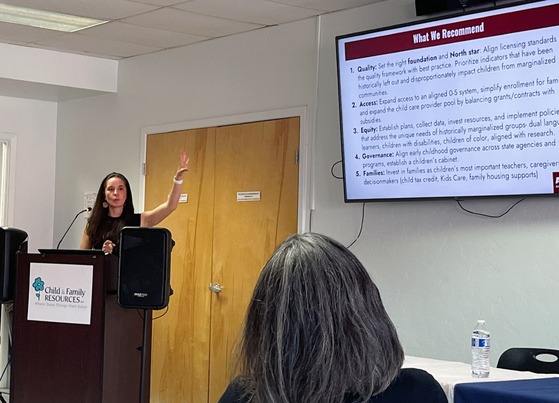 Dr. Shantel Meek - author of the Start with Equity Arizona report.
The report presentation was followed by a panel of five local experts working with groups highlighted in the report. Nicole Scott, Director of PEEPs for Pima County, and someone I got to know during the Children in Nature conference, was among them. She shared that the number of children served through PEEPs has increased to 1,700 in its current year (third year), up from 850 in their first year.
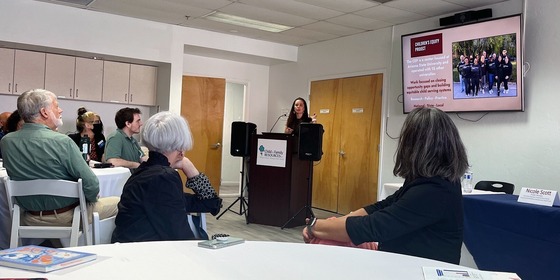 Dr. Shantel Meek - author of the Start with Equity Arizona report sharing out to an audience of dedicated early education advocates.
It was great to share space with so many dedicated individuals working towards improving the systems intended to support our children and families. The work continues!
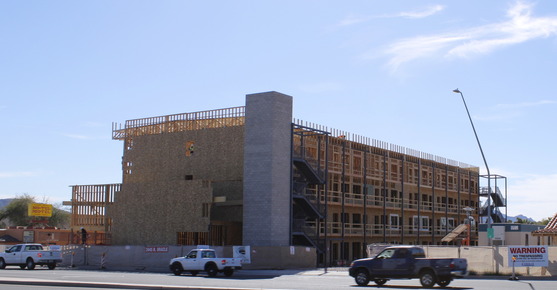 Construction site of the Milagro as seen from the east side of Oracle Rd.
There is some new construction going up on Oracle Road just north of Grant. On August 23 of last year the City of Tucson broke ground on their newest affordable housing project: Milagro on Oracle.
The Milagro is a redevelopment of the former No-Tel Motel property. Originally the De Anza Motel (owned by the Lambos Family), the property was part of a string of motor courts that lined Oracle Road and was built for travelers to stay in during the 1940s.
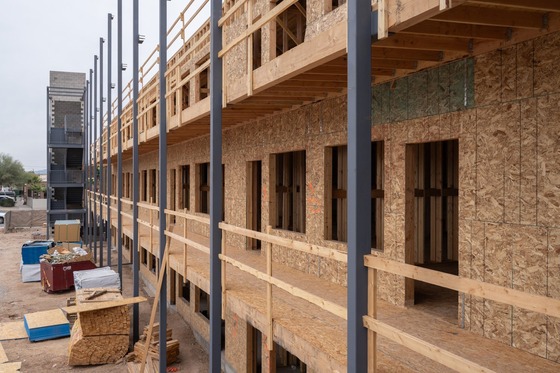 Construction of Milagro.
Only seniors will live at Milagro. The residents will be mixed along with 19 formerly unsheltered folks. The City’s new nonprofit development arm, El Pueblo Housing Development, is working with Gorman & Company to develop the project along, a national affordable housing development firm.
Milagro is just one part of Tucson's strategy to build more affordable housing.
But what about the beautiful mural that adorns the east side of the building?
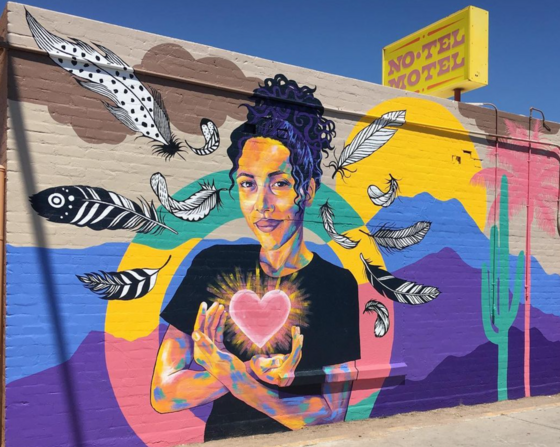 The original mural soon after it was finished and before a window was cut out of it.
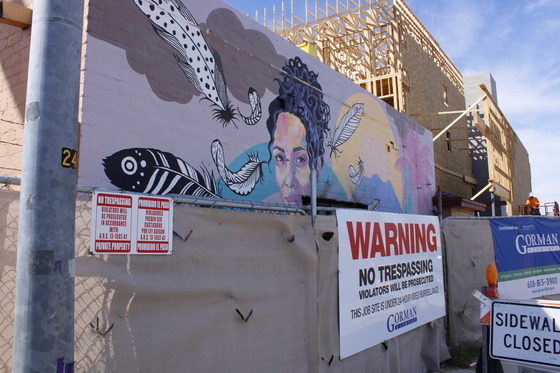 Jessica Gonzalez's mural as it stands today.
The mural will be saved sort of, not really, but a new one by the same artist Jessica Gonzalez will go up in its place without the window cutting into it. The City is currently working with the artist to hammer out the details. Her goal will be to incorporate the window and themes from the original work into the new mural.
Construction is expected to be complete by early 2025. Questions? Contact Sarah Meggison: sarah.meggison@tucsonaz.gov.
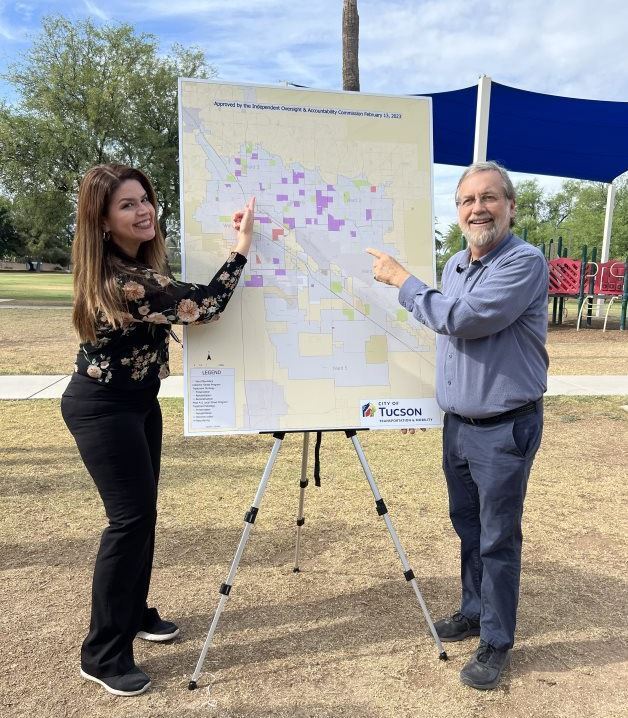 Mayor Romero and Vice Mayor Dahl with a map of approved City projects for year in May 2023. Blacklidge bicycle boulevard was one of many such projects.
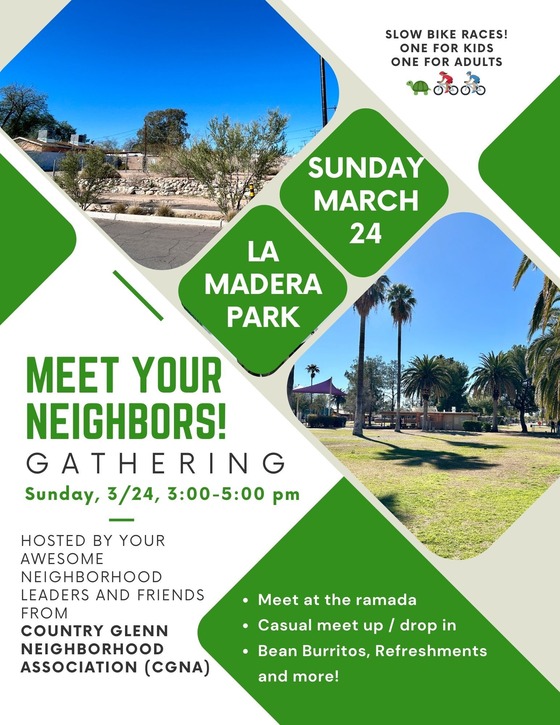
The City of Tucson has won a competitive $2,577,591 Reconnecting Communities and Neighborhoods Grant to create an east-west bicycle boulevard connecting Oracle Road to Columbus Boulevard. Under the leadership of Mayor Regina Romero and Department of Transportation and Mobility Director Sam Credio and his team, the City’s successful grant application will create a low-stress route improving safety and connecting five parks and four schools in neighborhoods that have experienced historic disinvestment.
The 4.5-mile bicycle boulevard will connect pedestrians and bicyclists and increase accessibility across all forms of mobility. This is the second year the City successfully competes for a federal Reconnecting Communities grant.
"Thank you to our Congressional delegation for supporting this project to help the City of Tucson continue investing in creating more walkable and thriving neighborhoods. I am grateful to our federal partners at the U.S. Department of Transportation for helping us layer investments in historically underserved areas that make streets safer for Tucsonans,” said the Mayor.
The Blacklidge Bicycle Boulevard also makes use of traffic calming features and landscaping that also shade, cool and beautify Tucson neighborhoods. The project is partially funded by voter-approved Proposition 407 and is part of the City of Tucson’s Bicycle Boulevard Master Plan.
“Blacklidge Bicycle Boulevard connects so many neighborhoods and residents across Ward 3 who use it as a safe alternative to busy traffic routes. As a result of this grant, the city of Tucson will be investing federal dollars to expand this biking network, create traffic calming infrastructure, and add landscaping to help decrease the urban heat effect,” said Vice Mayor Kevin Dahl.
|