|
Resilient Southwest Building Code Collaborative
Improving the buildings we live, work, and play in is a key component of mitigating climate change. In 2019, the energy used in residential and commercial buildings, such as cooling or operating appliances and equipment, contributed to nearly half of Tucson’s greenhouse gas (GHG) emissions. Improving the efficiency of buildings can reduce the emission of GHGs and other harmful air pollutants and save people money at the same time. For community members with limited income and/or inefficient homes, the cost of summer cooling could be the choice between staying comfortable and safe or putting food on the table for their families.
Inefficient buildings also put the lives and health of residents at direct risk. During extreme heat events, the focus is often on those that spend significant time outdoors – the unhoused; outdoor workers; people without cars that are dependent on walking, bicycling, or public transportation; undocumented border crossers, etc. – but of the 126 heat-related deaths in Pima County in 2023 that were not among border crossers, over a third occurred indoors. In response to this climate emergency, the Tucson City Council adopted a Climate Action and Adaptation Plan (CAAP) in March 2023 which identified multiple actions that can improve the resilience, health, and safety of the built environment including:
E-2.2 Collaborate with other Arizona cities to pursue funding to develop regional energy code standards (including mandatory and voluntary energy reach codes) that promote highly energy efficient and/ or zero-emission buildings in new construction.
CR-2.5 Create climate-resilient design codes and standards for residential, commercial and institutional, and industrial buildings, including standards for landscaping (e.g., tree canopy, green infrastructure) and architecture (e.g., passive design to support thermal comfort and air quality).
CR-2.6 Create climate-resilient design codes for buildings with a focus on energy efficiency, including but not limited to specifications for low-income weatherization, air conditioning, and enhanced filtration for wildfire smoke.
To advance these priority actions, the City of Tucson is partnering with other community leaders across Arizona and New Mexico, technical partners, and community-based organizations to develop strategies that will make new buildings more climate resilient and to retrofit existing buildings to be safer, healthier, and cheaper to operate. Through a Department of Energy (DOE) grant, building code experts such as the New Buildings Institute, the International Code Council, and University of Arizona’s Institute for Energy Solutions will bring their expertise on how to make homes and businesses safer in extreme heat events, more water efficient, and more energy secure. This knowledge will be supplemented by a Technical Advisory Group of local and national building experts, with technical assistance from the DOE’s Pacific Northwest National Laboratory. This technical assistance will evaluate the cost effectiveness, energy savings, and other impacts of proposed strategies to improve the way buildings are constructed.
 |
Another major partner, LISC Phoenix, will work directly with community-based organizations to ensure that marginalized communities have a seat at the table and a voice in the development of strategies that reduce the burden of energy costs and identify other inequities of building practices. An Equity Advisory Panel will be established to guide the Technical Advisory Group on how the needs of these communities can be captured in those strategies. A key intersection of energy and equity involves how buildings can be made more efficient, safe, and comfortable for the occupants while remaining affordable, both in construction costs and in long-term utility costs. Finding the balance between these goals requires genuine engagement of the most impacted communities and cutting-edge thinking about building practices.
The result will be a Regional Resilience Code that communities throughout the Southwest can adopt to supplement their building regulations to help protect their communities from impacts of climate change that are specific to the region and unique to the Colorado River basin. Adopting new building regulations can be challenging for communities, so another essential element of this project is providing implementation resources to local building departments. Technical partners will provide code training, vouchers for building specialist certifications, and other implementation resources to help cities, towns, and counties build their capacity to effectively improve their buildings.
For more information, visit the project page on the City’s Climate Action Hub.
|
|
How are we doing?
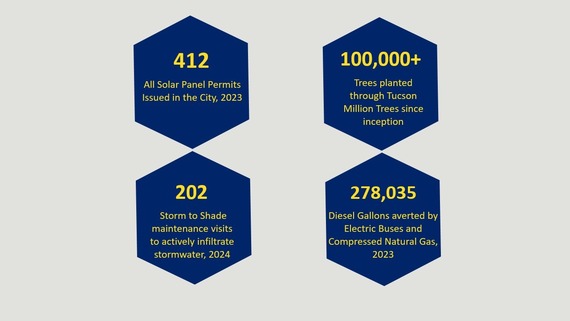
2023 Climate Action measurements from the City of Tucson.
Climate Action and Adaptation Plan Updates.
The January 2024 Climate Action Report explored the benefits of rainwater harvesting. We are pleased to continue the conversation centered on water management and feature a story highlighting the relationship between the City of Tucson and the Central Arizona Project.
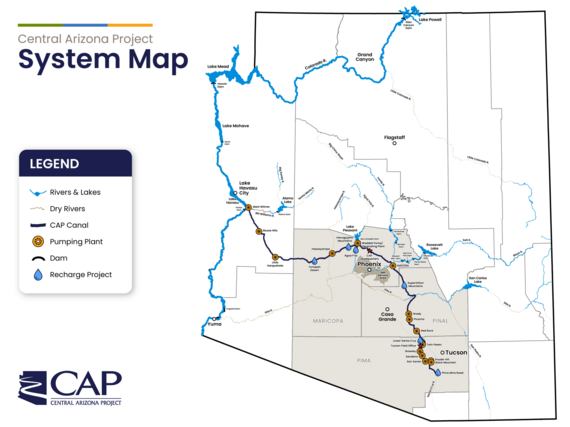
The Central Arizona Project system stretches 336 miles from Lake Havasu to Pima Mine Road south of Tucson.
CAP's Partnership with Tucson
Each year, Central Arizona Project (CAP) provides Colorado River water to more than 80 percent of the state’s population living in Maricopa, Pinal, and Pima counties. This water supply has been critical to Arizona’s economy for decades.
CAP is a 336-mile system that includes canals, pipelines and pumping stations and begins at Lake Havasu on Arizona’s western border and ends about 15 miles south of Tucson near Pima Mine Road and I-19. Since deliveries began, CAP has carried enough Colorado River water to fill a pool the size of the city of Tucson more than 300 feet deep. CAP is overseen by the 15-member, publicly elected Central Arizona Water Conservation District Board of Directors.
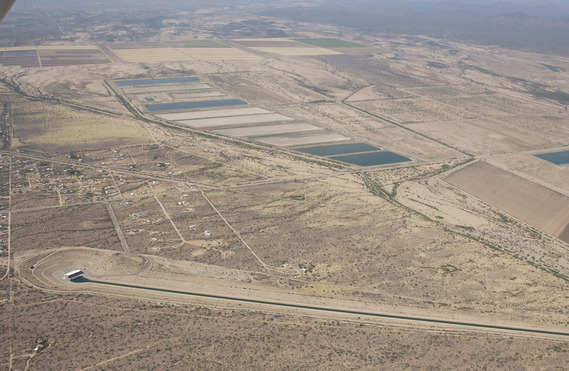
Each year, CAP’s Brawley Pumping Plant provides billions of gallons of Colorado River water to Tucson’s Central Avra Valley Storage and Recovery Project.
CAP and the City of Tucson are long-time partners, working to reduce groundwater over-pumping, storing available CAP water underground for the future, helping to reduce the amount of water taken off the Colorado River, and planning for the long-term health of our region.
-
The City of Tucson is CAP’s single largest municipal customer and has access to more than 45 billion gallons of Colorado River water each year. Because of the City of Tucson’s commitment to taking all of this water, they have been able to store a lot of water underground for the future, as well as reducing how much groundwater the City of Tucson needs to pump to meet the needs of its water customers. Both efforts have resulted in rising groundwater levels in many areas in and around Tucson.
-
The western United States has been in drought for more than 20 years, and runoff from snow in the Rocky Mountains, the main source of the water in the Colorado River, has been below average in most of those years. As a result, water levels in the two largest reservoirs along the river dropped by more than 70 percent during that time.
-
Over the past decade, CAP has been fortunate to partner with the City of Tucson, other cities and towns, and several Native American tribes to reduce the drain on Lake Mead, the nation’s largest constructed reservoir and the main source of CAP’s water supply. This year, the City of Tucson is stepping up to the plate once again, leaving some of its annual CAP supply in Lake Mead, in exchange for funding to invest in Tucson’s water systems.
-
The City of Tucson and CAP have been working together to plan for the future of the Colorado River. With support of Mayor Regina Romero, Tucson Water Director John Kmiec joined with more than 40 other leaders representing cities, tribes, businesses, environmental groups, and elected officials who, since 2018, have been meeting to come up with solutions to the challenges we face from a shrinking Colorado River supply and a warming climate. City of Tucson leadership helped pass the 2019 Drought Contingency Plan, which implemented additional conservation measures for the river.
-
The City of Tucson is also part of an expanded effort to develop Arizona’s position on how the Colorado River will be managed after 2026, when the 2007 Interim Guidelines for operating the river expire. Information on these Arizona Reconsultation Committee (ARC) meetings, along with more details about all of CAP’s history, operations, and climate change adaptation planning, can be found at CentralArizonaProject.com.
Check this out.
Actions from around the community contributing to Tucson's climate resilience.
Climate Resilience around the Community.
There's still time to Beat Back Bufflegrass this month. Volunteer events continue in February to combat invasive buffelgrass. This plant outcompetes saguaros for space, nutrients, and water. It also poses a serious fire risk both in the desert and in our city. Follow the link below to sign up to volunteer or learn about other buffelgrass pulls throughout Tucson.
The Arizona Community Tree Council (ACTC) in conjunction with The City of Tucson and Tucson Clean & Beautiful host the 2024 Tree Festival & Climbing Championship, fun for the whole family at Reid Park in Tucson. The Tree Climbing event is Friday, March 15 and 16, 2024 from 8am-4pm. The Tree Festival is Saturday, March 16, 2024 from 10 AM – 4 PM. Arizona arborists will participate in a tree climbing competition throughout the days that are designed to simulate the challenges they face in their daily work. Festival-goers can watch the competition on both days while on Saturday perusing exhibit tables, food trucks and fun family activities.
|
|
|
|
|