Date: 02/20/2024
Topics in This Issue:
-
Just Smile
-
Friends of Big Bear Valley
-
Music
-
Pima County Mosaic Project
-
Migrants/Asylum Seekers
-
UA/Board of Regents
-
Blenman Elm Historic Neighborhood Home and Garden Tour
-
Romance Scams
-
Plastic
-
Iskashitaa Refugee Garden Art Program
-
Administration of Resources and Choices (ARC)
-
High School Battle of the Bands
-
Moyo the Giraffe
Just Smile
It falls under the heading of kids being kids no matter what their mama looks like:
Kids are the same in every living creature! 😂
pic.twitter.com/seyfNqnurm
Friends of Big Bear Valley
More on the eagle team sharing time on the nest and eaglets to come. They’re pretty regular – about 1-hour shifts. If one of them is late the one doing nest-duty gets pretty loud calling out for relief. Here’s that switch about to happen.
Here’s the best shot I’ve been able to get of the eggs – I think there are 4 but may be only 3. As you can see, they’re pretty good size. This eagle is getting ready to take his/her post for the upcoming shift.
And here’s a little public display of affection between mom and pop.
 And this guy’s just mugging for the camera.
 From the chat happening along with the live feed it appears the babies should be arriving any day now. If you keep the live feed going in the background the sounds are calming, until the eagle sitting on the nest loses patience waiting for the shift change. Then if you’re on a zoom or a phone call you’ll need to shut off the video feed for a few minutes.
Here’s a link to the feed.
https://www.youtube.com/watch?v=B4-L2nfGcuE&ab_channel=FOBBVCAM
Music
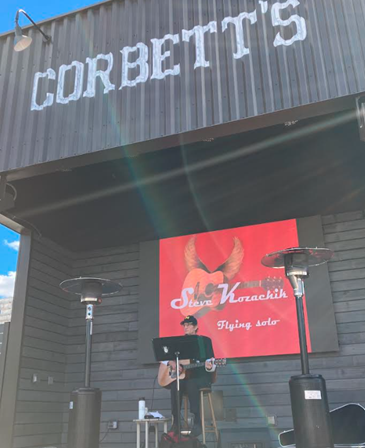
One more fun piece before hitting ‘the news.’ Thanks to Corbett’s GM Kyle for connecting and booking a couple more music sets over there. If you haven’t been yet you really should check them out – music going Thursday and Friday evening, Saturday noon and then Saturday and Sunday evenings.
Stop by Saturday, March 9th at noon and/or Saturday, April 13th at noon. I’m taking some of the Saturday lunch sets. Lots of activities happening in the venue – food, pickleball, cornhole, and lots of TV’s if you want up with sports that are happening. And music.
Diana and I visited Tohono Chul on Friday – will be booking some events up there as well.
Pima County Mosaic Project
A little over a year ago I wrote about a major destination project Pima County was planning. It’s called Mosaic Quarter (MQ) and is located on land adjacent to the Kino Sports Center. Here’s an architectural rendering of what the finished product is planned to look like.
I anticipate that in March the Pima County Board of Supervisors will vote on moving the financial projection package forward in the form of a lease agreement. That’s a key vote because once they approve the deal Knott Development, in partnership with Hensel Phelps contractors and of course Pima County will be within weeks of breaking ground. The development will be a game-changer for Southern Arizona as a destination for amateur and some professional sports, community events, public use of the facilities, multiple restaurants, hotel and other amenities. As an addition to the existing Kino complex, MQ will be an attraction our friends at Visit Tucson and the Metro Chamber will be able to recruit to.
The finished product will include an Ice Plex with 2 community rinks and one with seating for 3,000 fans. There will also be a fieldhouse with interchangeable playing surfaces. It will have the capability of hosting basketball, volleyball, pickleball, indoor soccer, badminton and 7-person football. There will also be a sports plex – about ½ the size of the field house and with the ability to host the same line up of sports activities. And finally, the pavilion (the photo I’ve got shown above) with food, music, and outdoor activities.
This is just informational – updating you on the progress being made on this major project. Kudos to the Pima County team, and to Knott Development for their work on dotting I's and crossing t’s and getting the project to this point in the process.
Migrants/Asylum Seekers
About a decade ago Ann from my office and I began working with the incoming migrant community literally out of the waiting area in what was then the Greyhound bus depot – then located just west of the TCC in a double wide trailer. Community volunteers under the title of Project Mariposa provided the ‘staffing.’ It was all volunteer.
As the issue grew in numbers Greyhound asked us to relocate and Catholic Community Services (CCS) stepped up and became the primary partner managing the immigrant issue in Tucson and Pima County. Community volunteers were and continue to be the backbone of the operations. I introduced the CCS director (Teresa Cavendish) to the owner of the Benedictine (Ross Rulney) and we agreed to use that facility as a temporary respite. When we first toured the facility – preconstruction – we anticipated housing about 50-75 people per day. Before the first month of our using that building had passed there were over 400 people per night staying in literally every floor of the monastery. Ross did not charge a penny to us for using the facility, and in fact poured thousands of dollars into keeping the plumbing and other utilities functional. As I noted, this has been a community-driven process. We used the site for 6-8 months until it went under construction for what is now the Benedictine apartments.
From there we transitioned into the county-owned former juvenile detention center that’s located out on Ajo. I say ‘we’ but the reality is this became a CCS/County function at that time. The county signed a lease agreement with CCS and that’s still in effect. The current housing capacity out at Ajo (Casa Alitas) is right around 150 people per day.
The number of migrants coming to Tucson and Pima County has been averaging around 1,000 per day. The county and CCS have been handling the lion’s share of the logistics – transportation, food, clothing, housing – when numbers got too large the city would help with temporary leasing of hotels, being reimbursed by the county through their federal allocation.
With the failure of the recent federal immigration bill that ‘federal allocation’ is drying up. The county anticipates they’ll be out of cash by around the end of March. The cost of the full operation (Casa Alitas plus the other off-site facilities they’ve had to stand up due to the increased numbers) is roughly $1M per week. If the federal government is no longer going to fund the work being done by Pima County, then they have to decide if they’re coming out-of-pocket for what would be in the $50M per year range, or if they scale back the operation. The Board of Supervisors will discuss that on Tuesday. Here’s one quote I pulled from the county memo issued over the weekend on this topic:
There is no feasible way the County could afford to maintain sheltering services for an average of 1,000 people a day or more. At $1 million or more a week, it would cost County taxpayers between $50 million and $60 million a year to maintain current operations.
The County Administrator issued a memo in which she laid out the basic facts; those are, the feds aren’t paying the freight, we’re facing our own budget challenges, do you (Board of Supervisors) want to fund this, or do we shut it down? Even the use of alternate county facilities on a severely scaled back basis would cost hundreds of thousands of dollars depending on the level of services and capacity they arranged for. If I’m counting votes, I’m guessing they’ve got enough support on the Board to signal to the feds that come the end of March the capacity goes from 1,000 per day down to 150 per day and the optics become a stain on the federal failure to manage our immigration policy. Another quote from the administrator’s memo:
It is severely frustrating and disappointing that we are in this situation. This is a crisis of the federal government’s making due to the failure to pass sensible border and immigration reform and to provide the necessary funding to local jurisdictions forced to deal with the deleterious effects of federal border policy.
And of course she’s right. The concluding portion of the memo says this:
My recommendation is to not fund any of the options presented in the contingency respite site plans. We have done all we can for five years with nearly a dozen County departments having been involved in the management of the complex sheltering coalition.
There’s not another council office that has been as directly engaged with this issue as the ward 6 office and staff. We continue to receive your donations and get them delivered out to CCS/Casa Alitas every week. Due to notice requirements CCS has already advised many of their staff that they will be terminated when the county facilities are shut down. Anticipating the Board vote, Casa Alitas is likely going to be the sole location for migrant drop-offs, and if the numbers don’t significantly decline, we could see street releases in as little as 7-8 weeks. They will certainly see them in Santa Cruz and Cochise counties.
What is needed now continues to be the clothing, such as jackets, sweaters, sweat pants, gloves (warm gloves are important and in great need) and all the hygiene products you’ve been bringing. Sunscreen, soap, shampoo, toothpaste, and that sort of thing. New underclothes and socks are important. Kids’ toys too. But watch this space as those needs may soon change. Over the weekend I spoke with the CCS director and it’s clear that if/when they’re solely operating out of Casa Alitas and federal support disappears as the county reimbursement, CCS will then rely more on direct cash donations. I’ve already set aside some funds for that purpose. I’ll let you know if that’s where this heads.
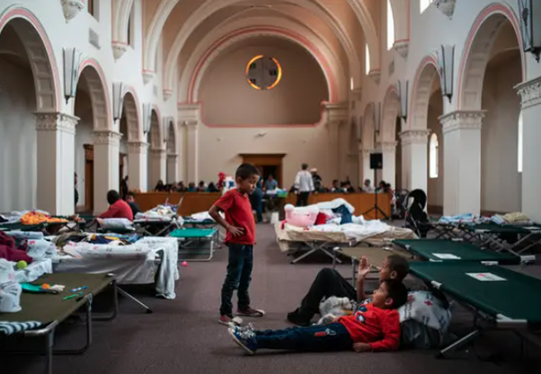 |
The Benedictine is long gone. It served its purpose and we’re grateful to Ross Rulney for his generosity. Soon the auxiliary intake centers that have been run by the county may be shuttered – a function of the federal failure to manage their own border responsibilities. Catholic Community Services is not walking away from their work. They’ll need your support. I’ll keep writing about how this evolves following the Board of Supervisors vote and the response from D.C. What’s clear though is that Pima County cannot pull $1M per week from their budget and continue doing the feds’ work for them and shift the costs from FEMA dollars to local ones.
UA/Board of Regents
The UA has selected a new AD. Here’s the opening bio on the new athletics director as posted in Wikipedia.
Desiree Don Reed-Francois (born May 7, 1972) is an American attorney and college athletics administrator who is currently the athletic director at the University of Missouri. She has more than two-and-half decades of experience in intercollegiate athletics, including overseeing the external operations for several institutions. On March 3rd, she will become the athletic director at the University of Arizona.
If building trust in a serious commitment to transparency and shared decision making is something Robbins and ABOR have been honest about, this selection process has been anything but that. Desiree might be a great fit – but unless it’s the best-kept secret around, the campus community has not been involved. Maybe donors have been, but if that’s the case it’ll only fuel the current concerns over how the UA is being run. Here’s what’s happening in Phoenix related to shared governance.
Throughout the course of this financial mess one of the things the faculty senate has been asking is to be included in decision making. The term of art is shared governance – sharing responsibility for setting policy. It’s clearly a concept Robbins and his team have resisted, giving mild acknowledgement that it’s on the table, but with no firm commitments.
While the off-ramp from this mess is still a work in progress, including shared governance, there’s work happening in Phoenix that would give Robbins the ‘out’ he might want if in fact sharing his authority is not something he’s interested in. Or maybe the UA administration is simply unaware that HB2735 is being crafted. Maybe. But that’s not believable to anybody paying attention to this issue. Here’s the pertinent part of the bill that’s making its way through the Arizona State Legislature.
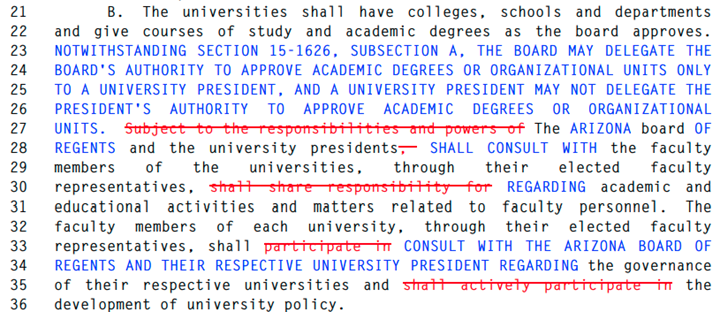 |
Note that they’re striking any reference to sharing responsibility for setting policy and vesting all of that in the office of the president. And ‘A University President may not delegate’ that authority. How very convenient if one is not inclined to participate in shared governance – simply have the ability taken away from you by statute.
During the committee hearing discussing the bill its sponsor Representative Grantham made 3 important points; one, “shared governance is not how a university should run,” second president Crowe up at ASU has been doing it right in maintaining financial controls, and third Robbins at the UA has let things get out of control. Fixing that does not require a change in state statute. It requires a change in leadership – Robbins.
Here’s the full text of the bill.
Shared governance is something the Faculty Senate has been asking for. So far it was given a gentle nod of approval. If there’s behind the scenes work happening up at the state legislature to give Robbins and crew the chance to shrug their shoulders and say they’d love to, but the state just preempted them, then this bill might be an example of that. Certainly, behind the scenes communications regarding on-campus ‘problematic’ issues is nothing new to the UA under this leadership. This is an email exchange that makes the point – Dudas works for Robbins and Washington White is Vice Provost and Dean of Students. I don’t know the others, but to suggest timing the termination of someone when it would not give faculty the opportunity to ‘create chaos’ is at best unprofessional. I have redacted the names of the people they were concerned about – this isn’t about them.
From: "Washington White, Kendal H - (kwashing)" <kwashing@arizona.edu>
Date: April 4, 2023 at 4:50:35 AM MST
To: "Allen, Treya - (treya)" <treya@arizona.edu>, "Rodrigues, Helena A - (hrodrigu)" <hrodrigu@arizona.edu>, "Krominga, Beth - (bethkrominga)" <bethkrominga@arizona.edu>
Cc: "Serrano, A Maria - (serranoa)" <serranoa@arizona.edu>, "Vejar, Alma R - (avejar)" <avejar@arizona.edu>, "Lanehart, Sonja - (lanehart)" <lanehart@arizona.edu>
Subject: Personnel Issue
Good Morning Friends,
I had a conversation with Jon Dudas this week regarding the Cultural and Resource Centers including the behavior of the staff and other colleagues who are problematic. (... and others).
Jon Dudas and I agree that if we release employees from the University, we will wait until after the end of the Spring semester (at the end of May or June). The rationale is that if we make any removals, it will give people another opportunity to create chaos.
Of course, Treya will continue to work with Beth regarding the Centers’ staff. Helena, I appreciate your partnership.
Regarding J, I’m unsure about him – is he aligned with the Center Directors? If not, I would move forward regarding his employment. If so, I think we do the same at the end of the May or June.
Kendal Washington White she/her
Vice Provost for Campus Life and Dean of Students
Dudas was the guy who made the statement at the city council meeting related to the non-binding resolution I offered asking the UA to COVID test all students, whether they lived on or off campus. He called the resolution ‘pandering and unconstitutional.’ I was evidently ‘problematic’ as well - less than 2 weeks after the resolution failed 6-1, my position was eliminated at the UA. The mayor and council took his bait. Robbins pays Dudas $454,000 per year, not counting incentives.
If the legislature passes HB2735 onto Governor Hobbs’ desk it will be interesting to see what kind of reception it gets. Unless simply eliminating the ruse of shared governance is the goal, changes to state statute are not needed in order to allow Robbins to do what Crowe at ASU has been successful at for years.
The UA is putting out talking points related to its financial game plan. Here are a few frames from the power point the UA shared with neighborhoods surrounding campus last week.
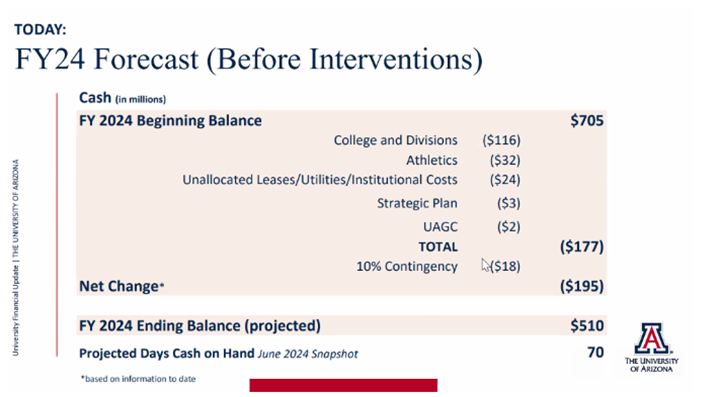
Note in this first slide – athletics is not an external factor, despite the UA calling it one. Athletics is an auxiliary unit operating on campus and a unit that received $87M in a loan that Robbins now says will not be repaid. And they’re looking for another $32M this fiscal year. That’s not an ‘external’ factor that led to the financial problem the UA is facing.
This slide shows the overspending continues in the current fiscal year. Over ¾ of the operating units on campus are projected to overspend their budget.
Without any changes in that financial trajectory the UA will end up with 70 days operating cash on hand. The ABOR policy is to have 140 days cash on hand.
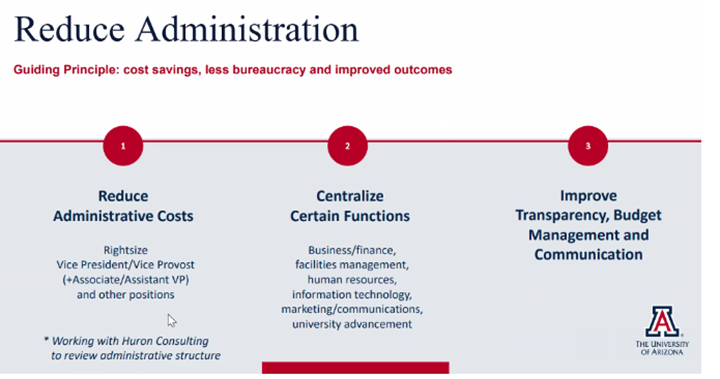
One of the proposed solutions is to “modernize” athletics. When Robbins first admitted to the financial mess, he said they’d be cutting sports in the athletics department. He has since walked that back. Now he’s talking about centralizing administrative functions. Centralizing administrative functions only shifts the workload to a different operating unit on campus. HR or I.T. work doesn’t disappear just because it’s happening in a different location on campus. That’s not going to be a huge money saver unless he’s just going to dump the added work on existing employees and lay off the current athletics workers.
Resetting the budget from zero doesn’t imply meaningful savings if the spending only ends up where it already is. And since the bulk of spending is on personnel setting ‘hard caps’ will necessarily involve layoffs. Enhancing revenue means raising ticket prices. There is a price elasticity that’ll drive some current ticket holders off. And ‘setting long term goals’ speaks to the issue of the national athletics model. It has been broken for decades. If the goal becomes to stop trying to chase after competing with major football powerhouses that fill stadiums with over 100,000 fans each week, then that runs counter to ‘competing for championships.’ That is one of the athletics stated goals – it's within this ‘goals’ section that the longer-term savings can be found. But at a cost the community may not embrace.
 |
One of the functions being discussed for centralizing is Fund Development. There are development officers in many operating units. In athletics there is a whole section of workers whose job it is to nurture donors. Pulling the development function out of UA operating units and housing it in the UA Foundation may have the added ‘benefit’ to the UA of eliminating donations from public scrutiny. If as Robbins says transparency is a key part of the realignment, consolidating work in a way that reduces sunlight isn’t probably the best way to achieve openness. Some have suggested that during the course of the renovations at Tucson Country Club the UA funneled multiple private memberships through the UA Foundation. If that’s not true, then they should open those books for the public/media to see.
Reducing administration is a legitimate area to study as long as it’s understood that everyone is not equally responsible for the bloat and mismanagement that has occurred. To retain or return to the core mission of the UA is key. Across the board cuts to ‘administration’ may run counter to that goal.
There’s clearly more to come. Now the state legislature is taking an active role, joining ABOR paying outside consultants, the governor and on campus concerned faculty and staff. Meanwhile the guy who was asleep at the wheel is guiding the ‘fix.’
During Robbins’ interview with the Arizona Republic editorial board, he said this about the next athletics director: “We’ve got to get the right leader in our athletic department. Someone who has experience, preferably a national figure who’s going to be a leader, who can come in and solve these problems and navigate our change from, sadly, the demise of the Pac-12 into the Big 12.”
He was evidently conducting that interview knowing full well that a selection had been made. Trust? That does not demonstrate a serious interest in ‘modernizing’ the athletics operation. It’s more chasing the big boys down the financial drain. We’ll soon see if adding an attorney to the athletics department is modernizing.
Blenman Elm Historic Neighborhood Home and Garden Tour
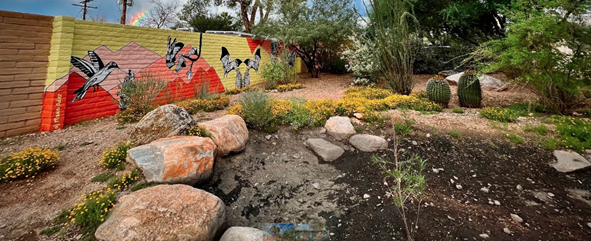
This is a shot of the newly painted mural next to the pollinator garden in Blenman Elm. It’s located at Treat and Seneca. Since it’s on the bike route it gets lots of eyeballs. Now the neighborhood is inviting people to tour other parts of the historic neighborhood and enjoy some of our local urban history.
Blenman Elm has been an established neighborhood for over 100 years. The neighborhood leadership team has put together a self-guided tour that’ll take you to historic homes designed by nationally renowned architects, and to gardens and sculptures produced by some masters in the trades. Included are also some examples of some great green infrastructure projects.
The tour will take place on Sunday, April 14th from 11:30am until 4:30pm. The check-in on that day takes place at 1650 N. Bentley – the Blenman Elm school parking lot. A portion of the proceeds from the tour will be donated to the school. The remainder will help fund neighborhood projects – like the Seneca garden. For more information on the tour please reach out to the BE folks at blenman.elm@gmail.com. Or if you just want to get tickets now you can do that at https://BEhometour24.eventbrite.com.
Romance Scams
My office has been doing a lot of work in the sex trafficking area. Great inter-agency works a couple of weeks ago led to the bust of several local predators. The state attorney general sent out an advisory recently that could relate to the trafficking area, but more likely its building awareness of a scam being used to gain access to peoples’ financial information – or just to their money directly. And the fact that PCOA (Pima Council on Aging) also ran an educational piece on the issue shows in many cases scammers are targeting seniors.
The issue is called ‘romance scams.’ It often happens online or through social media. The scammer (groomer) spends time establishing a trusting rapport with the victim, and then at some point in the phony relationship the person comes up with a heart-wrenching story asking for money. Since many seniors are living alone and in some cases are lacking companionship, the grooming takes hold, and they fall prey to the request for funds. The AG indicates that this form of scam affects “tens of thousands” of people every year.
The number one lie told by the scammer is that they need money because a relative is either sick, hurt or in jail. They also might pitch a “great investment” opportunity. Here are the warning tips the attorney general’s office lists in their advisory:
-
Someone who is quick to profess their love.
-
Someone who pretends to be a hero, such as a soldier, in a faraway place.
-
Someone who continuously makes plans to meet in person but never follows through.
-
Someone who makes a sudden request for money to deal with an emergency.
-
Someone who asks you to wire them money, put money onto gift cards and give them the PIN codes, or send them money through a money transfer app or cryptocurrency.
The number one tip is to simply not send or wire money, gift cards or any form of funds to a stranger. Don’t share personal information on social media platforms. And be wary of how a person’s story might change. If you’re a senior who may have been approached in a suspicious way, speak to your family and friends to get their input, and you can reach out to the Internet Crime Complaint Center at www.ic3.gov.
You may also file a complaint with the consumer fraud division of the Arizona Attorney General’s office by going to www.azag.gov/consumer. Please speak to your loved ones about this and make them aware that it’s not just ‘something that can’t happen to me.’
Plastic
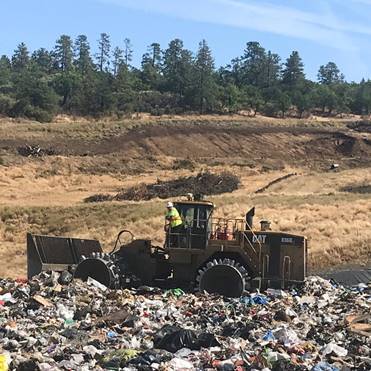
Think about this next time you’re leaving the grocery store with a handful of food in the plastic bags they send you home with. It takes 1,833 of those plastic bags to make one single 22-pound ByBlock. Each week we collect about 8 tons if plastic. If all of that was made up of single use bags it’d mean we’re collecting the equivalent of over 1.3 million plastic bags every week and making just under 800 blocks. So, the next time you’re unloading your groceries think that the community is bringing us over a million of those bags (the equivalent of) every week. That’s the impact your involvement in the plastics program is having.
As far back as 1989 a plastics trade group called the Vinyl Institute said, “recycling cannot go on indefinitely, and does not solve the solid waste problem.” Why? Because making plastic is cheap. Recycling it costs much more than the material is worth. It’s basic economics. So, we’re left with this:
This is the environmental analog to the misinformation the nicotine, opioid and PFAS industries all put out. During a 1994 meeting with the American Plastics Council (another trade group) the VP at Exxon Chemical said, “We are committed to the activities, but not committed to the results.” He was talking about producing plastic. Here’s a link to the full NPR story:
Last Thursday evening Ann and I took part in a special gathering called by the Sunshine Mountain Ridge HOA. They’re located way up north of Craycroft and River. They wanted to hear about the program. There was a full house showing the broad interest in the program that exists not only within the city limits, but out in the county as well.
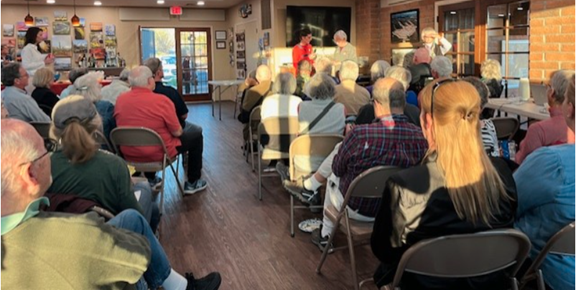
Diana and I visited Tohono Chul on Friday. I’m working with them on some music events. Tohono Chul is also collecting plastic and having either staff or volunteers bring it to the ward office every week. Every home and every business can be a part of what we’re doing.
As readers of this newsletter know we’re still working on standing up the ByFusion facility in Tucson. We have regular progress meetings – it's too slow. Our mound of plastic continues to grow. But to help offset that we’ve sent just under 50 tons of plastic to ByFusion for processing. With it they’ve put over 2,000 blocks to use in construction projects, have included 3 tons of marine debris in that work (saving marine life in the process,) and have avoided over 27 tons of CO2 through the diversion work. All of that is good and is a testament to the many of you who are participating in the program. The only troubling part of the story is that we’re still seeing about a 20% contamination rate. That’s way too high for what is a voluntary, opt-in program. Please do not use the orange plastics bins for your regular trash. It’s hurting the program when you do.
Continued thanks to the vast majority of program supporters who are doing it right. It’s important environmental local work that’s addressing an important global environmental problem.
Iskashitaa Refugee Garden Art Program
Our Iskashitaa partners in working with refugees are hosting a public open house to show off their Refugee Garden Art program. It’ll be held over at St. Mark’s church – 3809 E. 3rd St. on Wednesday, February 14th from 8am until 11am. This week will be of particular interest to both me and to Ann – we've been to Zambia and have worked with the locals who use recycled paper to make necklaces. The art they’re sharing this week will be centered around recycled paper beads.
If you haven’t seen this work, you should take some time to stop by. It’s really amazing how beautiful and resilient the necklaces are. For a while I was sending old schedule posters over to them – lots of colors and easy to work with.
Administration of Resources and Choices (ARC)
Last week I had a section on the ARC program. We’re hosting them each Tuesday at 4pm. The program is about building a Boarding Home business, the goals of which include augmenting income for the homeowner, but also to provide stable and affordable housing for seniors. The program follows HUD rules – this is not a work-around to stick more student housing into neighborhoods.
There will be several more weeks of these presentations, but it's important to understand that they build on one another. So, if this is a program, you’d like to learn more about its important that you get involved this week or next. If the program material gets too far ahead of you, you’ll need to wait for the next round of presentations.
The ARC folks have this website that shows the variety of home ownership and senior protection programs they offer: https://arc-az.org/
This is a HUD-certified counseling service. If renting out an unused bedroom is of possible interest, please come by and get this information. It’s free – there are only a few spots left in this round of training so stop by and get signed up. If you’ve got questions about the program, you can call the ARC team at 520.623.9383.
High School Battle of the Bands
No, our Tucson Parks staff is not piggy backing on the post-Super Bowl activities that took place in Kansas City. This ‘battle’ is legit – and one that you should get your young ones involved with.
Tucson Parks is partnering once again this year with the Arizona Daily Star and others to host this competition between artists who are between the ages of 13 and 18. It’s a high school focused chance for our youth to share their musical talents. I prefer to call musical events sharing opportunities vs a competition. But the reality here is that winners will be chosen, so I guess they are competing.
Best Life Presents is one of the city co-sponsors in this event. The grand prize of the competition will be to record an album with Best Life, and have them help to promote the disc. This is open to all kinds of music genres – just be sure to get your band into the mix by applying before Friday, March 15th. The event will be held at the Reid Park bandshell beginning at noon on Sunday, April 7th. Please use this link to get signed up – and have fun sharing. It’s really all about the music. Winning is the cherry on top. Battle of the Bands information and application
Moyo the Giraffe
And speaking of our parks, the Zoo team ran a public survey asking you to vote on a name for the new baby giraffe who’s now out and about at the zoo. Of the over 6,500 entries Moyo was chosen as the most popular of the choices offered. It’s Swahili for ‘heart.’ Notice on Moyo’s neck where I’ve circled a heart-shaped marking. That’s why Moyo was one of the options.
Others say they see 2 hearts on her neck. I don’t - but whether there’s one or two the important point is the baby has a name. And she’s now out more often for you go visit. Moyo is now just over a month old. She’s just over 6’ tall already and growing. Giraffes are a species that’s rapidly disappearing. We saw them all over the place during one of our trips to Africa. The animal conservation work being done by the Tucson Zoological Society is important to keep in mind during your visits to the zoo.
You can see all of the zoo activities, hours of operation and ticketing information here: https://reidparkzoo.org/ And here’s a short video they put together to introduce Moyo:
Sincerely,
Steve Kozachik
Council Member, Ward 6
ward6@tucsonaz.gov

City of Tucson Resources
|