Date: 02/05/2024
Topics in This Issue:
-
311 App
-
UA/Board of Regents
-
Plastics
-
TEP Midtown Reliability Project
-
TEP Home Energy Workshop
-
Puppy Mill Legislation
-
Illegal and Racist Covenants
-
PFAS Maximum Contamination Levels
-
Iskashitaa Social Justice Scholarship
-
Heritage and Cultural Survey
-
Planning and Development Services Survey
-
Tucson Wildlife Center
-
Sculpture Tucson and Reid Park Zoo
-
Cease Fire Everywhere
311 App
In previous newsletters I’ve shared that the city is rolling out a 311 non-emergency phone system to help relieve calls from the 911 center. That system is now up and running.
If you’ve got a smart phone, you can download the 311 app and use it to report any of a variety of things. Those include potholes, broken play equipment in your pocket park, report if your trash pick-up didn’t happen as scheduled, water bill questions and any other city function. There are a few ways you can engage the system – one is to simply call 311 and speak to the call taker. Or download the Tucson 311 app to your phone and make your report that way. There’s also a 311 portal on the city of Tucson website. Use this link to find that: Tucson 311 Service Request Portal and download links
Please don’t ever hesitate to continue reaching out to our office if you’ve got questions. But I know many of you prefer to and are capable of navigating the system on your own. Your choice – we're good with however you’d like to make your report. The great thing is that with the 311-system operating our 911 dispatchers will be free to handle the true emergencies they’re trained to help with.
UA/Board of Regents
Credit Governor Hobbs for firing off her note that I shared last week. It essentially called out both Robbins and ABOR for the mess they’re in and called for getting distance between the Board and the UA administration in terms of both looking into the causes and identifying solutions. Given that the faculty senate is in no hurry to vote No Confidence, the burden shifted to the governor’s office. She has now given Robbins/ABOR until February 9th to come up with a solution and to engage an outside audit firm and to let her and the public know their game plan for digging out of the mess they’ve created.
In light of the alleged distance that ABOR and the UA says exists in the investigation/resolution of the mess it’s interesting to note that ABOR has agreed to fund some pretty critical pieces of whatever the ‘fix’ is going to end up looking like. They’ve already agreed to fund multiple mid-term reviews of process, financials and that sort of thing. In addition they’re going to fund a consultant whose specific scope of work is to look into the overspending that has been happening in intercollegiate athletics (ICA,) they’re going to fund a consultant to look into the financial impact the global campus is having on the UA, and they’re going to fund Huron Consulting – a group hired to specifically look into the UA’s administrative structure. Clearly the Board sees that they have some culpability, or they wouldn’t be so quick to own these outside measures. The consultants need a clear arms-length distance from both ABOR and the UA.
This is from a Reuters story that ran about the time I started on the city council: NEW YORK (Reuters) - A global consulting company that rose from the ashes of the destroyed accounting firm Arthur Andersen is now facing a scandal of its own.
The problems at Huron Consulting Group Inc may reflect a corporate culture that carried over from Arthur Andersen, the firm that collapsed in connection with the Enron Corp scandal in 2002, legal and corporate governance experts say.
At the time Huron got into trouble with the Securities and Exchange Commission and several of their top administrators who had ties with the Enron/Arthur Andersen scandal had to leave the company. So, it could be bad news that the UA is hiring a consulting firm that has a sketchy history with the SEC, or it could be good news that the firm knew it had to get rid of the leadership responsible for getting them in trouble. I wish I had the confidence to believe Robbins and his inner circle did their due diligence before signing up with Huron. And getting rid of leadership that caused financial problems is something ABOR and the governor need to reflect on. So far all they’ve done is identify some scapegoats.
Regarding the ICA overspending, Robbins said ‘the athletics model has flipped on its head in the last 4 or 5 years’ resulting in the deficit spending. That’s not quite accurate. The ‘athletics model’ has been broken and ‘flipped on its head’ for decades. Robbins should call and I could give him the background he lacks. The world of intercollegiate athletics has been in a facility arms race for decades. The change in the past 4-5 years is that until now we had a president who’d rein in the ICA spending. Now it’s keep up with the Jones’ and put nothing but winners on the field. ICA is projected to run yet another deficit that’s north of $30M this fiscal year. That’s on top of the $32M they ran last year, and whatever they spent the $87M Robbins ‘loaned’ to them over the previous few years. Last week Robbins finally admitted that the athletics department may never pay that $87M back. What’s needed is a president who’ll set the cap and force them to operate within it. That might mean avoiding paying over $13M in coaching buyouts (even if donors paid it, that’s $13M those donors don’t have to fund capital projects,) building aquatic facilities for women’s water polo and then deciding not to have the sport, and tens of millions on other facility upgrades, all in an effort to compete with schools that have much larger overall budgets.
In the UA’s own early analysis of the problem Robbins’ own Strategic Plan is said to have added about $150M to the financial stress on the UA. John Arnold, the guy tasked with wearing his ABOR hat simultaneously with his interim CFO hat has also pointed to “institutional funding for research” as a large part of the problem. You can look back at previous newsletters where I made that point – based on data from the National Science Foundation. Arnold also pointed to the increase in financial aid the UA is handing out. In FY’18 that number was roughly $189M. This coming fiscal year it’s projected to be $362M. The current overspend for this fiscal year is in the $177M range. In one year, the UA’s cash reserves went from $845M down to $705M. According to the current forecast that will become $510M next year. It’s not a trajectory any business could sustain. I was a bit (just a bit) surprised to see that fact was missed by the business leaders who put together the meeting they held in support of Robbins. The UA is now projected to have their day’s spending on hand at about ½ the level set as the standard by ABOR. And yet the Board continues to wave the Robbins flag.
There are rough edges of a ‘plan’ being discussed. Some of those include having operating units submit budgets calling for reductions of from 5% to 15%, a hiring freeze if you’re not athletics, taking a fresh look at financial aid, halting any ‘non-essential’ capital projects, layoffs and some other similar efforts, the combined effect of which will not make up for the financial waterfall that’s happening.
Next steps are to watch for the February 9th report, and to see how long the Hobbs patience lasts. She mentioned the fox guarding the henhouse. It’s unclear if the fox is Robbins, Arnold, ABOR or if there are actually 3 foxes in the mix. It is a wholly bad look for the UA, city, and the tri-university system. Another bad look was the manufactured media story crafted by the big donors last week. The UA is a land grant institution, not the plaything of the well-to-do. Nobody from the private sector who attended that meeting is going to feel the ticket price increases that are now being announced. The taxpayers generally will – and the closest they’re going to get to a meeting like that is buying a car.
At last week's faculty senate meeting Robbins and Arnold both acknowledged ‘administrative bloat.’ I wonder though if he has his immediate area (or self) in mind because in terms of bloat, what Robbins has is significantly more than a little financial baby bump.
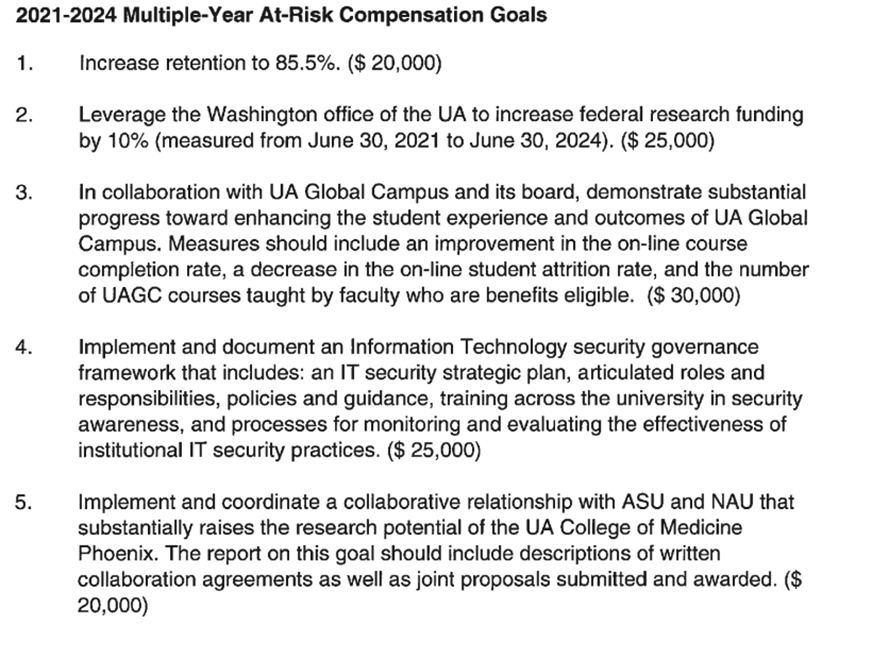
Robbins’ base salary is $816K. Add to that his $10K annual car allowance, his free use of the $1+ million-dollar house in Sam Hughes neighborhood, 3.5% annual salary increases and the fact that each year the UA puts 21% of his salary into his retirement account. Last year that alone was $171K. His annual retirement set aside is triple what many UA faculty are earning in their base salary. But that’s not all. I pulled these additional financial incentives from his contract:
 
It’s not surprising he’s so bent on protecting the Global Campus. His bonus depends on it. Most people get hired to do a job and they don’t get extra bonus salary for doing it as expected. That’s bloat.
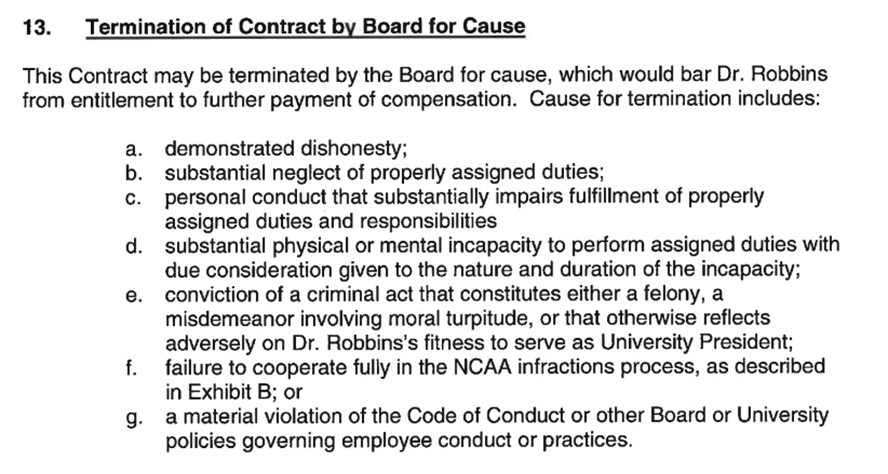
Robbins has some termination language in his contract. I pulled this directly from his contract – you can view it here, courtesy of The Daily Agenda, one of Tucson’s newish online media sources:
If ABOR simply told him to leave, they’d be on the hook (we’d be on the hook) for the balance of his deal through mid-2026. That’s a few million dollars. But there are ‘for cause’ reasons they could use to terminate the contract now. This is from his employment contract:
Is telling ABOR that he has accepted the ‘resignation’ of the CFO when in fact it was a shift in titles being dishonest? Is it honest to host private parties to strategize over the purchase of the Global Campus and calling the effort “operation antelope” in order to keep the effort secret? Is running the UA into a fiscal condition where they now need to make $200M in spending cuts neglect of his duties? That’s all now for ABOR – or the governor – to decide.
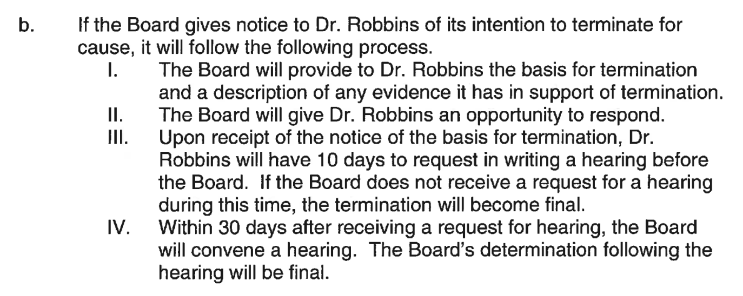
If the Board does decide to terminate his contract, there’s a process they’d have to go through. This is also language from his employment contract:
One of the big donors who attended the Bobby rally last week said he couldn’t operate his business if certain employees had tenure and he couldn’t get rid of them. One wonders how his business would be doing if it followed the same ‘spend what you don’t have’ mentality that the UA is now trying to work out from under. And if he’d have retained the employee most responsible for putting them in that position.
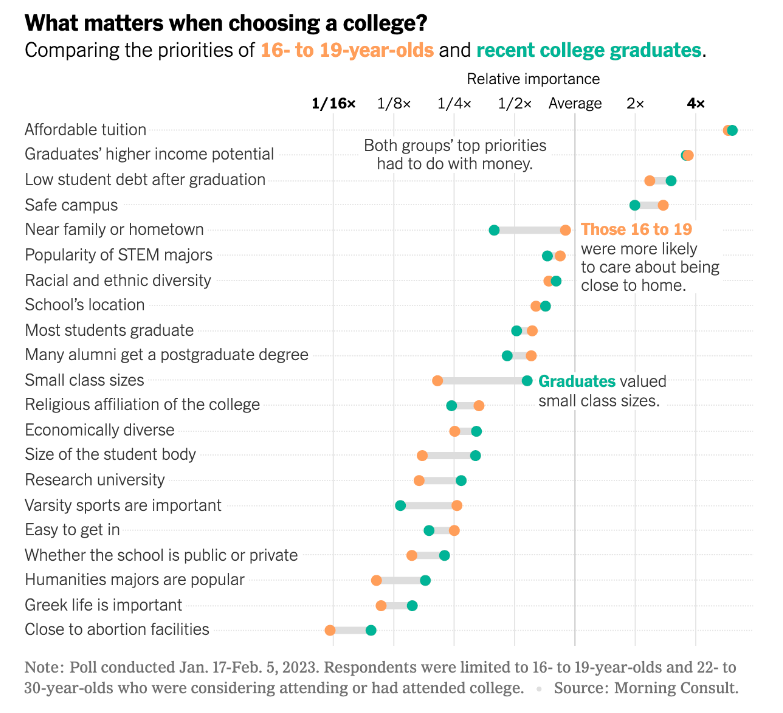
Morning Consulting did a survey to see what matters most to prospective college students. In the Arizona constitution it says higher education should be ‘as nearly free as possible.’ At the UA in-state tuition begins at $13,600. Out of state is $41,000. That doesn’t include books, housing and living. According to the Morning survey ‘affordable tuition’ is the number one criterion of importance. Having a good football team is way down the list. Administrative bloat does not help reduce those tuition costs.
Once again thanks to Dylan Smith from the Tucson Sentinel for running my op-ed, here's a link to that piece.
https://www.tucsonsentinel.com/opinion/report/020424_kozachik_ua_op/kozachik-admin-bloat-embattled-ua-doesnt-help-reduce-tuition-students/
Plastics
In my meeting last week with Heidi, the city manager’s office and our environmental services director we covered some important ground as an update to the project progress. Most importantly is that the design for the ByFusion building is complete and the construction is starting soon. That’s a key milestone in getting them to Tucson and beginning the full-scale operation locally.
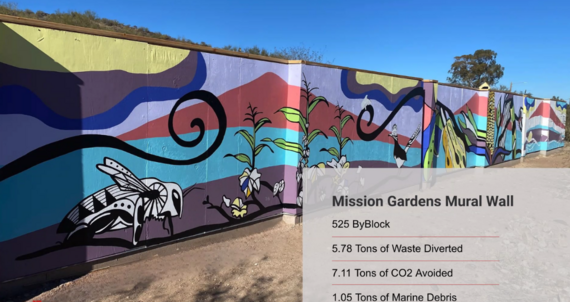
As many of you know we’re not waiting on their arrival to begin using the ByBlocks for local projects this is a picture of the Mission Garden mural wall – and the inset shows how much impact just that one project has had on the environment. They’ll be able to remove the cement board the murals are painted on and add new ones from time to time. Notice also that in partnership with BF we diverted over a ton of marine debris – mixed in with the Tucson plastic in forming the blocks that make up this wall. So, your local efforts are also having a significant impact on the ocean pollution that’s floating around in the Pacific.
 |
During our meeting we also reviewed the data on how much plastic has been processed over in L.A. by ByFusion – plastic that we’ve sent to them in an effort to manage what we’re collecting while the production building is being built. Last week you topped 8 tons in contributions. That’s great and is a credit to you. Keep it coming. We’re working with BF on ways to enlist some 3rd party partners during this interim period while we’re collecting, but before we have the full production capacity. More on that to come.
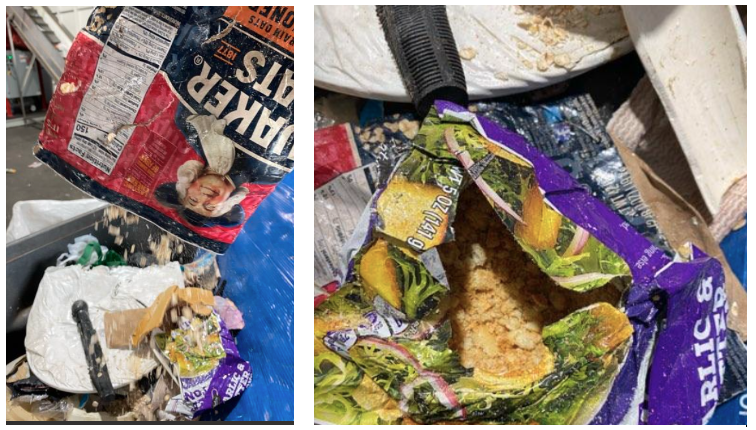
One very troubling bit of information we discovered while looking at the data is that the contamination rate is just over 21%. This is an entirely voluntary program. There’s no excuse beyond laziness for much of the contamination we’re finding. It’s lots of food waste – giving the appearance the people are simply dumping their household trash into the plastics bin. Here are a couple of pictures showing what we’re finding:
If we’re gathering 8 tons of contributions, and 20% of it is contaminants, that’s over 3,000 pounds of waste material that’s being tossed into the orange bins that doesn’t belong there.
While you do not have to wash out your empty food containers before tossing them into the plastics bin, just throwing in your scrap food is not at all in line with what this program is trying to achieve. Throw your trash into your trash can. Not the orange bin.
Early in the pilot phase of this program our contamination rate was excellent. This is not a good trend. Please help us educate others so the program can achieve all of the solid environmental goals we’re hoping it will.
TEP Midtown Reliability Project
This is just a very quick reminder about the upcoming public open house being sponsored by TEP. It’s intended for them to share where they are in terms of planning for the transmission line project, and what their planned next steps will be. Here’s the information on that meeting. It’s free and is open to the public.
TEP Home Energy Workshop
A while back we hosted a workshop in which TEP came and talked about many of the ways you can reduce your electric bill at home. They had some energy saving goodies to hand out, and lots of good easy to implement ideas. Due to the strong support of that first workshop, we’re hosting another one.
The meeting is scheduled in our community room. It’ll take place from 5:30 until 7pm on Wednesday, March 6th. Please mark your calendar now and let us know that you’re coming so we can give TEP an idea as to the size of the crowd. Last time they ran out of the give-away items at the event and had to follow up with several of the people who came.
Puppy Mill Legislation
Thanks are due to Chorus Nylander and KVOA for continuing to shine a light on the issue of puppy mills. Last week he reported on a local woman who purchased a puppy at Pets at Park Place. Here he is:
Days after she brought home the little cocker spaniel, he came down with what ended up being a series of ailments, the combined total of which cost her over $5K to treat. Add to that the purchase price of the dog was about $2K. To help make her whole for the losses Pets at Park Place reimbursed her for $190. Here’s a link to the full story:
Several years ago, I had worked with the city attorney, and we drafted an ordinance that would ban the sale of dogs in retail establishments unless they were sourced from a local shelter or rescue. Pima Animal Care Center and the Humane Society are over-stuffed with dogs and cats. Please spay or neuter your animal. At the time we passed our ordinance the city of Phoenix also passed a similar one. The owners of the pet stores lobbied the state legislature and were able to get preemption legislation passed preventing our ordinance from going into effect. Instead, they crafted their own bill that has some requirements for posting notices of where they source their dogs, and inspection opportunities for the USDA. The Department of Agriculture inspects the beef you buy. They don’t have anything close to the staffing needed to police puppy mills that are scattered throughout the midwest and southeast. In fact, many of the dogs Pets at Park Place have sold came from mills in the midwest. The state law that’s in effect is virtually worthless.
In his story Chorus mentioned a bill that Representative Juan Ciscomani is sponsoring in D.C. It’s called the Puppy Protection Act of 2023. It totally misses the source of the problem with puppy mills. HR1624 requires the Department of Agriculture to require that retail pet stores provide the following:
-
adequate housing, exercise, and veterinary care;
-
appropriate and nutritious food;
-
continuous access to potable water; and
-
meaningful socialization with humans and compatible dogs for at least 30 minutes each day.
None of that is anything pet stores shouldn’t already be doing. It’s certainly not anything the Department of Agriculture is going to have time to monitor, and it does nothing about addressing puppies that are mass-produced in puppy mills. In the KVOA piece I said that if Ciscomani wants to do something productive in this area he should be returning our local right to adopt meaningful ordinances that force sourcing of dogs and cats sold in stores from shelters and rescues. Right now, they’re being euthanized due to overcrowding. Our hands are tied in terms of our ability to legislate solutions.
I’m grateful to Channel 4 for sticking with this issue. If it had been left to local control, we’d have addressed it years ago and the puppy purchased in the piece would have been in a loving home for less than $100 and would not have come with underlying medical conditions that were unfair to the buyer and inhumane for the pup.
If Representative Ciscomani wants to talk, he knows how to find me. There’s an easy fix.
Illegal and Racist Covenants
Over the course of the past couple of years multiple neighborhoods scattered throughout the community have been wrestling with how to excise racist and illegal covenants from their CCR’s - Conditions, Covenants and Restrictions. Those are rules put into place by neighborhood associations that are intended to govern how a particular area develops. Many were written back in the early-to-mid 1900’s - post-war era – and they contain a particular covenant that restricts who can live in the neighborhood based on race and ethnicity. These are private contracts between the buyer and seller of a property and so the city has had no role in helping to eliminate the offensive conditions.
The San Carlos neighborhood has come up with one way to do a work-around. I’ve shared that process in previous newsletters. Now the state legislature is finally taking up the cause through SB1432. The explicit purpose of the bill is to provide a relatively easy pathway for neighborhood associations to eliminate the condition without affecting any of the other terms of the CCR’s.
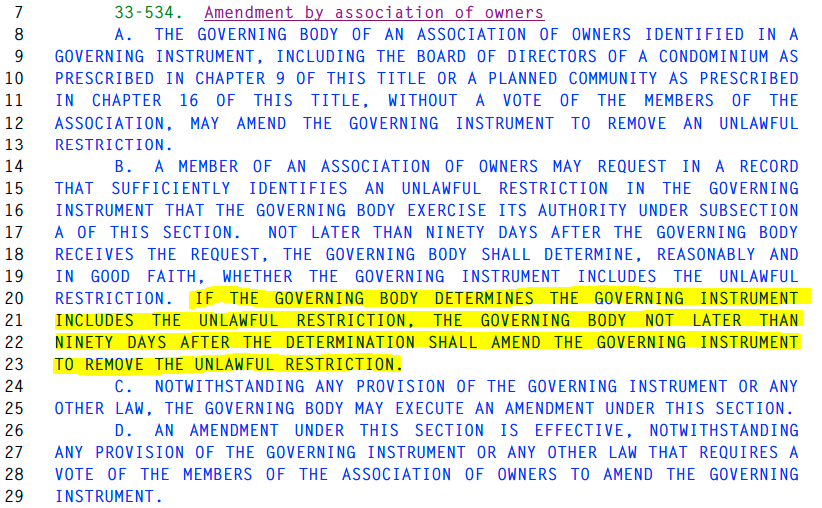
The racist conditions are illegal and have been since the Fair Housing Act was passed back in 1968. But without reopening the entire set of CCR’s, until now there was no way to take a scalpel and excise just the illegal part. Here’s the language being proposed that allows a property owner to take the action:
SB1432 - CCRs
And here’s the language that would allow a neighborhood association board to take the action on behalf of all of the CCR’s throughout their neighborhood.
If you’re so inclined, let your state representative and senator know that this is an important and long-overdue bill that will simply allow CCR’s to reflect both the law, and most importantly the ethos of who we are as a diverse and welcoming community.
PFAS Maximum Contamination Levels
M&C get quarterly updates from our water staff on how we’re doing monitoring, controlling and remediating the PFAS contamination that exists is some of our water wells. PFAS is the contaminant that was largely infused into our water supply by the actions of the Arizona Air National Guard and operations that took place by the DOD out at DMAFB. There’s plenty of federal interest in the topic now – finally – and through our congressional teams’ efforts we hope to be seeing some significant funding coming our way soon to help defray the costs we’ve so far had to absorb.
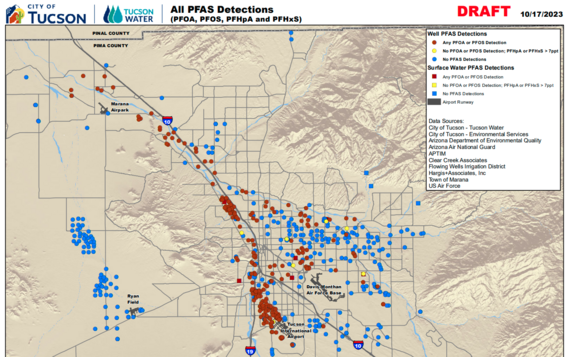
This map shows the extent of the pollution – the red dots show where we’ve tested and found evidence of PFAS contamination.
PFAS is actually an acronym that broadly encompasses 6 different compounds, each of which is being detected in varying amounts in both our groundwater and in water wells. We’ve shut down over 20 wells in order to contain the spread of the chemicals. None of the water that Tucson Water is serving to our customers is tainted with PFAS.
Right now, the EPA does not have any enforceable contamination levels for PFAS. They are currently studying the issue and are expected to announce some Maximum Contamination Levels (MCL) by the early part of this year. A year ago, they issued a health advisory (non-regulatory – just the EPA giving you a head’s up to be aware) for PFAS of 4 parts per trillion (ppt.) They later revised that down to a level so low that even their own approved testing methods cannot detect it. The message they sent was that if you can detect any PFAS, you should take the potential health effects seriously.
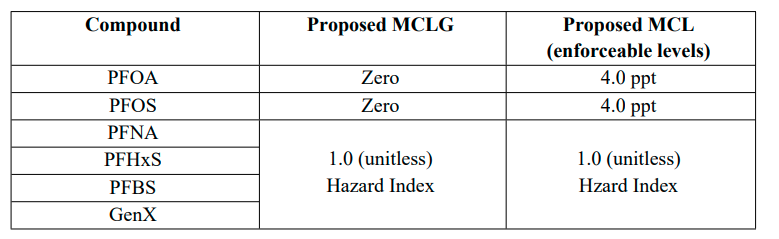
Currently the EPA is considering issuing two different contamination level standards. This table shows what’s under consideration:
What I have already objected to is that EPA is about to set the regulatory, enforceable MCL at 4x the level they’ve already told us we should be concerned about from a health perspective. Note in the table – there’s a column titled Proposed MCL. That’s the legally enforceable level if the rule they’re proposing is adopted. It’s at 4ppt. However, the ‘Proposed MCLG’ is zero. What’s that column? The title stands for ‘Maximum Contamination Level Goals.’ The difference between the enforceable MCL and the advisory MCLG is that the “goals” level is strictly a health-based level. They’re factoring in financial impact when setting the MCL.
The public comment period on this rulemaking ended last June. I had the link in newsletters throughout the spring. Now if you’d like to voice your concerns (or support) of the direction this issue is headed you need to reach out to our congressional delegation. The EPA will likely have their MCL levels adopted before this summer, so if you want to weigh in, now’s the time to do that.
In the meantime, we’re about to begin construction of a treatment facility that’ll be located at the north end of the midtown plume. You’ll see it around the Broadway/Randolph Way intersection. The goal of that facility is to limit the movement of the plume in the direction of our central well field. That’s all good, and the ADEQ has been a good partner in helping to move that project along. But if the allowed exposure level is higher than what the EPA earlier said was of concern then one has to wonder the efficacy of the money being invested into treatment. If you’re so inclined, please join me in advocating with our federal delegation to resist the proposed MCL for PFAS and require the EPA to adhere to their own health advisory levels – not trading public health for industry profits.
Iskashitaa Social Justice Scholarship
Over the past decade we at the ward 6 office have partnered with Iskashitaa on numerous projects related to our refugee population and Iskashitaa’s work supporting them. Now I’m pleased to help them promote their Jim and Robbie Dick Memorial Social Justice Scholarship. It’s being awarded to one Tucson area high school senior who has been active in promoting the values of peace, social justice, human rights and cultural understanding. I know they’ll get a bunch of very quality applicants.
The $5,000 award will go to a local youth who has been an active volunteer in spreading those values. The money may be used to help fund the costs of college, community college or a trade school. The deadline for completing the application is April 1st. You can use this link to get all of the information on how to apply: https://www.iskashitaa.org/scholarships-1-1 and if you’ve got more questions about eligibility, you can contact the Iskashitaa folks at iskashitaascholarship@gmail.com. The winner will be notified by May 1st.
Heritage and Cultural Survey
And while you’re online filling out forms also take a moment to let us know your priorities in the area of our local heritage and culture. With this link https://somosuno.tucsonaz.gov/ you’ll find a short survey instrument you can use to share your thoughts on what makes Tucson and our region unique from a cultural perspective. We’re also working with the folks who are gathering the survey data and will be hosting some small neighborhood-scale ‘coffees’ to get some more personal contact.
Our heritage and culture is expressed in many ways – architecture, food, music, faith traditions, art and much more. They all weave together to form the fabric of who we are. I shared with the survey folks the importance of also looking at who we are through Tucson and Pima County’s involvement in the film industry. There are a lot of ways heritage and culture can be passed on and celebrated. The survey is our first step in gathering data that will help guide us in how to better promote the ‘who we are’ message. Our friends at Visit Tucson will be able to use this information in their work marketing the region. Thanks for participating. The survey will only take a few brief moments to complete.
Planning and Development Services Survey
One final survey – this one comes from our Planning folks. It’s a tool they’re using to get information on how they can improve – or build upon things they’re already doing well – to improve our services to the development community. Time is money in the development world. While we’re attempting to build efficiencies into our internal processes to enhance affordable construction, this tool will serve as important information guiding that effort.
You can either click here to open the survey or scan this QR code and it’ll open for you.
Without gathering and acting on input from our customers we can’t improve. The survey touches on customer service, the PDSD website and tools you find there. We get phone calls about process improvements we might consider. This survey is a way for you to share those ideas directly with our planning staff. |
|
 |
Tucson Wildlife Center
If you follow this newsletter, you’ll know we at the ward 6 office are big supporters of the work Lisa Bates and her team of staff and volunteers does out at the Tucson Wildlife Center (TWC.) They take in all sorts of injured and sick wildlife, nurse them back to health and release them back into the wild. This isn’t an adoption program, but one in which the entire goal is to reintroduce our wildlife back to their original habitat.
The cost of providing that work is nearly $2,000 per day. They’ve been doing it since 1998 and the work is funded largely through donations. It’s the only full service and state-of-the-art wildlife rescue hospital in all of Southern Arizona. Coming on Sunday, February 25th the TWC is hosting their 12th annual fund raiser – a big event that everybody who cares about this important work is invited to attend. It’s goal as a benefit is to raise the much-needed funding so they can continue their work.
TWC receives no state or federal assistance for their work. And they provide it free of charge to anybody who drops an injured critter on the doorstep. They get them from all 8 counties throughout Southern Arizona. It’s a big and an important job. They touch roughly 4,000 injured or orphaned animals each year. Here are a few examples of critters they’ve cared for just in the past year:
A baby ringtail trapped in construction equipment.
• A coatimundi hit by a car.
• A great horned owl that was poisoned.
• A bobcat kitten found by landscapers.
• Exhausted seabirds blown in on hurricane winds from the Sea of Cortez.
• A red-tailed hawk that suffered an electrical injury on a power pole.
• A raccoon cub left behind in a chimney when his mother was frightened away.
The event is going to be held at Loews Ventana Canyon Resort. This flyer has all of the information. I’m happy to be providing music during the silent auction and mingling portion of the event starting at 4:30pm. Come early and say ‘hi.’ It’ll be great seeing another full house this year for the event.
 Tickets are available for purchase at https://tucsonwildlife.com/
Sculpture Tucson and Reid Park Zoo
If you’re out on the loop at Dodge you’re seeing Brandi Fenton Park on the north side of the path. You can also reach it from Dodge or River Road. At the west end of the park you’ll notice several large sculptures – they’re the work of Sculpture Tucson.

Sculpture Tucson is a non-profit whose mission is to create a hub for the display and appreciation of the arts through sculpture. Their office is right out at the sculpture site at the park.
Coming on March 15th, 16th and 17th they’ll be hosting this year's Sculpture Festival. Please mark your calendar now and make time to see these wonderful works. The variety, creativity and talent you’ll see is amazing. I jog past there at least a couple times each week and enjoy seeing the work from the path or River Road.
|
One special treat this year is this work being provided by local artist Pat Frederick. The elephant is named La Profesora – as you can see, she comes without tusks. La Profesora has an educational component. In the wild both male and female elephants have tusks. That is until they’re poached for the ivory. Pat’s work is both an art piece, and an educational piece teaching about the plight of elephants internationally. It’s great that Sculpture Tucson is making La Profesora a part of this year's show.
 |
Shortly after the sculpture festival La Profesora will be relocated to the entryway of Reid Park Zoo. It’s a perfect way to sensitize zoo visitors to the importance of the international elephant conservation work the Tucson Zoological Society in partnership with Reid Park Zoo is involved with. So, enjoy the sculpture festival, and find La Profesora outside the zoo – and spend some time at the wonderful elephant enclosure appreciating the conservation work our local zoo and their partners are involved with.
Cease Fire Everywhere
For the past month we’ve been getting people purporting to represent ‘the Jewish community’ speaking at call to the audience. They’re asking M&C to adopt a ‘cease fire’ resolution, calling on Israel to stop bombing Gaza. I met with one of the groups who has been making that request and explained that any resolution I signed would have to be balanced. That is – everybody stops bombing everybody. I won’t sign a one-sided resolution. I thought we had all agreed on that concept but in the past week I’ve had no fewer than 7 contacts from members of the Jewish community asking if I was going to be proposing a cease fire resolution. I had 3 more exchanges on the topic over the weekend. You see there’s a stark divide even within that community on what such a resolution should contain – if one is desired at all.
To everyone who has reached out I’ve told them I won’t sign something that’s not balanced. I’ve also added that my grandfather on my dad’s side (Kozachik) grew up about 20km from Kiev. And I’ve wondered where the outrage has been for the past 2 years over Putin bombing the life out of civilians in Ukraine. So, I wrote the resolution you can read below and sent it to both the group who has been coming to call to the audience and to the various others from the broader Jewish community. I’m sharing it here because I’m done answering the questions/phone calls/texts. Now if someone wants to see what I’ll support I’ll just refer them to the newsletter. If anybody else on the M&C wants to bring this forward, I’ll happily sign on. To date that has not happened – so this is simply my own statement. Otherwise, I’m done answering the question about some resolution I’ve supposedly been crafting. Here it is.
Whereas international conflict is occurring daily throughout the world
And Whereas the loss of human life, including civilian casualties is tragically incalculable
And Whereas all too often extreme orthodoxy is both the catalyst of, and the reason conflict continues
And Whereas ironically all major religions contain some form of tenet that mirrors the call to treat others as you would want to be treated
And Whereas the toll of human lives lost is intensified by the immense power and destructive potential contained in modern weaponry, placing the world at the brink of unimaginable consequences
And Whereas the continual killing of innocents throughout the world is an unfortunate and unnecessary condition of our shared humanity
And Whereas the Tucson mayor and city council share the common values of respecting human life, respecting the diversity in belief systems throughout the world, and a concern for where the trajectory of international conflict may lead.
Now therefore we, the City of Tucson mayor and city council support and join the voices worldwide now calling on all parties in all conflicts worldwide to lay down their arms, stop the killing and search for areas of common ground.
Sincerely,
Steve Kozachik
Council Member, Ward 6
ward6@tucsonaz.gov
City of Tucson Resources
|