Date: 12/11/2023
Topics in This Issue:
-
Billy Sassi
-
Plastics Program
-
Capstone and West University
-
Homeless/Migrant Needs
-
311 System Launch
-
Neighborhood Support Network Data
-
Grevy’s Zebra at Reid Park Zoo
-
Dementia and Assisted Living
-
Giggle Switch
-
Southern Arizona Transportation Museum
-
Senior Olympics Registration
-
Flu, RSV, COVID
-
Downtown Parade of Lights
-
Sustainable Tucson
-
Fitz
Christmas Quiz – can you identify these? I’ll share the answer in a section below.
Billy Sassi
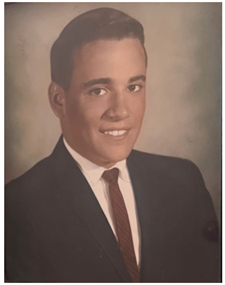
If you knew Billy it’s likely that you never saw him dressed quite like the picture. In fact, either swim trunks and/or a Hawaiian shirt was more the style. Billy was a Tucson Parks & Rec employee for 40 years, retiring in 2022. He trained thousands of lifeguards and water safety instructors – and more importantly he developed close relationships with many of them. Billy passed away last week. I know many will be surprised and saddened to learn of the loss. His memorial was held last Tuesday at East Lawn. If you ever swam at the Catalina High School pool, you knew Billy. The Catalina High swimming pool is owned by TUSD. I’ve got an email out to some of their administrators asking what the process would be to name the pool in Billy’s honor.
Plastics Program
Each week we’re collecting between 5 and 6 tons of your donations. The streets were repaved around ward 6 last week and even with that little added hike to get to the rolloffs the total count didn’t drop off a bit. Thank you for your faithfulness to the program.
During last week we had contact with people from the Tucson Botanical Gardens, an Eagle Scout troop, another HOA wanting some ideas on how to start up a program at their property and the ongoing influx of emails from many of you sharing articles you’ve found on the topic of plastics. On Friday Nadia and I joined representatives from 3 local Rotary Clubs out at Casa Alitas. The purpose was to allow the volunteers who serve at Alitas to share the work they’ve done in starting up a plastic collection program out at the shelter.
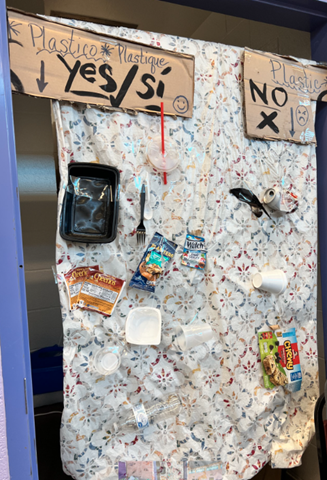
Meals served at Casa Alitas are boxed in plastic, and they’re served with plastic utensils. You can see some of them hanging on this informational board that was made by the volunteers:
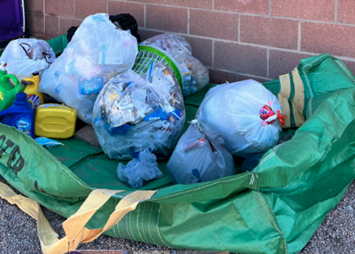
Everyone served a meal at the shelter is now putting their used plastic into a collection bin. That bin is brought to the ward 6 plastic rolloff and will end up being a part of our local block-producing product. Here’s a small Casa Alitas load getting ready to make the trip to our office:
We’re grateful to the Casa Alitas volunteers and to the Rotarians who worked together to put the logistics of this program together. It can be replicated easily in any business or non-profit setting in the community. What cannot be easily replicated is the work being done out at the shelter. They’re taking in families – over 1,000 new arrivals daily. Without the county, volunteer and Catholic Community Services staff all pulling in the same direction, Tucson would have seen street releases of migrants by now. The plastics program making its way into the shelter is one tiny example of how the volunteers are including the Alitas work with the broader community.
Ok, back to plastics. One report that was shared with me last week was issued by the Organization for Economic Cooperation and Development (OECD.) That’s a coalition of 37 democratic countries who are joined together working on policy issues that are of mutual interest. In this case it was the proliferation of plastic waste worldwide.
The problem of plastic pollution is captured in the reality that every year over 20 million tons of plastic waste feeds into the world's oceans, rivers and lakes. That’s the equivalent of 2,000 garbage trucks full of plastic being dumped into the ocean every single day. And the OECD study anticipates the problem only getting worse. This graph shows their projection – the amount of plastic pollution is expected to triple by 2060 if we simply continue on as we are.
Currently, less than 20% of the plastic that’s produced is recycled. That’s according to the OECD report. I’ve seen others that have that figure much smaller – around 5%. But even at the OECD number that means 80% of the plastic we produce is going into landfills, oceans and the side of the road. And the bulk of what’s ending up as waste is in the form of single use items such as packaging and low-cost products.
We can each do our part by reducing or eliminating our use of single use products. Take your own cloth bags to the grocery store. Take your own carry out containers to restaurants. And continue collecting your plastic and bringing it to us for use in the block program. While our combined efforts won’t move the international needle, we’re setting an example that if followed by others could make a difference in the mess we’re collectively creating.
One of our plastics partners is the Assistance League. They’re located about a block north of Speedway on Alvernon. They do great work out in the community helping people with household goods, and providing bags that include the basic necessities for families just getting started in a home setting. They’ve been regulars in the plastics program since we began it as a pilot.
Assistance League is partnering with the Tucson Roadrunners hockey organization for a fund raiser that’ll benefit the League. During the hockey game there’ll also be a 50/50 raffle that will benefit them. You can get tickets for the game at a discount by either heading over to the League offices on Alvernon, or going to their website. Either way you’ll see more than a 50% reduction in the ticket price.
The game will be held on Saturday, December 16th. They drop the puck at 7pm. You can find the Assistance Leage website at this link: www.altucson.org.
Capstone and West University
On Tuesday I’ll be asking M&C to join in supporting the culmination of a very long and somewhat complex process for the redevelopment of the SE corner of Speedway and Euclid. Right now, there are several older houses on the corner. They’re contributing historic structures in the West University historic development zone. And they’re all slowly falling apart – it's what is affectionately termed ‘demolition by neglect.’ A part of the Capstone project will include the preservation of the houses.
Credit for getting this project across the finish line goes to the West University board and neighbors, including those from surrounding neighborhoods, the Capstone development group, Joel Ireland and his team, and our housing department leadership. There has been a lot of time invested into the multiple moving parts of this project and it’ll be nice to see it finally cross the finish line.
This is a rendering of what was first proposed. You can see Capstone wanted to come in and just build another box-like structure framing the Speedway/Euclid corner. The wall of buildings running south along Euclid is what the WUNA folks would see across the street. Early on we let Capstone know that was a non-starter. They understood and worked to find solutions.
When the M&C adopted the Main Gate overlay back in 2012 one commitment made to WUNA was that Euclid would serve as a buffer between that neighborhood and the towers being built to the east. The wall of buildings shown in the initial rendering is not a buffer. Through a series of meetings this is a rendering of what’s being voted on tomorrow:
What’s not entirely clear from the picture is that along Euclid now there will be a line of 2 story workforce housing units, each stepped back from the right of way to allow for wide pedestrian space. Capstone is not in the workforce housing business, but they’ve included 30 units in this project as a way of addressing my request for something non-student, and affordable, and as a way of addressing the ‘buffer’ and massing concerns. The units will be made available for people earning between 80% and 120% of the area median income and none of the tenants will pay over 30% of their income on rent.
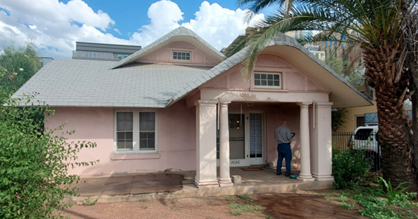
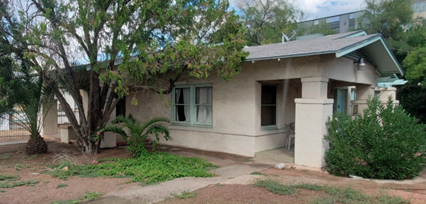
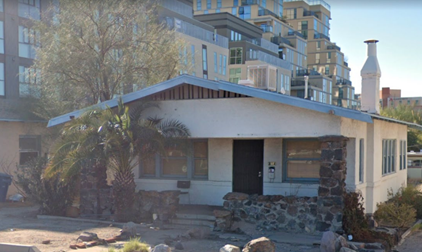
The rest of the site will include 114 student housing units. The heights will range from 24’ up to 78’. Capstone is going to relocate 5 of the historic homes that are right now sitting on that corner onto a parcel located in West University – the same historic district so WUNA doesn’t lose them as contributing structures. One of the existing houses is in such bad condition that it is just going to be demolished. Here are a few of the houses that will be moved – just to give you a taste of the effort being made to facilitate this project.
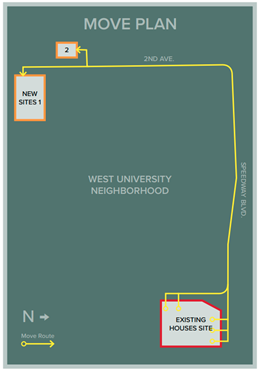
I mentioned Joel Ireland up above. He owns some land in WUNA and it’ll be on his property that these houses will land. He’s working with Capstone on a financial agreement through which he’ll restore the houses and use them as rentals. This is the route they’ll travel to get to their new resting place:
Capstone has signed a Community Benefits Agreement with West University through which a couple thousand feet of sidewalks and ADA ramps will be installed within the neighborhood. A part of our agenda material for Tuesday is also going to be a development agreement Capstone is signing with the city that will put into place the commitment for the workforce housing, a payment agreement to our housing department to do annual monitoring of the tenant qualifications, and a security agreement between Capstone and TPD. As I noted, there are a lot of moving parts to the agreement.
One important aspect to the agreement is that it may have some nexus to how the NW corner of Speedway/Euclid is developed. While the built environment in the immediately adjacent area is not identical, certainly the concerns over encroachment by student housing towers, the existence of contributing historic properties, massing and all the rest that comes with new residential development are present. We’re at the early stages of working out a solution to ownership on the NW corner. Having this robust and multi-faceted development agreement with Capstone should serve as a nice prelude to what kinds of conversations happen in those parcels kitty-corner across Speedway.
There will be other student housing developers who want to bring their product into our market. They should look at the Capstone set of agreements as a starting template.
Homeless/Migrant Needs
Each year HUD requires that we conduct a regional Point in Time count of the homeless population. I referred to it in last week’s newsletter. The Tucson Pima Coalition to End Homelessness (TPCH) is conducting this year’s count.
The count will take place on the morning of Wednesday, January 24th. It’ll run from 6am until 11am. The TPCH team is recruiting volunteers to help with the count. They’re after about 300 people to come and take part.
All volunteers will be required to take part in a 2-hour training session ahead of the 24th. That training will mostly be done in small groups, and in person. By special request they’ll try to accommodate requests for virtual training. During the count all volunteers will be asked to wear a mask, and to be current on your COVID 19 vaccinations. If you are not vaccinated, or you don’t want to wear a mask they can still find ways – other than being out in the field counting – that you can help.
The street count will be done using an electronic app. That’s what the volunteers will be trained in using. You don’t need a smart device in order to take part, but you will be assigned to a group in which at least one person has one to use. Thank you in advance for those willing and able to get involved with this. Everyone reading the newsletter is aware of our homeless situation. This is one way to help get those in need to the services that can benefit them. You can register for the count here:
Our collection needs continue to be shampoo, sunscreen, lotions, toothpaste/brushes - generally hygiene products. Also, cool weather clothing, new socks and underclothes. While we were out at Casa Alitas last week, I noticed they might also be running short on shoelaces. We at the ward 6 office, and the county folks, CCS and volunteers out at Alitas continue to be grateful to everybody who is taking part in this ongoing donation process. And whatever doesn’t make its way to Alitas will find a home at one of the city housing shelter operations.
311 System Launch
When I was first elected in 2009, we had discussions around the M&C table about how to stand up a non-emergency line for people to call, avoiding clogging up the 911 system. Last week, after significant investment and work by our Public Safety Communications Department staff, I.T., TFD, TPD and our executive leadership team across all departments, the 311 system is finally up and running.
The purpose of a 311-call line is to allow people a non-emergency way to get information or assistance with city services. An example might be simply getting help with a water bill adjustment. Or calling about how to address a homeless camp nearby. Those are not 911-types of calls and to rely on the emergency line simply ties up that call-taker while other true emergency calls are waiting.
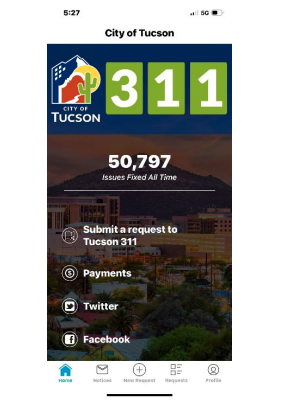
Since this is not an emergency line each call taker can spend more time with callers than is the case at 911. And because calls may take a bit longer to sort through the commo department is providing more than one way to connect with 311. Of course, simply dialing that number is the first. In addition you can access 311 by using the online platform. You can find that at www.tucsonaz.gov/311. And finally, there’s a 311 app that’s available in both Google and Apple stores. That app allows you to both report and to track the progress of items you’ve reported. You access it by opening the See Click Fix app. You’ll see the 311 option on the screen:
 |
Our regional 911 center has received some significant upgrades. The call takers are well trained and ready to help you with your emergency calls. The implementation of the 311 center is going to be a huge help to the emergency system, decreasing wait times at 911, and giving callers with non-emergency needs a more appropriate way to secure city services. The city manager’s team deserves a ton of credit for working through the logistics of getting this up and running. And of course, constituent services remain a top priority at ward 6. Feel free to call or email to us anytime we can help you weave your way through the city system.
Neighborhood Support Network Data
On a similar note, in recent newsletters I’ve shared that Don Ijams – creator and keeper of a significant data set related to neighborhood code enforcement and police reports – is stepping away from his work maintaining that site. A replacement has stepped forward – thanks to Harold Hallikainen, one of our ward 6 Mitman neighbors. Harold has merged all of Don’s data into a new replacement site. You can access it here: https://neighborhood.w6iwi.org/ Just click the link, click on the neighborhood you want history of calls about and the information will pop up.
Many thanks to Don for his hard work, and now to Harold for getting involved and helping to preserve all of that effort.
Grevy’s Zebra at Reid Park Zoo
When my bride and our little girl and I travelled to Africa on our game safari, these critters were all over the place. They’re Grevy’s Zebras. Our trip was over 20 years ago. What was easy to spot back then is now endangered.
Our trip was to Kenya. Between Kenya and Ethiopia there are only about 2,000 Grevy’s left. You might note that Anna, in the picture shown above is a little on the plump side. Yes, the zoo keepers are getting her enough exercise and the right diet. They also provided Anna with Ben – and yes, Anna is carrying her 3rd baby. Given that Grevy’s are falling so drastically in numbers, being able to successfully breed is a big deal.
Anna will give birth early next year. The Zoological Society has also added Zuri to their stock at the zoo. She’s another mature female and also an experienced mother. She’ll be helpful to Anna once the new baby is born. Ben won’t be disappointed either.
Stop by the zoo during the holidays. You can find out all of the holiday activities they’ve got going on by using their website: https://reidparkzoo.org/
Dementia and Assisted Living
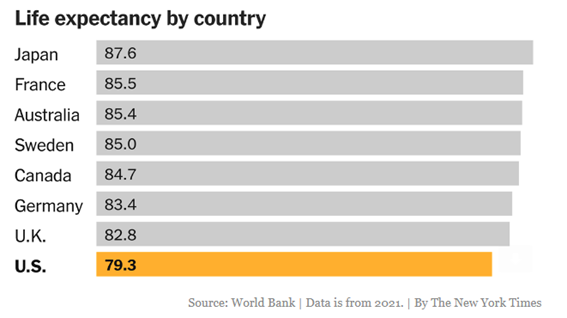
On a fairly regular basis I try to include items about the aging process, health care support and related items. Our friends at Pima Council on Aging (PCOA) sponsor several programs through which seniors, caregivers and families can get instruction and support. One area where PCOA can’t pull a rabbit out of a hat though is in the cost for health care. In the U.S. we’re far and away the international leaders in cost. The outcomes aren’t what you might expect though.
The NYTimes had a good review of health care costs by nation, and a comparison to life expectancy. This chart shows how much Americans spend on their health care on an annual basis – with our peer countries also listed. We’re almost double Germany, the second-place nation.
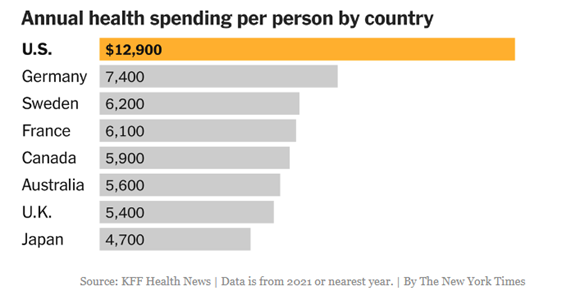 |
The Times’ analysis as to the reasons for the increased costs in the U.S. showed that we don’t spend more money because we’re sicker than the rest of the developed world. It’s that just about every form of care we receive is more costly. Our doctor’s visits, our hospital stays, our drug prescriptions and surgeries – all cost more than in comparison countries. The survey noted that the American health system puts the premium on maximizing profits for private health care companies, and the loser is the family budget. I was in Walgreen’s over the weekend and overheard a lady speaking to the pharmacist about a $450 charge for her prescription. Without the insurance it would have been $1,100. Small comfort – she was still out the $450.
One prime example of a niche in our health care system that is out of control expensive is assisted living. It’s no mystery that we have an aging population. Boomers are aging out of the workforce, and into retirement. I know several examples of people who are wrestling with the challenge of maintaining in-home living vs stepping towards assisted living facilities. Even for simple daily activities such as dressing, grooming, cleaning and cooking the costs associated with a care facility just for those non-medical services are extreme. And too often they’re a la carte – you pay for each ‘service’ you check on the menu when you sign up.
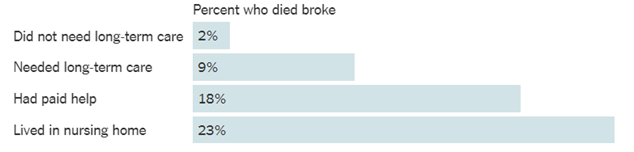
Check out this graphic. It shows the outcome for people who had savings of between $170K and $1.8M when they turned age 65. Living in a nursing home caused roughly a quarter of them to die broke.
If you’re working through caregiving, and the debate over how to maintain in-home living vs other forms of assistance, please consider reaching out to PCOA for some guidance. They can’t fix the cost piece, but they are familiar with options and training you can access that could help make your decision-making process more informed. You can reach them at 520.792.7262, or through their website at https://pcoa.org/
Oh, and the success we see from our doubling in cost for health care? This table shows those results. Please stay well.
Giggle Switch
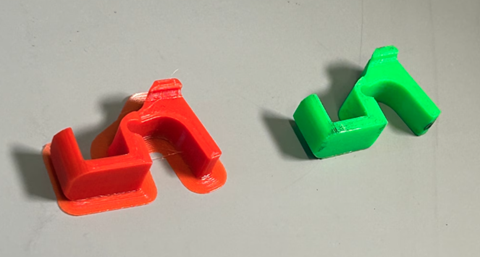
I opened with this picture. Have you had time to think about what it is? It’s called a switch, or a giggle switch. It’s also called a sear, or a Glock switch. The gun-maker Glock does not produce them.
A giggle switch can be made with a 3-D printer. It takes about 45 minutes to crank one out. So what are they used for? They’re small switches that you can install in seconds to a gun and turn that weapon from a semi-automatic into an automatic. Instead of you having to pull the trigger for each shot, the switch holds the trigger in position so the rounds are discharged in the very same manner that an automatic weapon fires the bullets. Here’s an example of one that’s sold online – the logo indicates that Glock is the manufacturer. It’s fake. These are not produced by gun makers. The BATF says the device is illegal.
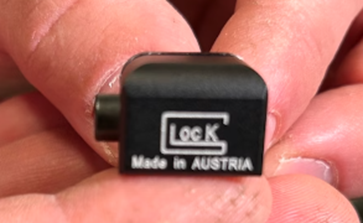 |
The switch is about the size of a playing die. They can be made of either metal or of plastic. They can be used on pistols, or long guns such as the AR-15. The BATF says they’ve confiscated over 5,400 of them in the past few years. Please consider writing or calling members of Congress to let them know that yet another way to create carnage is creeping into our cities. And if you’re a parent be sure your kids understand what responsible gun ownership, handling and storage involves. Gun control can be achieved without violating 2nd Amendment concerns.
Southern Arizona Transportation Museum
 |
|
It’s time to start marking your calendar for upcoming holiday events. One that is truly family friendly, fun and also educational is happening downtown at the historic train depot. Coming on Saturday, December 16th from 10am until 2pm the train guys will host the 18th annual Holiday Express.
|
The event takes place at the depot – 414 N. Toole. There will be live action displays, a reading of The Polar Express, holiday music sing-alongs, letter writing to Santa, and he just might make a personal appearance during the course of the event. There’s parking right at the depot. Thanks to those who continue to work in support of the historic train museum, and for their work in bringing these events to the public.
Senior Olympics Registration
This reminder – the deadline for registering for the Tucson Parks/Pain Institute of Southern Arizona Senior Olympics is on Friday, December 29th. To be eligible you must be 50 years or older. The events will take place at a variety of locations throughout the city between January 6th and January 28th.
Senior Olympic events include archery, volleyball, basketball shooting, racquetball, pickleball, and some more sedate activities such as bridge. You can register by using this site: festival website If you’ve got questions about signing up, please call the parks folks at 520.791.4877.
Flu, RSV, COVID
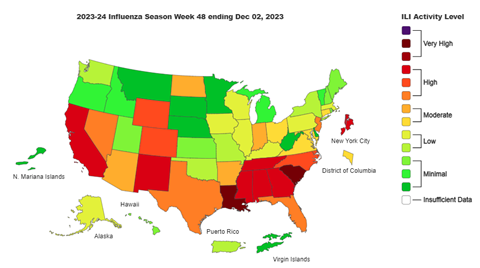
Flu infections are now in the high category in Arizona. This map shows how it’s spreading across the south and southwest. We’ve gone from ‘minimal’ to high in just the past week. Please be careful in crowds, get your flu vaccination and stay home if you’re sick.
I was down for 3 days last week. It wasn’t the flu – there are also respiratory germs floating around. The holidays are almost here. Please don’t blow it for others by taking your infection out into public places. And despite myths to the contrary, masking with an N95 mask is still an effective tool to use in crowded spaces.
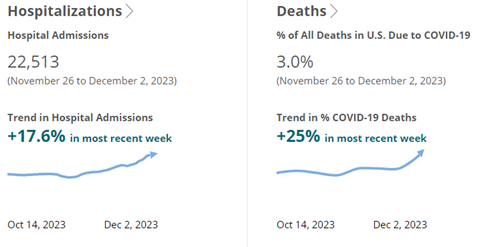
COVID case counts are increasing nationally. This is a CDC graphic I pulled from their site over the weekend. What it shows is that for certain vulnerable populations, COVID continues to be a potentially severe illness. Consider a vaccine booster if you’re in one of the groups who could be hit hard by the virus. In Pima County we’re averaging about 110 new cases per week. While that’s far below the pandemic heights, it’s still a big number, especially if you’re in a group that could end up hospitalized from the stuff.
It’s the holidays – think of others before you take your infections out into public.
Downtown Parade of Lights
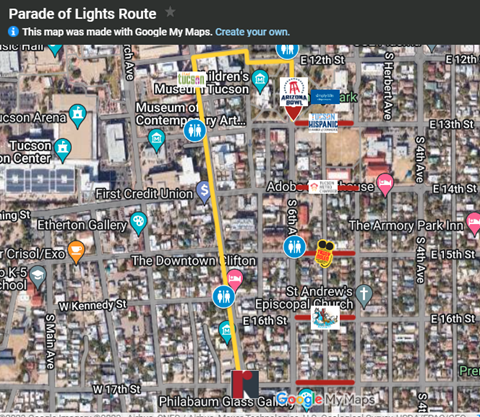
The downtown holiday parade of lights is coming on Saturday, December 16th. This is the 29th annual edition of the parade. The route is familiar – generally around the Armory Park/Children’s Museum area. The parade begins at 6:30pm, but you’ll see road closures well ahead of the starting time.
The parade will begin on 17th Street and Stone. If you’d like to watch it go past you can join the thousands of people who line the route each year. Bring your own lawn chair, or just sit on the curb. This map shows the route – there's plenty of room to watch, and there’ll be food trucks with warm goodies at the park for spectators to enjoy.
Sustainable Tucson
 |
|
On Tuesday evening Sustainable Tucson has invited Karen Wilhelmsen from the Pima County Department of Environmental Quality to join them in a discussion about gas-powered lawn maintenance equipment. The meeting is again by zoom and can be accessed through their website: www.sustainabletucson.org.
|
In a study published by the U.S. Public Interest Research Group, with support from Environment America and Frontier Group they make the point that in the U.S. gas-powered lawn and garden equipment releases a significant amount of carbon dioxide into the atmosphere each year. You can see the full report at this link:
“Lawn Care Goes Electric”
https://publicinterestnetworkI.org/wpcontent/uploads/2023/10/Lawn_Care_Goes_Electric_Oct23.pdf
That report will form the backdrop for Karen’s presentation. It will be followed by a Q&A/discussion.
Fitz
It’s fitting that I’m closing with this because the event was the closing of Dave Fitzsimmons’ public appearance career. On Saturday my bride and I were very much honored to be included in the full house at the Rialto for Fitz’ final public event. He has been producing the Arroyo Café show for 9 years. This will be his last.
That’s Fitz off to the left. Throughout his career he has drawn over 10,000 cartoons, published internationally and for which he was named a Pulitzer Prize finalist. In Tucson we know his work well. As a result of his work as an emcee, auctioneer and/or event host, Dave has helped to raise more than a million dollars for local charities. On Saturday the proceeds went to Doctors without Borders. It was great to be involved with the event – and even more so it has been my honor to be able to call Fitz a friend. We’ll miss his work. Thanks for making us think, and laugh.
Sincerely,
Steve Kozachik
Council Member, Ward 6
ward6@tucsonaz.gov

City of Tucson Resources
|