A Complete Streets Approach to Climate Resiliency.
 The Department of Transportation and Mobility (DTM) is currently taking actions to achieve a climate resilient-city, leading the way to reduce greenhouse gas emissions to support sustainable development for everyone. Climate Resilient Development isn’t achieved with a single decision or action. It’s the result of all the choices we make about climate risk reduction, emissions reductions, and sustainable development on a daily basis. DTM continues to implement policies, programs, and pilot projects, to become more climate resilient and keep Tucson green and clean.
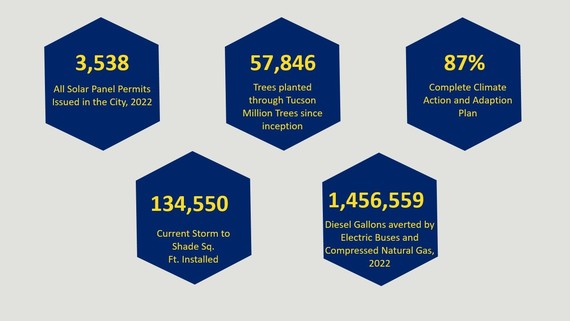
Sun Tran, Tucson’s public transit service, was the first public transportation system in Arizona to launch electric buses in 2021. Their goal is to replace all-diesel buses with either electric or compressed renewable natural gas buses by 2028. Sun Tran, received $12 million from the federal government to purchase 19 electric vehicles and 10 charging stations (August, 2022). The City of Tucson, Tucson Electric Power, the Pima Association of Governments, and the Regional Transportation Authority also contributed money to bring the total amount for this project to $15 million. The Federal Transit Administration’s Low or No Emissions Grant was used to purchase 10 electric buses for Sun Tran, in addition to the vehicles, the money was used to install five dual-sided charging bays at the Sun Tran north yard. Sun Tran, will continue to procure additional busses for Sun Tran and Sun Van as part of this program.
DTM became part of Global Cool City Alliance Cool Roadways Partnership in 2019. Excessive Heat is a major urban challenge. The need to protect people from extreme heat is one of the key resilience and sustainability challenges of the 21st Century. The department began meeting with vendors that are also part of the alliance to discuss and understand their products, that claim to reduce surface temperatures and reduce heat island affects by reflecting the heat off roadways. These products were also a rejuvenator, much like a traditional fog seal for the existing asphalt, to extend the life of roadways.
In December 2021, DTM conducted a pilot project on South Country Club Road from Broadway to Aviation Highway. An application of PlusTi from Pavement Technology Inc, was applied to all travel lanes and bike lanes on Country Club Road.
DTM partnered with the University of Arizona, College of Architecture, Planning & Landscape Architecture in a grant through National Institute for Transportation and Communities. The University performed pre and post studies, collecting data relevant to surface temperatures, ambient air temperatures, wind speeds, and weather conditions. Once pre and post data is collected and compiled, it will show whether there was a reduction in surface temperatures, ambient air temperatures, and a reduction in heat island effects. The overall project size is 47,400 SY of roadway, 1.60 lineal miles, 6.33 lane miles
In years to come, DTM will continue to monitor and collect data to show how the product is holding up, whether it continues to have results as indicated in the Universities studies.
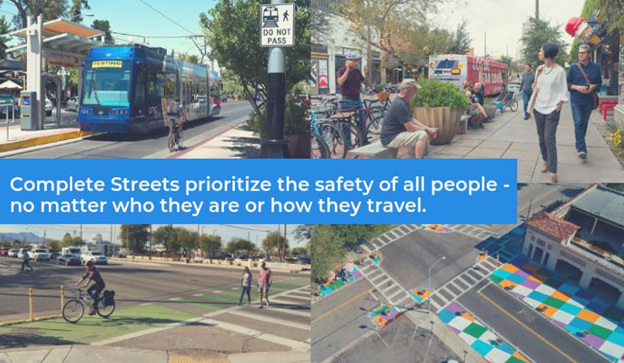
Complete Streets are streets designed and operated to enable safe use and support mobility for all users. Those include people of all ages and abilities, regardless of whether they are travelling as drivers, pedestrians, bicyclists, or public transportation riders. The concept of Complete Streets encompasses many approaches to planning, designing, and operating roadways and rights of way with all users in mind to make the transportation network safer and more efficient.
The desired outcome of a sustainable transportation system includes making walking, cycling, and transit commonly used and enjoyed in every Tucson neighborhood. This is being accomplished through two key actions:
- Creating more greenways and bikeways in historically underrepresented locations throughout the city
- Creating walkable bike paths, greenways, and vibrant rest areas
- Encouraging walking and biking, and expanding mass transit
- Lowering the carbon intensity of the current transportation system by:
- Developing policies, such as, Complete Streets,
- Encouraging environmentally friendly transportation modes and providing infrastructure for electric vehicles and low carbon fuel vehicles.
To reduce vehicle-related collisions with cyclists, bicycle-only lanes that clearly distinguishes boundaries by using vibrant green colors painted on the roads and median traffic calming installations are added. By not allowing through traffic on roads, this gives opportunities for the cyclists to move and cross major streets or even neighborhood streets safely. These traffic calming installations include raised medians, chicanes, or edge islands. The installation of the traffic calming devices is also an opportunity for green infrastructure, which provides many benefits such as shade/reducing UHI’s, improved air quality, rainwater harvesting devices/retainage, and neighborhood beauty.
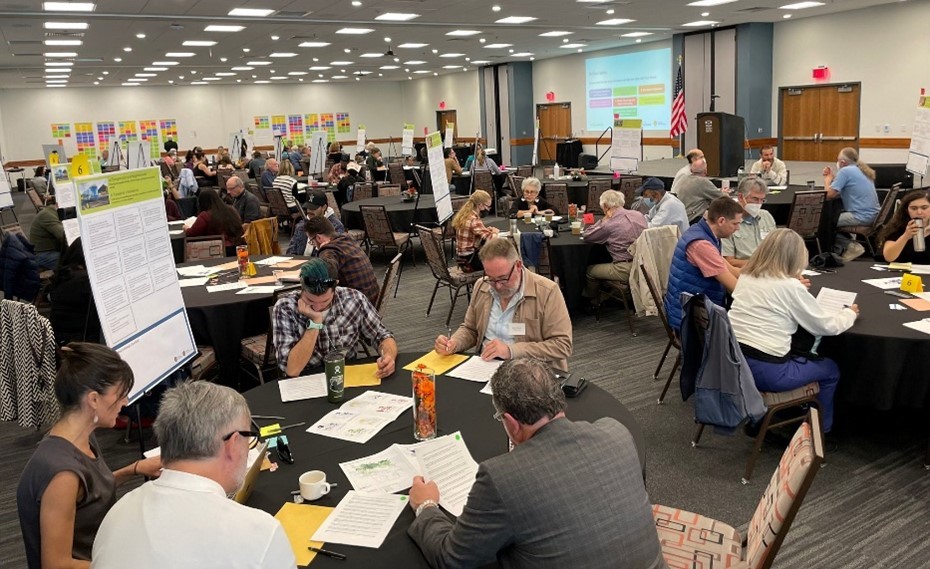
With these long-term desired outcomes defined, planning is underway to identify additional short and mid-term goals and metrics. Along with environmental metrics, additional social and economic goals are being considered that would best articulate the community's desired outcomes to become a socially, economically, and environmentally resilient city.
The Department of Transportation and Mobility converted ~22,000 streetlights (roadway lighting) from HPS and LPS to modern LED, completed in 2018. Luminaires communicate through a wireless network that allows for system monitoring, dimming capabilities, and energy usage data.
When all lights were installed, they were dimmed to 90 percent brightness. To compensate for Lamp Lumen Depreciation (LLD) and Luminaire Dirt Depreciation (LDD), the city will increase the brightness proportionately.
- Intersections and crosswalks are dimmed to 90 percent of total output, at all times.
- Most other lights are dimmed to 90 percent upon first illumination (dusk), and then dim to 60 percent at midnight.
- High pedestrian areas around the university, downtown, and the streetcar route are dimmed 90 percent upon first illumination (dusk) and then dim to 60 percent at 3 a.m.
Additional information, traffic signals were also converted from incandescent to LED approximately 10-15 years ago, with red and green converted first and yellow some years later.
|