 Board passes $1.8 billion budget for FY 2027
Addresses priorities for health, safety, and prosperity of County residents
PIMA COUNTY June 24, 2026 – Using the new Strategic Plan and the Prosperity and One Pima initiatives as guides, the Pima County Board of Supervisors June 23 adopted the County budget for fiscal year 2027, which begins July 1. The budget funds key Board priorities called for in the planning documents, including infrastructure, housing, public safety, employment, and health and wellbeing.
In presenting the budget, Pima County Administrator Jan Lesher reminded the Board of the overarching goals of the budget that she outlined in May during discussion of the Tentative Budget.
“Our goal throughout this process has been to protect core County services, maintain long-term financial sustainability, and advance the Board’s priorities in public safety, transportation, housing, public health, environmental stewardship, and economic opportunity,” Lesher said in May.
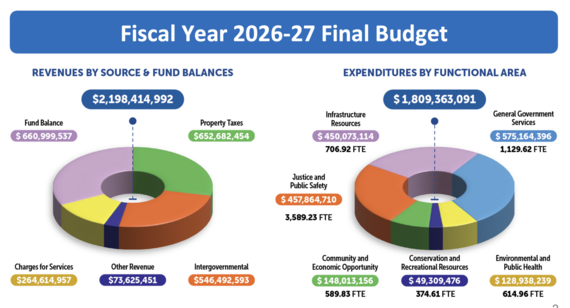
The Board adopted the $1.81 billion budget in a series of votes for the various parts that comprise the total budget. The total budget is a 3.3 percent increase over the current fiscal year. The budget does not include an increase in taxes for the general operations needs of the County, however Board policies addressing state cost shifts, infrastructure funding, and affordable housing increased the total County property tax rate by about 8.7 cents per $100 of net assessed value. The total property tax rate of $5.2835 per $100 of net assessed value is still nearly 70 cents less than the highpoint of the tax rate in the 2010s during the recovery from the Great Recession.
Key principles funded in the budget include:
- Preserving strong reserve levels and long-term financial stability;
- Supporting recruitment and retention of a high-quality workforce;
- Investing in infrastructure and deferred maintenance;
- Protecting services for vulnerable residents;
- Leveraging grant funding and partnerships wherever possible; and
- Maintaining transparency and accountability to taxpayers.
While the Board set the expenditure ceiling for the coming fiscal year when it adopted the Tentative Budget in May, the Board was still able to make changes within the budget at adoption. Though the adopted budget is substantially the same, the Board did ask the County Administrator to accommodate spending for several areas, most notably employee compensation.
Changes to the adopted budget from the tentative include:
- A one-time $1,000 retention stipend to County employees earning $45,000 or less a year, available to permanent employees hired before June 28. Board Chair Jennifer Allen estimated the retention stipends would cost $1.3 million.
- $400,000 for additional grading of high-traffic dirt roads in rural areas
- $250,000 for two additional Information Technology Department employees who are needed to meet federal and state auditing requirements for County vendors and contributing organizations.
- $186,000 for an additional Community Health Worker for the Health Department focusing on noncommunicable diseases.
- And small amounts to support the operations of the International Sonoran Desert Alliance in Ajo, and for senior meals programs in Ajo and Flowing Wells.
Remaining a competitive and caring employer is part of the Public Service Pillar in the Strategic Plan and to that end the Board approved a 3% pay increase for employees for next fiscal year. The Board has provided pay adjustments for employees six out of the past seven years to keep County pay competitive with other governments and the private sector, and to help employees keep up with the nagging costs of inflation.
Inflation was one of the key reasons why the Board chose to help employees on the lower end of the County pay scale or who are part time with the one-time $1,000 retention stipend. District 5 Supervisor Andrés Cano also asked Lesher for the FY 2028 budget cycle to review employee pay ranges $45,000 and below with an eye toward ensuring County pay is sufficient to meet basic costs of living.
The adopted budget does not raise property tax rates for general County operations. However, Board Policy requires adjustments to the rates for infrastructure funding, affordable housing, and to pay for unfunded mandates from the state that are referred to as state cost shifts. State cost shifts this budget year are more than $134 million.
There are two components to County property taxes – a property’s assessed value and the tax rate. Using formulas set by state law, rates for the different County property taxes are multiplied by the assessed value to determine the tax bill. The elected County Assessor determines values. Annual tax bills sent by the County Treasurer include every property taxing jurisdiction a home or business is in, including school, fire, and Community College districts. Of those, the County only imposes four types of property taxes:
- The Primary property tax, which funds the General Fund;
- The Library District, revenue from which can only be used for the Library;
- The Regional Flood Control District, which can only be used to fund RFCD infrastructure, programs, and administration;
- And the Debt Service tax which repays borrowed funds.
The Board voted on each part of the FY27 budget separately. The votes were:
- 4-1 to adopt the budget with primary property tax rate of $4.2733 per $100 of NAV, which is 7.9 cents more than FY 26
- 5-0 to adopt the Regional Flood Control District budget with a tax rate of $0.3407, which is 1.18 cents more than FY26
- 4-1 to adopt the Library District budget with a tax rate of $0.5820, which is 2.41 cents more than FY26
- 5-0 to adopt the Debt Service budget with a tax rate of $0.0875, which is 2.75 cents less than FY 26
The Board also set the budgets and tax rates for numerous special taxing and facilities districts as required by state law. It also approved the budget for the Stadium District which provides the bulk of the funding for the operation of the Kino Sports Complex.
Strategic Plan Funding Amounts
The FY 27 budget furthered the process of aligning the budget with the Board’s Strategic Plan and Board Initiatives and specifically identifies funds being allocated for the Board’s priorities.
-
Public Service – Effectively manage core functions and provide excellent customer service; $957 million
-
Quality of Life – Improve the quality of life for Pima County residents; $525 million
-
Infrastructure & Growth - Prioritize critical infrastructure and economic growth; $306 million
-
Sustainability and Conservation – Promote conservation, sustainability, and climate resiliency; $23 million
Highlights by Strategic Plan Pillar:
Public Service
- Retains a 15% fund balance essential for emergency funding in the event of natural or financial calamities, and to maintain the County’s superb AA+ and AAA bond ratings, which qualify the County for low interest rates on borrowed funds
- Provides competitive pay increases for employees
Quality of Life
- Provides $10 million for the continuation of the Pima Early Education Program Scholarships (PEEPS), which provides scholarships to qualifying parents to pay for pre-school and other early education for young children
- Provides $8.7 million for affordable housing and prevention of homelessness
- Continues $3 million in funding for Emergency Eviction Legal Services (EELS), which helps people in danger of losing their homes navigate the associated legal processes with a goal of keeping people housed
- Provides $1 million for green industry workforce development
- Provides more than $4 million for neighborhood reinvestment, environmental mitigation, and utility assistance
Infrastructure & Growth
- Allocates $25 million in Pay-As-You-Go (PAYGO) funding for transportation infrastructure
- Funds $251 million in capital improvements, including:
- $9 million for the improvement or expansion of several libraries, the relocation of the downtown library, and improved broadband internet at libraries
- $3.3 million for lighting at Arthur Pack and George Mehl parks
- $20 million for the Middle Mile project that provides the needed broadband infrastructure extensions to underserved mostly rural areas.
- $4 million for improved flood control near the Pima County Fairgrounds and South Houghton Road.
- $8 million for the Canoa Ranch sewer line extension
- $2.5 million for the relocation of the Elections Center to Drexel Road.
Sustainability and Conservation
- Provides $2.2 million for the acquisition of open space in furtherance of the goals outlined in the Sonoran Desert Conservation Plan.
Additional FY 27 Budget resources and information:
County Administrator’s Recommended Budget
County Budget Webpage
Pima County vs. Maricopa County Property Tax Rate Comparison
Total Tax Burden by County
Pima County’s Portion of a Property’s Total Tax Bill
|