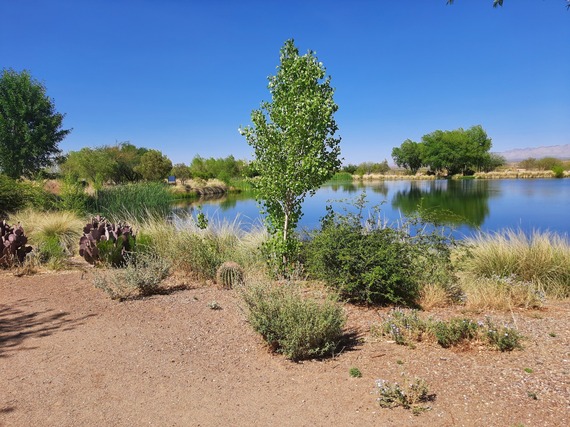
 Getting ready for summer
at Historic Canoa Ranch
The weather may be getting warmer, but Historic Canoa Ranch is still a wonderful place to visit. As summer approaches, plenty of wildflowers are blooming around the ranch, including penstemons, globe mallows, and desert marigolds. It's fascinating to watch the changes unfold in front of your eyes from season to season.
If you're visiting the ranch during the day this time of year, we recommend applying sunscreen, drinking plenty of water, and limiting your time in direct sunlight. Remember to stay safe while you're enjoying our beautiful grounds!
Bird of the Month: Lucy's Warbler
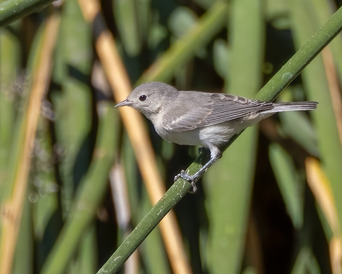
Many warblers pass through Historic Canoa Ranch on migration, adding splashes of color to the desert landscape. Wilson’s, Red-faced, and Townsend’s Warblers all pass through the Ranch on their way to higher latitudes or altitudes.
One warbler, however, migrates north and perseveres through the summer heat in southern Arizona’s desert valleys. This is Lucy’s Warbler, the smallest warbler in North America at a touch over 4 inches.
Warblers are known to be a colorful group of birds. Lucy’s Warbler, on the other hand, is more muted in tone, pale gray above, and white below with darker wings. Both sexes have a rusty patch on the rump. Males have a similarly colored patch on the crown. Structurally, Lucy’s Warbler has a noticeably short tail compared to most other members of the family.
Their habitat includes desert valleys with mesquite and streamside forests with cottonwoods and willows. Lucy’s Warbler is one of only two members of their family that nest in cavities, which can be old woodpecker holes, under loose bark, and in crevices on tree trunks. They often advertise their presence by their loud sweet-noted song, which is similar to that of the Yellow Warbler.
Compared to some other warblers, Lucy’s Warbler is not the most colorful. However, the bird is a tough little survivor that rides out the heat of summer alongside us.
Wondering what Lucy's Warbler sounds like? You can find recordings of the bird's call and song here.
Last Month’s Trivia Question: Which warbler is a true desert breeding bird?
Answer: The true desert breeding warbler is the subject of this month’s article, Lucy’s Warbler. The species was named after Lucy Hunter Baird, daughter of Spencer Fullerton Baird, noted leader of the Smithsonian Institution for many years and one of the most prominent ornithologists, mammalogists, and herpetologists in the nation.
In 2023, the American Ornithological Society announced it was going to replace all of the bird names named after people. Perhaps Mesquite Warbler would be a suitable new moniker for this charming bird?
This Month’s Trivia Question: As the article mentions, Lucy’s Warbler is one of only two cavity-nesting members of the warbler family. Which is the other?
|
Plant Spotlight: Desert Rose

The desert rose, also known as the adenium, is a drought-tolerant plant that can be found in deserts all over the world. In the Southwest, the rose may bloom from April through October and often loses its leaves during cold weather. It has a thick stem and distinctive-looking flowers with five petals.
This beautiful adenium was donated to Historic Canoa Ranch last year by the Green Valley Gardeners. More than 35 years old, the plant is currently in bloom. It may be viewed at the Manning Jr. ranch house. It's just one of numerous beautiful plant specimens you can see during your next visit to the ranch!
|
Honoring Pima County's pristine night skies

Everyone's talking about Pima County's fantastic stargazing opportunities! In the May 26 issue of People, the Tucson Astro Trail ranked at No. 1 on the national magazine's list of "25 Things to Do, See and Eat This Summer." National Geographic recently named Tucson a "world capital of astronomy," calling it one of the best places for star buffs. Travel + Leisure magazine also highlighted the Astro Trail in a May article.
Historic Canoa Ranch closes its gates at dusk, but keep an eye out for occasional stargazing events in the fall, winter and spring! Check our registration page for these events, which are led by Pima County Conservation Lands & Resources' Environmental Education team in partnership with the Tucson Amateur Astronomy Association, and which take place at rotating locations including the ranch, Agua Caliente Park, and Tucson Mountain Park.
|
June programs and events
 Please visit our website to register for any of these upcoming events!
|
Friday, June 13, 8–9 a.m.
|
Anza Tour
|
|
Saturday, June 14, 8–9:30 a.m.
|
Historic Canoa Ranch Tour
|
|
Saturday, June 21, 8–9:30 a.m.
|
Historic Canoa Ranch Tour
|
|
Friday, June 27, 8–11 a.m.
|
Anza Trail Hike
|
|
Saturday, June 28, 8–9:30 a.m.
|
Historic Canoa Ranch Tour
|
|
|
|
Interested in doing some volunteering this summer? Visit our website to learn more about our volunteer opportunities at Historic Canoa Ranch and other Conservation Lands & Resources programs, and be sure to mark these dates on your calendar!
|
Tuesday, June 17 • Starts at 7:30 a.m.
|
Green Valley Gardeners Volunteer Days
|
|
Tuesday, June 24 • Starts at 7:30 a.m.
|
Green Valley Gardeners Volunteer Days
|
|