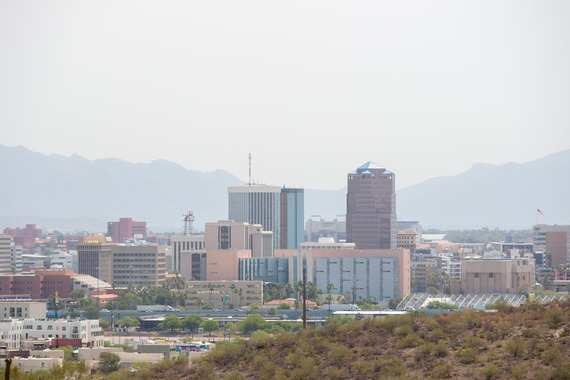
 Summer heat triggers surge in harmful ozone pollution
PIMA COUNTY, May 15, 2025 — As temperatures rise, so does ground-level ozone pollution, which is an expected seasonal increase during the hot and sunny days of summer.
To understand the cause of this rise, it’s important to distinguish between “good ozone” and “bad ozone.”
“Good ozone,” or stratospheric ozone, exists about 9 to 19 miles above the Earth’s surface and protects the earth from harmful ultraviolet (UV) radiation. In contrast, “bad ozone,” or ground-level ozone, forms near the surface and is both a pollutant and a greenhouse gas that can negatively affect human health.
“Bad ozone” is not emitted directly into the air but is created when volatile organic compounds (VOC) and nitrogen oxides (NOx) chemically react with UV sunlight and heat. One of the main sources of both VOCs and NOx in Pima County is from burning fossil fuels when driving gasoline and diesel vehicles.
From April through September, longer and hotter days in Pima County provide more time and conditions for this chemical reaction to occur, leading to increased ground-level ozone.
The U.S. Environmental Protection Agency (EPA) began setting standards in the 1970s to bring down ozone levels. These standards contributed to the development of new emission control technologies like catalytic converters, engine idling reduction technology, cleaner fuels, and electric and hybrid cars that use less or no gasoline or diesel.
In 2024, the air in Pima County exceeded the EPA ozone standard (0.070 ppm) on eight days as measured by the Pima County Department of Environmental Quality’s (PDEQ) air quality monitors. Ozone was in the “good” range on most days (212, 58%), was in the “moderate” zone for 144 days (40%), and was “unhealthy” for sensitive groups on eight days (2%) which was a four-day increase from 2023.
Since 2010, there has been a slight increase in average total ozone exceedance days per year. Possible explanations as to why unhealthy ozone days may be rising include an increase in wildfire emissions and other sources of VOC (paints, cleaning supplies, pesticides, gasoline vapors) and NOx (power plants and industrial facilities) — basically any source that involves the burning of fossil fuels) coming in from outside Pima County.
Ground-level ozone can take several hours or days to form and the wind can transport it from other states or even other countries, and this cannot be controlled locally. Due to these factors, research is needed to fully understand what is driving the rise of unhealthy ozone days in the Tucson area.
The first step in understanding this rise is through monitoring the air quality of Pima County. PDEQ monitors five criteria air pollutants, including ozone, at 15 monitoring stations located throughout eastern Pima County, including the Tucson metropolitan area and Green Valley. It issues Air Quality Action Day alerts when ground-level ozone is expected to reach or exceed 90 on the Air Quality Index.
In 2024, 14 ozone air pollution action days were issued by PDEQ, which is an increase from the six ozone air pollution action days that were issued in 2023. The alerts include information about populations most susceptible to exposure and the health effects that can result from breathing ground-level ozone like inflamed airways, difficulty breathing, coughing, and increases in asthma attacks.
To decrease the adverse health effects from breathing ground-level ozone, PDEQ implements and enforces federal and local air quality regulations to maintain healthy air.
At the individual level, one of the best ways to decrease ozone emissions is to reduce burning of fossil fuels by:
- Biking, walking, or taking public transit (which remains free) in place of driving
- Maintaining motor vehicles
- Refueling in the evening, reducing the interaction between solar radiation and VOCs and NOx
- Carpooling
- Reducing vehicle idling
- Working from home
- Combining errands into one trip
- Reducing the use of gas-powered lawn and garden equipment
“We can all play a part in reducing our polluting activities, such as biking, walking or taking public transit to work, even if it’s only one or two days a week, it makes a difference,” said Scott DiBiase, the director of Pima County’s Department of Environmental Quality.
Real-time ozone air pollution levels are available on the PDEQ website or through EPA’s AirNow website or mobile app. Individuals can sign up with ADEQ to receive five-day air quality forecasts in order to plan ahead, reduce exposure, and drive less on forecasted high ozone days. The public may also sign up to receive PDEQ Air Quality Action Day alerts when air pollutant concentrations have high potential of reaching unhealthy levels.
Additional information on ground-level ozone is available at www.pima.gov/HealthyAir.
|