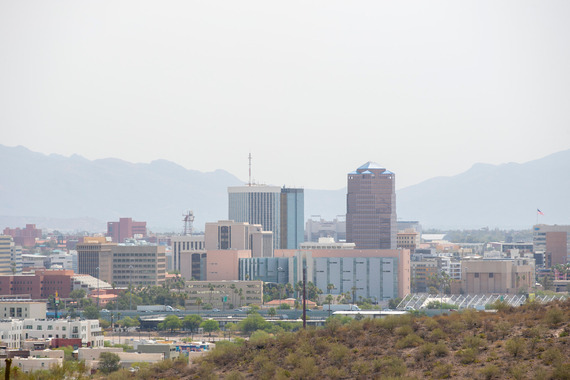
 Know Your Air: Ozone air pollution season has begun
PIMA COUNTY, April 19, 2024 – April marks the beginning of ground-level ozone pollution season, and Tucson exceeded the ground-level ozone health-based air quality standard at five different monitoring sites on April 17.
Breathing ozone can be unhealthy, especially for those who are sensitive to this pollutant. Some of the health effects that can occur by breathing elevated levels of ozone include: inflamed airways, difficulty breathing, coughing, and increases in asthma attacks.
The U.S. Environmental Protection Agency (EPA) determines air pollutant health standards to protect public health. In 2023, the air in Pima County exceeded the EPA ozone standard on four days as measured by the Pima County Department of Environmental Quality’s (PDEQ) air quality monitors.
Ozone was in the “good” range on most days (244, 67%), was in the “moderate” zone for 117 days (32%), and was “unhealthy” for sensitive groups on four days.
The ground-level ozone pollution season goes through September.
Corresponding with the beginning of ozone season, wildfire season, and World Asthma Day (May 7), the EPA’s Air Quality Awareness Week is May 6-10, 2024. This week will highlight opportunities to learn about what causes air pollution, why it is important, and actions people can take to improve air quality daily throughout the year. Each day highlights a different topic related to air quality.
There are many actions individuals can take to reduce emissions that contribute to ozone. Incorporating these actions, even occasionally, will help protect air quality and the health of loved ones.
To reduce ozone emissions:
- Replace car trips with biking, walking or taking public transit (which remains free)
- Maintain motor vehicles
- Refuel in the evening, reducing the interaction between solar radiation and precursor pollutants
- Share rides/carpool
- Reduce vehicle idling
- Work from home
- Combine errands into one trip
- Reduce the use of gas-powered lawn and garden equipment
Since 2010, there has been a slight decline in unhealthy ozone pollution days in Pima County.
"The data shows that our overall ozone status has improved since 2010, which is great news for Pima County,” said Scott DiBiase, Director of PDEQ. “It’s essential that all of us work together as a community to continue this positive trend and help to keep our air clean and healthy for everyone to enjoy.”
 |
Ground-level ozone tends to be elevated in the spring and summer when the Tucson region has more hours of intense sunlight to react with ozone precursor emissions – volatile organic compounds (VOC) and nitrogen oxides (NOx). Warmer temperatures also increase the amount of VOC emissions that evaporate from gasoline, solvents, paints, and even vegetation. NOx comes primarily from the burning of fossil fuels, such as in gasoline and diesel vehicles. Ground-level ozone air pollution is different than the protective ozone layer in the stratosphere that shields us from solar radiation.
Real-time ozone air pollution levels are available on the PDEQ website or through EPA’s AirNow website or mobile app. Individuals can sign up with ADEQ to receive five-day air quality forecasts in order to plan ahead, reduce exposure, and drive less on forecasted high ozone days. The public may also sign up to receive PDEQ Air Quality Action Day alerts when air pollutant concentrations have high potential of reaching unhealthy levels.
Additional information on ground-level ozone is available at www.pima.gov/HealthyAir.
|