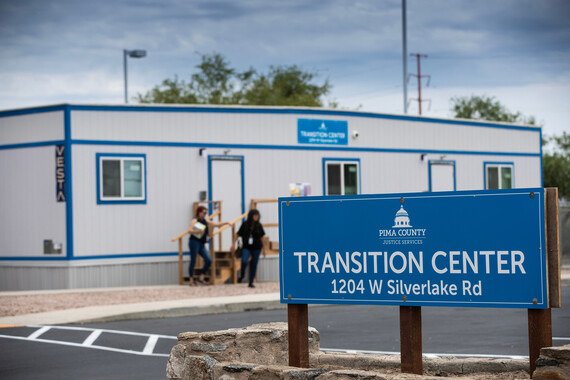
 Transition center connects people leaving jail with community resources
PIMA COUNTY, July 18, 2023 -- Pima County has launched a new effort to connect people being released from the County jail with the resources they need.
Since June 27, the transition center program, operated by the Department of Justice Services, has been working with people as they are being released.
Justice Services has hired four justice navigators, who meet with people brought to the Pretrial Services modular, located outside of the Pima County Adult Detention Complex.
The navigators are expected to begin working out of their own modular, located at 1204 W. Silverlake Road, by early August.
“We’re implementing our long-term goals of reducing the cycle of incarceration in Pima County,” said Justice Services Director Kate Vesely. “We want to empower individuals coming out of jail to address the underlying issues that got them there in the first place by providing them with the help that they need.”
Justice navigators, who have personal experiences similar to those they are trying to help, are focused on engaging with those charged with non-violent, non-dangerous misdemeanors who are released from pretrial services with a court date. The navigators speak with the person to identify any barriers they may face while going through the legal process and offer them the chance to connect with services they might need, such as housing, food, drug rehabilitation, medical care, transportation and more.
The goals are to reduce the number of people being re-arrested and to decrease the percentage who fail to appear for their court hearing. People miss their court date in about 20 to 30 percent of jail bookings.
According to national data from the Substance Abuse and Mental Health Services Administration (SAMHSA), 44% of those in jail suffer from a mental illness and 63% have a substance use disorder.
“We simply want to meet people where they are,” said Justice Services program manager Doyle R. Morrison. “Many of these people struggle with addiction, homelessness, and poverty. Some have trauma associated with the justice system. That trauma contributes to the cycle of incarceration. Giving them access to resources helps them break that cycle.”
The Pima County Board of Supervisors had considered constructing a similar facility three years ago, but those plans were tabled when the COVID-19 pandemic hit.
Throughout the pandemic, Justice Services began collecting items that individuals may need when they are released from jail, like socks, blankets, toiletries, and information about where to get services, housing, and treatment. These “resource bags” will also be distributed at the new transition center.
The transition center was awarded $1 million from the federal American Rescue Plan Act (ARPA). Justice Services plans to use a blend of grants and local funding to operate the center on a long-term basis.
It’s partially modeled after the Harris County Joint Processing Center in Houston, Texas.
“We’re using evidence-based practices,” said Mayra Ramos, Justice Services’ Administrative Support Services Manager. “We’ve seen the positive impacts that programs like these can have.”
The program, in collaboration with the City of Tucson and other community partners, will be prepared to aid up to 150 people per month once the transition center’s modular is opened. The program will be staffed Monday through Friday from 9 a.m. to 11 p.m., but hours are subject to change based on the needs of the people the center serves.
|


