AZGFD and ASU join in bird banding efforts at Hassayampa River
The data provides valuable tool for understanding bird populations
WICKENBURG, Ariz.– The balmy summer mornings at the Hassayampa River Preserve are filled with the chirps and chatter of birdsongs from the tree canopy. The rare desert riparian habitat is the perfect place to learn about how bird populations are faring across the continent.
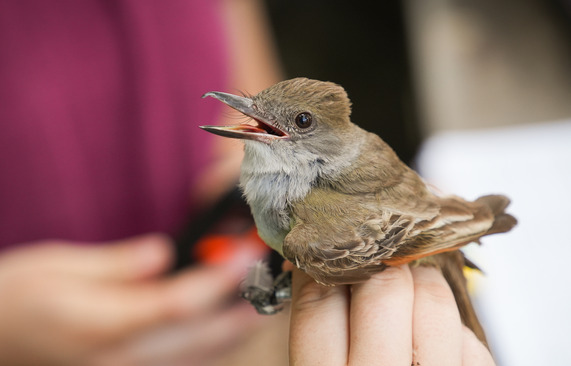
The Arizona Game and Fish Department (AZGFD) has partnered with researchers at Arizona State University and volunteers to gather data on the diverse bird species that live and migrate along the Hassayampa River through bird banding– the practice of temporarily catching, tagging and collecting data on individual birds.
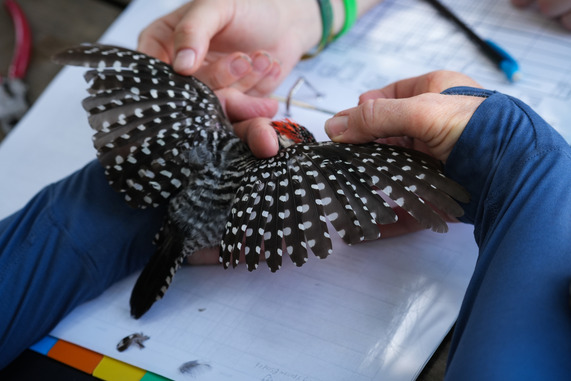
In the summer, researchers place mist nets around Maricopa County's Hassayampa River Preserve for a few morning hours every ten days. As birds are caught in the nets, the team carefully detangles them and records data points on each bird, like the species, sex, age and weight. The birds are then fitted with a uniquely-numbered band around their leg so that their data can be tracked in the future.
The data from a bird that has been previously banded is especially valuable, because researchers can follow its progress across multiple years.
The team works quickly and efficiently then releases the bird back into the preserve within minutes.
“The power of partnerships is what makes this possible. Managing a MAPS (Monitoring Avian Populations and Survivorship) station is a massive undertaking, and we are grateful to work in such a prime riparian habitat where we can share bird banding and research with the public firsthand,” said Chrissy Kondrat, AZGFD permits and bird biologist.
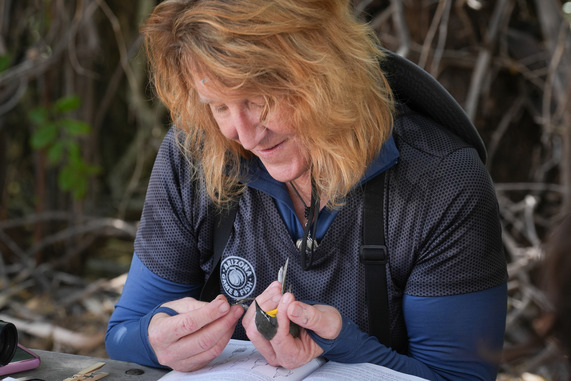 Dozens of species of birds have been observed and banded in the area, including common species like Abert’s towhee, yellow-breasted chat, song sparrow, summer tanager and yellow warbler.
Other rare species, like the federally protected southwestern willow flycatcher and yellow-billed cuckoo, have also been spotted in the preserve.
“We have a lot of very skilled bird watchers in Arizona that contribute to citizen science databases, but getting a bird in the hand can give us a more intimate look at their health, fat reserves, and a more accurate measure of population and demographic shifts,” said Adam Stein, a conservation biologist and assistant teaching professor at Arizona State University.
“Birds are a great indicator of the health of an environment. Riparian areas such as the Hassayampa are utilized by nearly 80% of Arizona’s wildlife species and under threat by multiple factors. By studying birds, we hope to maintain an early alarm system on these ecosystems as a whole,” said Stein.
The Hassayampa Bird Banding Station has been in operation since 2022 banding hundreds of birds for the past five summers.
The station is a part of the Monitoring Avian Productivity and Survivability (MAPS) program– a network of more than 1,200 stations across North America operated by public agencies, nonprofit groups and individuals and led by the Institute of Bird Populations. Since 1989, stations like the one at the Hassayampa River Preserve have collected information from more than 2.5 million bird captures.
“Our collaboration with Adam and team from ASU, along with volunteers from a number of different agencies and organizations provides a skilled team and offers young professionals invaluable hands-on experience,” said Kondrat. “While being up close with wildlife is always exciting, the true thrill comes from engaging younger generations in stewardship and seeing our research translate into on-the-ground conservation management.”
Click here for more information on banding efforts at the Hassayampa River Preserve and how to get involved.
###
|