|
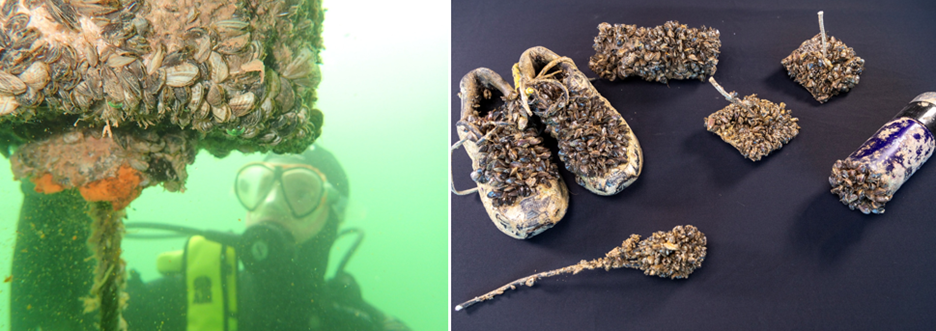
Invasive quagga mussels can quickly anchor to boat motors and other hard surfaces.
LAKE POWELL, Utah — With summer in full swing, many are making plans for their next boating trip. If you are planning to boat at Lake Powell or any other lakes in Utah this summer, the Utah Division of Wildlife Resources, Utah Department of Natural Resources Law Enforcement, and Arizona Game and Fish Department want to remind you of Utah’s boater requirements before you hit the water.
Aquatic invasive species requirements
Here are the main rules to be aware of:
- Anyone who launches a boat or any other watercraft in Utah — whether they are a Utah resident or non-resident — is required to take an annual mussel-aware boater course. This includes individuals with paddle boards, kayaks, and other non-motorized watercraft.
- Anyone who wants to launch a motorized boat in Utah must also pay an annual aquatic invasive species program vessel enrollment fee. This fee helps the Utah DNR operate the state’s program and keep AIS from spreading throughout Utah.
- When leaving any waterbody in Utah or when traveling into Utah while transporting watercraft, all drain plugs must be removed. Boaters should also remove any sea strainers while transporting their watercraft.
- All watercraft leaving Lake Powell — currently the only Utah waterbody with confirmed quagga mussels — are required to have an exit inspection during the inspection station's hours of operation. Inspections are not the same as decontaminations. After a watercraft is inspected, it must still be professionally decontaminated before that watercraft can launch at a different waterbody in Utah. If a decontamination can't be performed, the watercraft must follow the recommended cleaning and draining guidelines, and wait the required dry time before launching again in Utah. Utah's required dry times after boating at Lake Powell are 7 days in summer, 18 days in fall and spring, and 30 days in winter. However, wakeboard boats are defined as complex boats which always require a 30-day dry time — regardless of the time of year — unless they are professionally decontaminated by a Utah DWR-certified aquatic invasive species decontaminator.
- All watercraft users should always clean, drain, and dry their watercraft when leaving any waterbody to prevent the spread of aquatic invasive species, such as quagga mussels and invasive Eurasian watermilfoil plants.
How to pay fees
The aquatic invasive species fee is paid online through the Utah DWR website. The fee is $20 per watercraft for Utah residents, and $25 per watercraft for non-residents. The annual mussel-aware boater course must be completed before the aquatic invasive species program vessel enrollment fee can be paid, and then a current-calendar-year AIS boat decal will be mailed to you.
“The aquatic invasive species funds are used to help prevent quagga mussels from spreading from Lake Powell to other Utah waterbodies,” Utah Department of Natural Resources Law Enforcement Aquatic Invasive Species Statewide Operations Lt. Bruce Johnson said. “These funds help pay for new dip tanks being installed around the state that more efficiently decontaminate boats and also pay for staff to help inspect and decontaminate boats in areas without dip tanks.”
Due to ongoing severe drought conditions, Lake Powell will have low water levels this year. Boaters should check the Glen Canyon National Recreation Area website for updates on launch ramp conditions.
Visit the STD of the Sea website for a map of inspection and decontamination stations around Utah.
Negative impacts of quagga mussels
- They plug water lines, even lines that are large in diameter.
- If they get into water delivery systems, it will cost millions of dollars annually to remove them and keep the pipes free, which can result in higher utility bills.
- They remove plankton from the water, which hurts fish species.
- Mussels get into your boat’s engine cooling system. Once they do, they’ll foul the system and damage the engine.
- When mussels die in large numbers, they stink and the sharp shells of dead mussels also cut your feet as you walk along the beaches.
Negative impacts of Eurasian watermilfoil
- This invasive plant is detrimental to aquatic ecosystems because it spreads quickly and forms thick mats. Its density blocks out sunlight, and it outcompetes native plants, negatively impacting fish and other native aquatic species.
- Transporting even one piece of milfoil to another waterbody can start a new population of the plant in that waterbody.
- Eurasian watermilfoil (also called milfoil) can clog irrigation pipes.
- It can also tangle around boat propellers and cause damage.
- Removing milfoil from a waterbody once it’s found there is extremely expensive.
Learn more about how to prevent the spread of quagga mussels and other aquatic invasive species on the STD of the Sea website.
###
|