 Joint announcement from the Arizona Game and Fish Department and the New Mexico Department of Wildlife
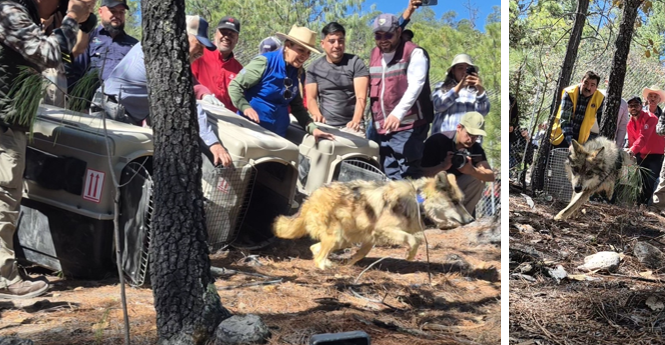
PHOENIX — The Mexican wolf has returned to the wild in the state of Durango, Mexico, marking a historic effort nearly 50 years in the making.
Thanks to extensive collaboration between state, federal and Mexican agencies and other partners, two family groups consisting of four wolves each were transported from the U.S. to Durango in March 2026.
Additionally, an adult female Mexican wolf from the U.S. equipped with satellite telemetry was released in the state of Chihuahua to an area where other wolves are documented. Additional wolves from the U.S. are slated to be released in late spring into the same area, where they are expected to find other wolves and form successful packs to expand the number and area occupied by Mexican wolves.
By the time of their listing in 1976 under the U.S. Endangered Species Act, Mexican wolves were absent from this country, with only remnant numbers existing in Chihuahua and Durango, Mexico. From 1977 to 1980, a U.S. Fish and Wildlife Service agent captured the last remaining Mexican wolves in Mexico to serve as the nucleus of a captive breeding population to save them from extinction.
The captive population has served as a recovery reservoir of Mexican wolves for release into the wild beginning in Arizona in 1998. By 2025, the population in the wild had expanded into Arizona and New Mexico and numbered at least 319, a benchmark achievement for Mexican wolf recovery.
About 90% of the historical range for this subspecies occurred in Mexico where wolves were absent for nearly 50 years until releases occurred in the Mexican states of Sonora and Chihuahua in 2011. While initially successful, the population in northern Mexico faltered and releases were halted due to the stagnant population. Durango was one of the last strongholds for this subspecies, and studies show it still contains abundant high-quality habitat for Mexican wolf reestablishment.
In 2025, at the meeting of the Saving Animals From Extinction (SAFE) program, it was approved and supported for Durango to receive wolves to be released in a mountain area with well-preserved temperate forests, well managed by local communities.
“Any international wildlife recovery program is difficult, as the listed animal generally has limited numbers to safely release,” said Clay Crowder, Assistant Director, Wildlife Management Division, Arizona Game and Fish Department. “Fortunately, the SAFE program has been extremely successful with managing the captive population, and excess animals are available for release. With the success of the captive wolf program and with amazing support from universities and wildlife management agencies in Mexico, approval was obtained for releases into both Durango and Chihuahua.”
“This transfer has its origin in the 2025 SAFE meeting in Mexico City, where Dr. Fernando Gual, in charge of Dirección General de Vida Silvestre of Secretaría de Medio Ambiente y Recursos Naturales, pledged his full support for reactivating the recovery program in Mexico and starting a new population of Mexican wolves back to the forest in Durango,” said Stewart Liley, Wildlife Chief, New Mexico Department of Wildlife. “It is important to recognize the unwavering support from Dr. Gual in making this dream become a reality.”
The list of those involved in this historic event is long and includes many different programs in the U.S. and Mexico. A key element of the release in Durango was the need of an aircraft to transport the wolves to the release site. Here, the Governor of Durango (Dr. Esteban A. Villegas) and his head of Natural Resources for Durango (Ms. Claudia E. Hernandez Espino), graciously afforded the Governor’s plane to move the wolves from Ciudad Juarez to the release site in Durango. Interestingly, the State of Durango seal now highlights two Mexican wolves.
“This is the first time this project has been implemented outside of protected natural areas or small private properties (ranches),” said Dr. Jorge Servin, Professor Metropolitan Autonomous University, Mexico City. “It is now being carried out in collaboration with a forest community (El Tarahumara and Bajios del Tarahumara). They believe that maintaining the biodiversity of their forests and ensuring their long-term sustainability is a guarantee of environmental, social, and economic benefits without degrading their natural resources.
“This is especially true for these owners of extensive communal lands with significant natural resources in Mexico. These actions, which include forest communities, also represent an attractive vision for public policy in the management of natural resources in collaboration with legal landowners in Mexico,” said Servin.
Recovering the Mexican wolf throughout its historical range is an accomplishment for the wolves themselves but also showcases the successful international cooperation among many agencies and academic conservationists to achieve this vision. While this is a new step in recovery, the multijurisdictional collaboration bodes well for more to come in Mexico.
|