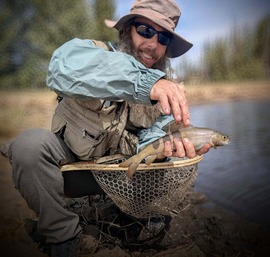
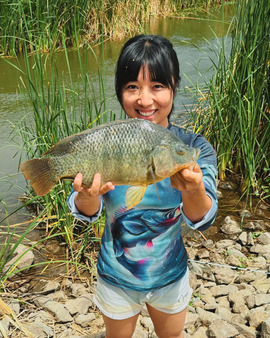
June 7 is Free Fishing Day: A great time to introduce a novice or youngster to fishing
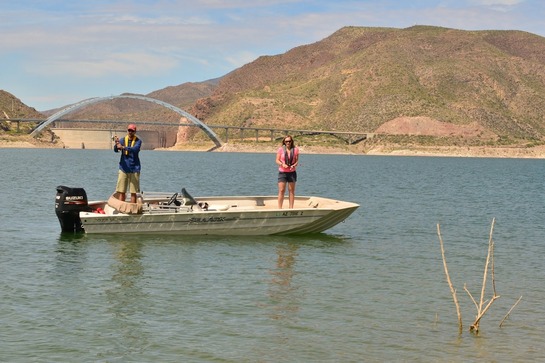
Many anglers have friends who have never been fishing but are curious to learn. One of the best ways to introduce them to this long-standing pastime is to take them out on Arizona's Free Fishing Day.
This year, Saturday, June 7, is the perfect time to do it, as the Arizona Game and Fish Department will not require fishing licenses at any state waters or community lakes as part of National Free Fishing Day.
“The goal of Free Fishing Day is to encourage people to enjoy the outdoors, spend quality time with friends and family, and experience the fun of fishing,” says Chase Newlon, AZGFD fishing R3 coordinator. "Many people who experience fishing for the first time enjoy it so much that they buy a license so they can continue enjoying it all year."
Fishing is already a bargain. Arizona fishing licenses start at just $37 for resident adults (18 and older) and $55 for nonresident adults. A combination hunt and fish license for youths (ages 10-17, residents or nonresidents) is only $5.
While a fishing license is not needed on June 7 this year, bag limits and other Arizona fishing regulations still apply and must be observed on Free Fishing Day. Children under 10 can fish for free all year in Arizona.
For information about fishing and license regulations and places to go, visit www.azgfd.gov.
Fishing tips and upcoming events
By Chase Newlon, AZGFD fishing R3 coordinator
Summer is right around the corner and the weather is starting to warm up. For those of you who are willing to brave the heat, fishing for warmwater species such as bass, catfish, and carp is really good right now. If you want to escape the heat and chase after some trout, then look into trying some of the creeks along the Mogollon Rim.
The small creeks along the Rim host a wide range of different trout species; brown trout, rainbow trout, Gila trout and brook trout can all be found along the Rim Country. A few of my favorite spots are the East Verde River for Gila trout and Tonto Creek for rainbow trout and brown trout.
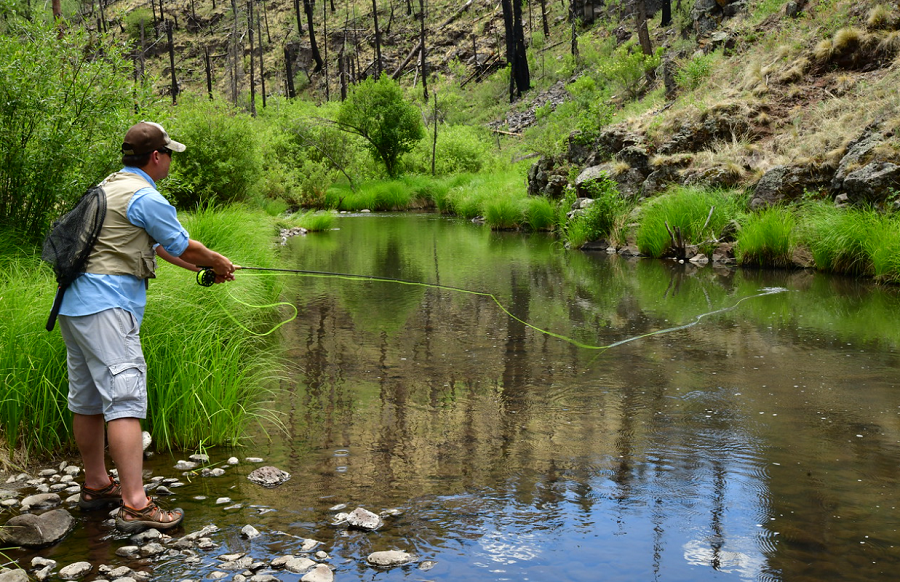
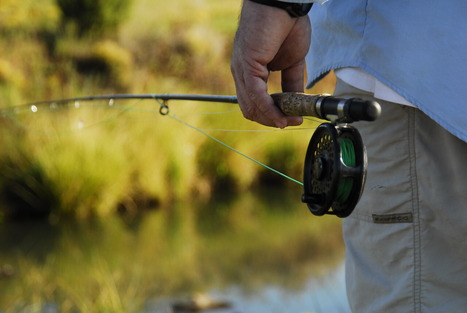
I have found fly fishing to be an extremely effective way to fish the small pools in these creeks and rivers. A dry dropper rig with a size 12 Hippie Stomper and a Pheasant Tail or Perdigon continues to produce fish for me. If you are unfamiliar with a dry dropper rig, click here for a quick tutorial. A short 7-foot, 6-inch 3 or 4 weight rod is ideal to help with close quarters casting and delicate presentations for these small creeks. The Orvis store in Phoenix will be hosting a seminar for those looking to learn more about creek fishing in AZ. See below for more details.
For the conventional gear angler, small Kastmasters, Blue Foxes and Marabou Jigs fished in the larger pools have been productive on these creeks. A 6- to 7-foot light or ultralight action spinning rod with 4- to 6-pound test works great for the small creeks.
As mentioned in the previous article, Free Fishing Day this year is Saturday, June 7. So whether you are a beginner wanting to try out fishing for the first time or an experienced angler that wants to get friends and family into fishing, this is a great opportunity for you. On this day a fishing license is not required for any public water in the state. If you would like to attend an event and have some experts help you learn the basics of fishing, check out the FishAZ network. It's filled with great events for all skill levels by a variety of great partners. For a full list of up-to-date events, visit https://register-ed.com/programs/arizona/239-fishaz-network. Just a couple of upcoming events are:
Thursday, May 15, 4:30 to 6 p.m. - Seminar, Fly Fishing Arizona’s Small Creeks, Orvis, Orvis Store, Phoenix. Join us May 15 from 4:30 to 6 p.m. to learn the ins and outs of fly fishing Arizona's small creeks. We will touch on the Arizona Trout Challenge as well. Learn the best rods, lines and leaders, how to choose the appropriate flies, and how to approach these spooky fish so you can have a fantastic day on the water. For more information, click here.
Saturday, June 7, 6 a.m. to noon - AZ Free Fishing Day Family Fishing Clinic, Arizona Safari Club International, Silverbell Lake, Tucson. Come out and enjoy Arizona Free Fishing Day 2025 with the Arizona Chapter of SCI. We will have fishing equipment and volunteers helping teach fishing techniques. This event is for all skill levels, so please come out and say hello! We will provide lunch at Ramada #4. If you have any questions, please visit www.azsci.com or email info@azsci.com. To register for this event, click here.
AZGFD unveils upgraded Fish & Boat AZ application to enhance your outdoor experience
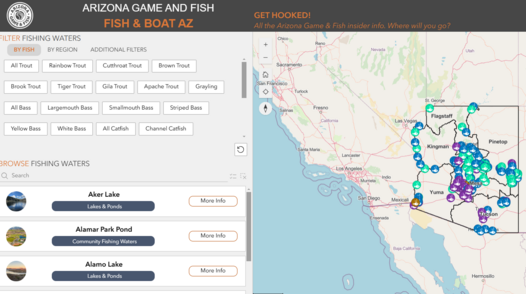
The Arizona Game and Fish Department (AZGFD) has launched a newly enhanced Fish & Boat AZ application, designed to provide a more intuitive and efficient user experience for anglers and boaters exploring Arizona’s waterways.
Building on the success of the existing Fish & Boat AZ tool, the new version leverages the advanced capabilities of the ArcGIS Experience Builder platform to deliver improved search options, allowing users to find and filter outdoor recreation locations more easily and efficiently.
Key improvements to the new Fish & Boat AZ application include:
-
Enhanced User Experience: Attribute-driven searching and filtering is more intuitive, helping users quickly locate lakes, rivers, and other recreation spots based on specific features or amenities.
-
Smart Navigation Integration: The application makes better use of existing Google Maps links, helping users seamlessly access navigation directions from their desktop or mobile device.
-
Improved Attribute Querying: Users can explore detailed information about waterbody features, boat ramps, fish species, and more through simplified, interactive queries.
The updated Fish & Boat AZ application will continue to be accessible at the existing domain, fishandboataz.azgfd.com, ensuring a smooth transition for returning users.
In addition to upgraded mapping and filtering features, the new application also provides quick access to important external resources, including:
- The AZGFD License Purchase Portal
- Official Fishing and Boating Regulations
- Trout and Bass Challenge information and updates
- Educational YouTube videos and tutorials for beginners and seasoned outdoorsmen alike
“We’re thrilled to bring these improvements to the public,” said Sportfish Program Manager Curt Gill. “This update will help make planning your next fishing or boating trip in Arizona easier, more informative, and more enjoyable.”
The new Fish & Boat AZ site went live this week. Users are encouraged to explore the upgraded site and take advantage of the new features.
For more information, visit fishandboataz.azgfd.com or follow AZGFD on social media for updates.
Kayak Angler magazine names Havasu among top 10 bass lakes in the country
AZGFD to offer paddlesports education courses that combine kayaking and fishing
When it comes to prime bass fishing locations for kayakers, the editors at Kayak Angler magazine have weighed in, and the results are in. Among the top 10 bass lakes in the country, Lake Havasu proudly claims the #6 spot. Known for its consistent fishing opportunities year-round, Havasu stands out as a top destination for anglers of all skill levels.
Anthony Garcia, the American Bass Kayak Series Angler of the Year, shared his insights, noting, “I can catch bass any time of the year on Havasu, but the spring is the best fishing.”
The surge in kayaking’s popularity has been a driving factor in this rise in interest. As people increasingly seek outdoor activities that combine both adventure and relaxation, fishing from a kayak offers a truly unique experience. Kayaking allows anglers to get closer to nature, providing a new perspective and access to otherwise hard-to-reach spots.
In response to this growing trend, the Arizona Game and Fish Department’s Boating Safety Education Program is planning to offer opportunities to get hands-on with both kayaking and fishing on open water. The course is designed to introduce you to the basics of fishing, tackle, bait selection, and more. The best part? You'll get to practice your new skills out on the water, possibly even casting your line in one of the best bass lakes in the nation.
This upcoming season, we’re planning to offer several courses, so keep checking our Paddlesports Education page. Courses will be posted as they become available.
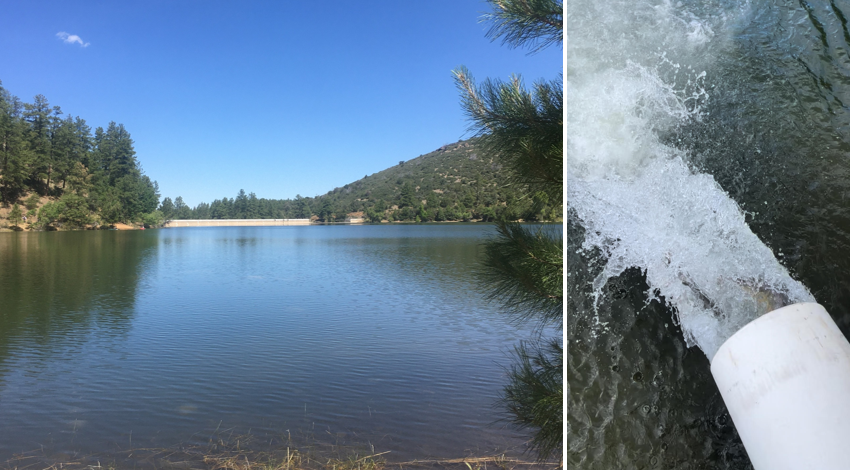 Goldwater Lake receives "retired" broodstock from Canyon Creek Hatchery
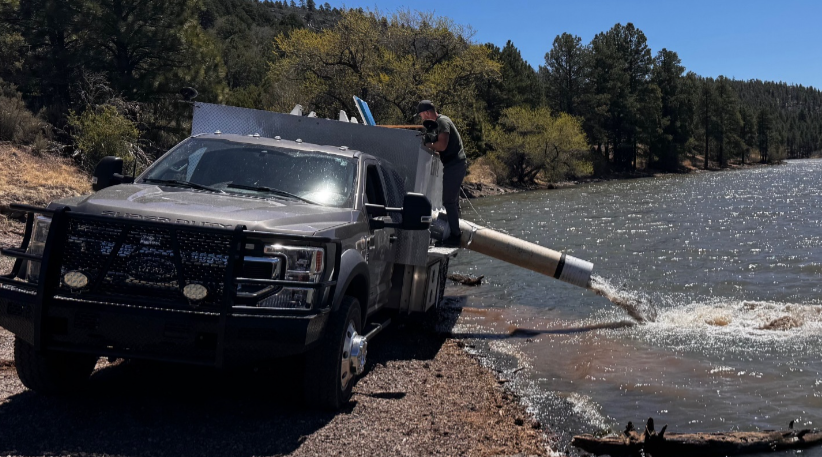
The Canyon Creek Fish Hatchery recently retired 216 Gila trout from its broodstock production. Retired brood fish generally range in age from 3 to 5 years old and give anglers the opportunity to catch a larger, mature fish.
The 216 Gila trout had an average size of more than 14 inches and were stocked into Upper and Lower Goldwater lakes in Prescott.
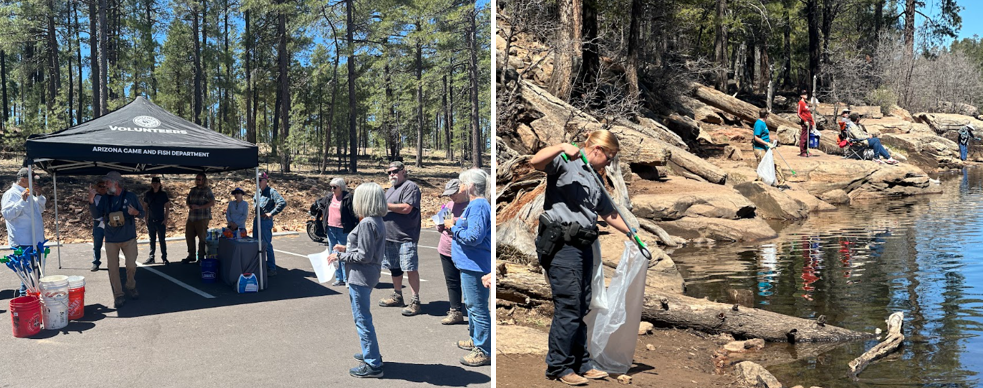 Earth Day cleanup at Woods Canyon Lake
AZGFD, APS, Forest Service and volunteers team up to remove fishing line, debris and protect wildlife
In honor of Earth Day, the Arizona Game and Fish Department, Arizona Public Service (APS), Apache-Sitgreaves National Forest and a cadre of volunteers teamed up for a cleanup project at Woods Canyon Lake — removing fishing line and debris that pose serious threats to wildlife.
APS, inspired by the story of a fledgling eaglet tangled in fishing line that required a year of rehabilitation for its injuries, reached out to AZGFD to plan the Woods Canyon Lake event for Earth Day.
“We wanted to come out here and give back to the community and protect our wildlife in this beautiful area," said Carl Nelson, APS forestry and resource management supervisor.
Fishing line can harm all kinds of wildlife, from small birds to large mammals, but some birds and their young, like eagles and osprey, are particularly susceptible because they find monofilament an attractive material for nest building.
“Once a chick gets entangled, it’s not going to act normally,” said Dan Groebner, AZGFD senior wildlife specialist. “The chick won’t eat as much, it won’t grow as fast, and it definitely can’t leave the nest.”
AZGFD biologists will attempt to rescue birds and other wildlife entangled in fishing line, but it’s not always possible.
“If nests are in dead trees or inaccessible, that chick is on its own and there’s nothing we can do,” said Groebner. “That’s why these types of preventative cleanups are so important.”
Unfortunately, cleanups like this are becoming increasingly necessary.
“Over the years, the littering has gotten worse at Woods Canyon,” said Timothy Rose of the U.S. Forest Service. “This lake is very heavily used. We can see over a thousand people on one day here during the weekends, so cleanups are very valuable for this habitat.”
The conservation partners hope that having a cleanup at the beginning of the season before the lake sees its heaviest usage will encourage folks to dispose of their trash responsibly. Visitors are encouraged pick up their trash and pack it out with them.
Frequent AZGFD volunteers, Ryan Gero and Dani James, love getting out to help Arizona’s wildlife and wild spaces and this Earth Day cleanup was no exception.
“Every bit counts — you always leave a site better than you found it," said James. “In the long run, it helps our wildlife and it protects our environment.”
“I’m just here for the animals,” joked Gero. “But luckily what’s good for the wildlife is good for everyone who wants to enjoy this lake.”
These Earth Day cleanup efforts highlight how everyday actions — like properly discarding fishing line and picking up after yourself — can have a positive and lasting impact on Arizona’s wildlife. Inspired to help? Visit volunteer.azgfd.gov for upcoming opportunities.
Want to know more about how fishing line affects wildlife? Read this.
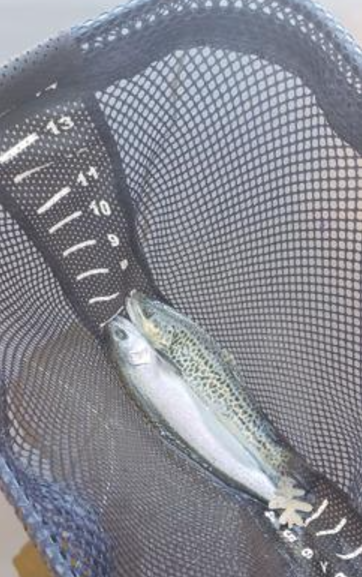
These Woods Canyon rainbow and tiger trout were caught while fishing two flies.
Photo courtesy of Jim Strogen and the Payson Roundup.
Double the fun: The art of fishing with two flies
Payson angler Jim Strogen has a good article in the Payson Roundup about the art of fishing with two flies.
"When I go to a restaurant," he says, "I often select something that I've enjoyed many times before, but sometimes I want to try something different. When I go fly fishing, I like to offer the fish a choice of fly options to match their particular feeding mood.
"I fish almost all of the time with two flies in both lakes and streams. Most often, it's with two wet flies under an indicator; sometimes it's a dry fly, hopper, or small popper as the dropper fly and a wet fly trailer; and other times, it might be two dry flies. It depends on fishing conditions and what the fish seem to be telling me they're hungry for."
Arizona regulations allow fly fishers to use two flies, and some states even allow the use of three flies at once. It's important to check the regulations to know what is permitted where you're fishing. Read Jim's tips here.
As boating season ramps up, boaters and anglers can help prevent the spread of aquatic invasive species
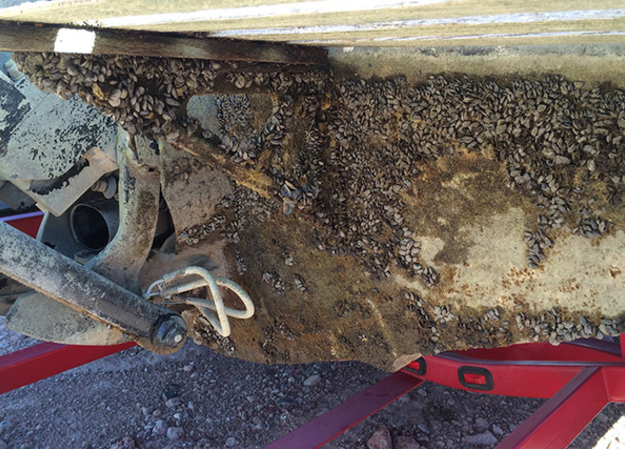
Boaters and anglers are urged to do their part to help prevent the spread of aquatic invasive species (AIS) such as quagga mussels, New Zealand mudsnails, and the recently discovered (in California) golden mussels. Please clean, drain and dry your watercraft (and pull your plug) before launching in ANY Arizona waterbody.
Please contact the Arizona Game and Fish Department Aquatic Invasive Species (AIS) Program at 623-236-7608 if you have any questions or would like to schedule an inspection. For information on the golden mussel detections in California, visit the California Department of Fish and Wildlife website.
For more information on aquatic invasive species in Arizona, including links to Director's Order #1 (list of aquatic invasive species of Arizona), Director's Order #2 (list of AIS-affected waters in Arizona), and Director's Order #3 (mandatory conditions for movement of watercraft, conveyances and equipment from affected waters), visit
https://www.azgfd.com/fishing-2/aquatic-invasive-species/.
In addition to the general AIS decontamination requirements and protocols described above, anglers should take note of the New Zealand Mudsnail Decontamination Options and Angling Recommendations.
Make it easy: Auto-renew your fishing license
The Arizona Game and Fish Department reminds anglers that they have the option to automatically renew their fishing, hunting or combo license when it expires.
To opt-in for license auto-renewal, customers must have an AZGFD portal account. Customers who have an existing portal account should use that account. Do not create a new portal account if one already exists. If assistance is needed to fix an existing portal account, email customer service at customer@azgfd.gov.
Selecting license auto-renewal is a three-step process: (1) Purchase a license, or use a valid license; (2) Add a credit card to be used to auto-renew a license; (3) Select the license(s) to be auto-renewed. Click HERE for step-by-step instructions.
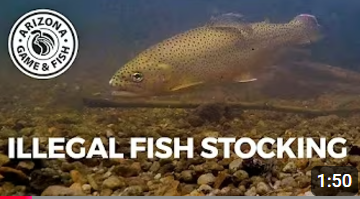
Reminder: It's illegal to transport live fish from one water body to another in Arizona
The video above is a good reminder to anglers that stocking or moving unauthorized fish from one water body to another is illegal and can harm existing native fish populations and sport fisheries. Following illegal stocking, fish can move on their own to other locations from where they were introduced and establish new populations.
Colorado River states have spent nearly $100 million to deal with illegally introduced fish – money that could have been better spent providing more angling opportunities. If you see anyone illegally stocking fish into our lakes or rivers, please report it to Operation Game Thief at 1-800-352-0700.
Recent stockings
Week of 4/28 to 5/2/25
Stocked with rainbow trout unless otherwise indicated.
North Central Arizona: Dead Horse Lake (channel catfish), Oak Creek.
Flagstaff/Williams area: Ashurst Lake, Cataract Lake (tiger trout), City Reservoir, Dogtown Lake, Frances Short Pond (rainbow trout, channel catfish), Santa Fe Reservoir.
Mogollon Rim: Canyon Creek, Christopher Creek, C.C. Cragin Reservoir, East Verde River (Gila trout), Haigler Creek, Knoll Lake, Tonto Creek, Willow Springs Lake, Woods Canyon Lake.
White Mountains: Big Lake (brook trout), Fool Hollow Lake, East Fork Black River (Apache trout), Show Low Lake, Silver Creek (Apache trout), West Fork of the Little Colorado River (Greer and Sheep's Crossing - Apache trout).
Community Fishing Waters (stocked with channel catfish unless otherwise indicated):
Payson area - Green Valley Lakes (rainbow trout).
Phoenix area - Alvord Lake, Chaparral Lake, Cortez Lake, Desert Breeze Lake, Desert West Lake, Discovery Ponds, Encanto Lake, Kiwanis Lake, Mansell Carter Oasis Lake, Papago Ponds, Paloma Lake, Pioneer Lake, Red Mountain Lake, Rio Vista Pond, Riverview Lake, Steele Indian School Pond, Sundance Park Lake, Surprise Lake, Veterans Oasis Lake.
Safford area - Graham County Fairgrounds.
St. Johns area - Patterson Ponds (upper and lower - rainbow trout).
Tucson area - Kennedy Lake, Sahaurita Lake, Silverbell Lake.
Yuma area - Yuma West Wetlands Pond.
Week of 4/21 to 4/25/25
Stocked with rainbow trout unless otherwise indicated:
Central Arizona: Salt River.
North Central Arizona: Goldwater Lake (upper), Lynx Lake, Mingus Lake, Oak Creek (Gila trout).
Flagstaff/Williams area: Ashurst Lake, Cataract Lake (channel catfish), City Reservoir (channel catfish), Dogtown Lake, Santa Fe Reservoir (channel catfish), Whitehorse Lake (channel catfish).
Mogollon Rim: Bear Canyon Lake, C.C. Cragin Reservoir, Canyon Creek, Christopher Creek, East Verde River, Haigler Creek (Gila trout), Knoll Lake, Tonto Creek.
White Mountains: Big Lake (brook trout), Silver Creek (Apache trout).
Southern Arizona: Riggs Flat Lake.
Community Fishing Waters (stocked with channel catfish unless otherwise noted):
Casa Grande area - Dave White Regional Park Pond.
Phoenix area - Alamar Park Pond, Bonsall Park, Copper Sky Lake, Eastmark Pond, Evelyn Hallman Pond, Festival Fields Pond, Freestone Pond, Friendship Pond, Gilbert Regional Park Pond, Greenfield Park Pond, Heroes Regional Park Lake, McQueen Pond, Pacana Pond, Tempe Town Lake, Water Ranch Lake.
Reports
NORTHERN ARIZONA
This week’s forecast for the high country calls for rain and thunderstorms early in the week, sunny and clear on Thursday and Friday, and then a chance of rain and windy into the weekend. Highs will be in the 50s to 70s and lows will be in the 30s to 40s for Flagstaff, Williams, and the Mogollon Rim. Water temperatures will be in the 50s to 60s this week. Lower elevations around the Verde Valley will see rain early in the week then sunny days with increasing temperatures into the weekend. Highs will be in the 60s to 90s and lows in the 40s to 60s. The majority of designated campgrounds on the Coconino and Kaibab National Forests typically open in early May; please check with the appropriate forest for specific details. Spring fishing is here. Most of the waters in Region II have been stocked. Spring is a great time to get out and target larger fish.
Bait Anglers: Worms, corn, and PowerBait will be your best bet for trout this week. Reminder, the use of live minnows and fish as bait is not allowed on any waters in Coconino County including all of the bodies of water listed below. Nightcrawlers are a good bet for walleye and anchovies are a good approach for northern pike. Catfish are commonly caught on worms, hot dogs, and anchovies. Small pieces of nightcrawlers and mealworms on small hooks are a good approach for panfish (bluegill, black crappie, yellow perch, and yellow bass).
Lure Anglers: Lures with flash and vibration such as Joes’ Flies, Panther Martins, Mepp’s spinners, Kastmasters, Rooster Tails, crayfish imitations, Pistol Pete’s, and Dare Devils are good choices. Think small for trout, 1/8 – 1/12-ounce lures are best (silver, gold, or copper). For warmwater species, crankbaits, soft plastics, and spinnerbaits have been working well. Pay attention to what is working and duplicate that presentation.
Fly Anglers: Producing flies this week include #10 bead-headed Simi-seal leeches (brown, black, olive, and wine), #10 bead-headed Wooly Buggers (brown, black, olive, and wine), #10-12 Zug Bug, #12-10 Dragonfly Larvae (olive), #18-16 Zebra Midge, #16-#12 Pheasant Tail, #12-14 Prince Nymph, #12-14 San Juan worm, hoppers, damselfly, stonefly, mayfly, hopper, and caddis fly patterns.
Check the fishing regulations before heading out as many of the lakes around Williams and Flagstaff have special regulations. Reminder, the use of live minnows and fish as bait is not allowed on any waters in Coconino County including all of the bodies of water listed below. Your licenses pay for the fish you catch; poachers are stealing from YOU. It is illegal to transport and release live fish in Arizona including all of the waters listed below; the illegal introduction of unwanted species is costly and diminishes the quality of our fisheries. If you observe a violation, please report it to the Operation Game Thief Hotline (OGT) at 1-800-352-0700.
WILLIAMS LAKES (Kaibab National Forest):
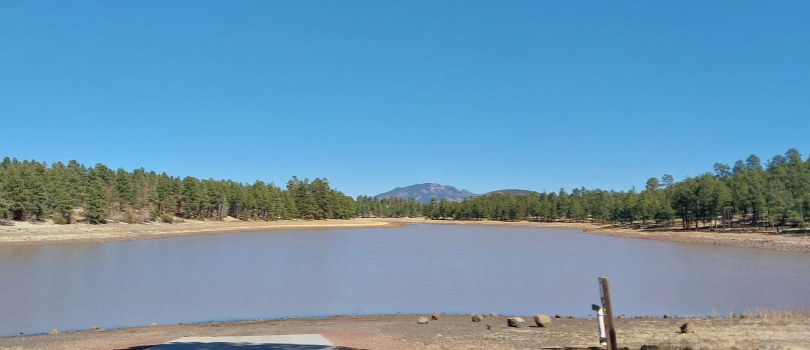
Kaibab Lake - The Kaibab Lake campground, boat launch, and day use areas are open. The limit is 2 bass minimum size 13 inches, the limit is 4 channel catfish, the limit is 4 trout. Only boats with a single 10-horsepower motor (or less) or single electric motor are allowed on Kaibab Lake. The lake is very low and launching a boat is challenging.
 |
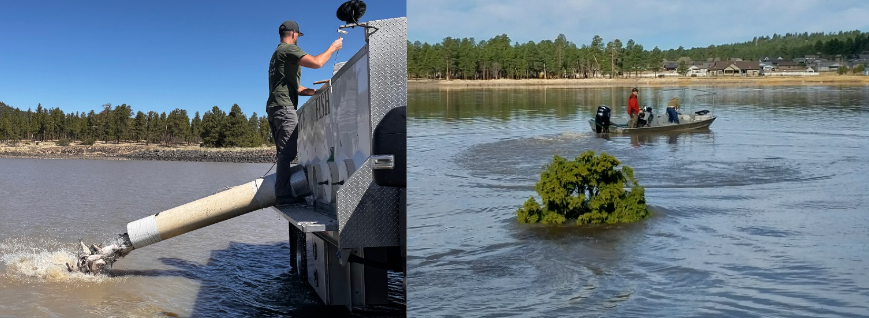
Cataract Lake - Both the County and Forest Service day use areas are open. Only boats with a 10-horsepower motor (or less) or single electric motor are allowed on Cataract Lake. The limit is 2 bass minimum size 13 inches, the limit is 4 channel catfish, the limit is 4 trout. On April 11, the Arizona Game and Fish Department, in partnership with the Kaibab National Forest, deployed approximately 25 juniper trees in the lake as fish habitat to benefit warmwater species such as largemouth bass, bluegill, and black crappie. Rainbow trout will be stocked this week. Surface temperature 57.66 F, pH 8.79, dissolved oxygen (D.O.) 8.22 mg/l, and turbidity 79.56 NTU on 4/23/2025.
 |
City Reservoir (Buckskinner Park) - Buckskinner Park and access to City Reservoir are open. The lake is full. The limit is 2 bass minimum size 13 inches, the limit is 4 channel catfish, the limit is 5 sunfish, the limit is 4 trout. Surface temperature 57.34 F, pH 9.03, dissolved oxygen 9.35 mg/l, turbidity 29.89 NTU on 4/23/2025.
Dogtown Lake - Dogtown Lake Campground, day use area, and boat launch are open. Only boats with a single electric motor are allowed on Dogtown Lake. No gas-powered motors. The limit is 2 bass minimum size 13 inches, the limit is 4 trout. Fishing has been good and anglers are catching trout and even a few bass. Rainbow trout will be stocked this week.
Santa Fe Reservoir - Only boats with a single electric motor are allowed on Santa Fe
Reservoir. No gas-powered motors. The limit is 2 bass minimum size 13 inches, the limit is 4 channel catfish, the limit is 4 trout. Surface temperature 69.15 F, pH 8.69, dissolved oxygen 7.97 mg/l, turbidity 415.5 NTU on 4/23/2025.
JD Dam - JD Dam is catch-and-release only for trout; no trout may be kept; artificial fly and
lure only; single-pointed, barbless hooks only. Only boats with a single electric motor are
allowed on JD Dam. No gas-powered motors. Anglers are starting to catch a few tiger trout. The tank remains low and the water is murky, making fishing difficult.
Whitehorse Lake - The Whitehorse Lake campground, day use areas, and boat launch are
open. Only boats with a single electric motor are allowed on Whitehorse Lake. No gas-powered motors. The limit is 2 bass minimum size 13 inches, the limit is 4 channel catfish. Surface temperature 69.34 F, pH 8.56, dissolved oxygen 7.93 mg/l, turbidity 727.1 NTU on 4/23/2025.
Russel Tank - The limit is 4 trout. Access to Russel Tank is open. The water level of Russel Tank has dropped from last spring and will not be stocked at this time due to lower water levels and water quality issues.
FLAGSTAFF LAKES (Coconino National Forest):
Lower Lake Mary - The day use area is closed but typically opens May 1. Check with the Coconino National Forest for details. Campgrounds along the Lake Mary Road corridor are open. The daily bag limit is 4 trout per day and 4 channel catfish per day. Northern pike are unlimited but must be immediately killed or released. Only boats with a single 10-horsepower motor (or less) or a single electric motor are allowed on Lower Lake Mary. A few northern pike and walleye remain in the lake.
Upper Lake Mary - Upper Lake Mary boat launch will remain open all year. The Narrows boat launch is closed for the winter season. Starting 10/19/2024, there will be no fees until April 2025. No trash services will be available during the off season, but one toilet will remain open. Statewide limits apply for the fish species in Upper Lake Mary, check your regulations (page 6). Northern pike and walleye are active along the shoreline and at the inflow areas of the lake.
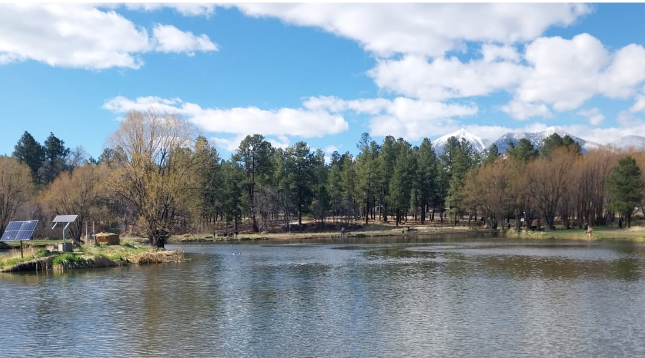
Frances Short Pond - The limit is 2 bass minimum size 13 inches, the limit is 4 channel catfish, the limit is 5 sunfish, the limit is 4 trout. Fishing has been good for trout with anglers finding success using PowerBait, worms, in-line spinners like Joe’s flies, and flies like Prince Nymphs (#12), Zebra Midges (#16-14), and gold-ribbed Hares’ Ears (#16-14). Rainbow trout and channel catfish will be stocked this week.
 |
Ashurst Lake - The Ashurst Lake Road (Forest Road 82E) is open. Only boats with a single 10-horsepower motor (or less) or a single electric motor are allowed on Ashurst Lake. The limit is 4 trout. Northern pike and green sunfish were illegally introduced and are not managed for in Ashurst Lake. Northern pike and green sunfish are unlimited in Ashurst Lake, please kill any northern pike and green sunfish caught. The lake is low and the boat launch is challenging, be cautious when launching trailered boats. This is a good time of year to target the large holdover trout that Ashurst Lake is known for. Rainbow trout will be stocked this week.
Kinnikinick Lake - Only boats with a single 10-horsepower motor or single electric motor are allowed on Kinnikinick Lake. Please do not put rocks on the boat launch: As the lake levels rise, the rocks become hazards for boats and trailers and block access to the lake for boat anglers. Tiger trout will be stocked this week.
Marshall Lake - Only boats with a single 10-horsepower motor or single electric motor are allowed on Marshall Lake. The lake is very weedy, making fishing challenging.
VERDE VALLEY STREAMS (Red Rock Ranger District, Coconino National Forest)
Oak Creek - As of Jan. 1, 2023, the catch-and-release section on Oak Creek has been
expanded to include Oak Creek from the Highway 89A bridge at Slide Rock State Park
upstream to the Sterling Springs Fish Hatchery property boundary including the West Fork
Oak Creek. This section will be catch and release only for trout, artificial fly and lure only,
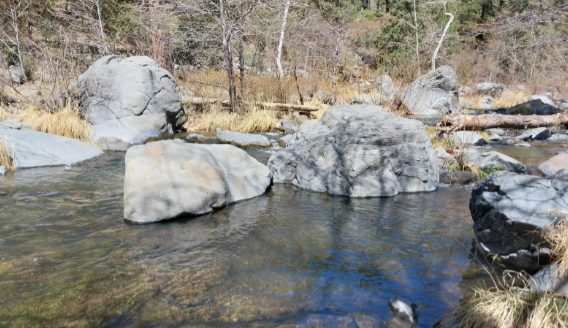
barbless hooks only. Stream flow is at base flow conditions with a recent reading of 31.0 cfs, stream temperature 55.4-58.5 F, turbidity 1.9 FNU @ 8:45 a.m. on 5/6/2025. Cave Springs Campground will remain closed for repairs. Access to the Cave Spring area opened April 11 for walk-in and angling access. The Banjo Bill picnic area is closed for repairs. The busy tourist season has started; to beat the crowds, try fishing early in the morning. Anglers are finding success on inline spinners and flies. Hellgrammite, Simi-seal leech, midges, elk hair caddis, hoppers, and mayfly patterns are a good bet. Anglers are catching Gila, rainbow, and brown trout. Rainbow trout will be stocked this week.
 |
West Clear Creek - Smallmouth bass are unlimited harvest in West Clear Creek. Roundtail
chub are often caught in sections of West Clear Creek; please release them unharmed. The limit is 4 trout. Stream flow is at base flow with a recent reading of 15.9 cfs and stream temperature 59.2-62.4 F 5/6/2025 @ 8:45 a.m. Rainbow trout will be stocked this week.
Wet Beaver Creek/Beaver Creek - Bass are unlimited harvest in Wet Beaver and Beaver
Creeks. There is the potential to catch a native sucker or roundtail chub; please release them unharmed. The limit is 4 trout. Stream flow is stable with a recent reading of 7.00 cfs @ 8:45 a.m. on 5/6/2025. Average base flow is about 4-9 cfs for Wet Beaver Creek. Rainbow trout will be stocked this week.
CENTRAL ARIZONA
The Lower Salt River is due to be stocked with rainbow trout this week.
At Bartlett Lake, pro angler Gary Senft reported he and his fishing partner caught 41 bass on a cool day. Starting early in the morning, they were having great success with skinny wire spinner baits. When the bite turned off around 9-10 a.m., Gary's partner switched to a 5150 shad-colored worm and the bite turned back on. They also used some other worms, including 5150 money shots and curley tails and Phat Pak slinky worms on a mini Carolina rig. Watermelon Senkos were also working. Fish were caught in about 12-20 feet of water. See the video.
At Saguaro Lake (report courtesy of Sportsman's Warehouse), fishing is rated as good. Bass are moving to depths of 15 to 20 feet, favoring structures and trees. Effective lures include Berkley soft baits, Yamamoto large Senko worms (4.5 to 7 inches), Robo Worms for drop shots, ZMan chatter baits, Strike King spinnerbaits, Keitech swim baits, and Missile flipping jigs. Topwater options like Spooks, Whopper Ploppers, and Rico's are also recommended. For deep-water fishing, consider Strike King and Rapala crankbaits and jerk baits. Catfish are biting well on bottom worms, stink baits, minnows, and chicken liver. Crappie anglers should try Crappie Magnets, Kalins, and Z-man micro lures. Saguaro Lake offers a diverse range of fish species, including largemouth and smallmouth bass, rainbow trout, crappie, sunfish, channel catfish, walleye, tilapia, yellow perch, and carp.
NORTH CENTRAL LAKES
Fain Lake and Mingus Lake are due to be stocked with rainbow trout this week.
MOGOLLON RIM LAKES (Mogollon Rim Ranger District, Coconino National Forest)
Bear Canyon Lake, Christopher Creek, East Verde River, Tonto Creek, Willow Springs Lake, and Woods Canyon Lake are all due to be stocked with rainbow trout this week.
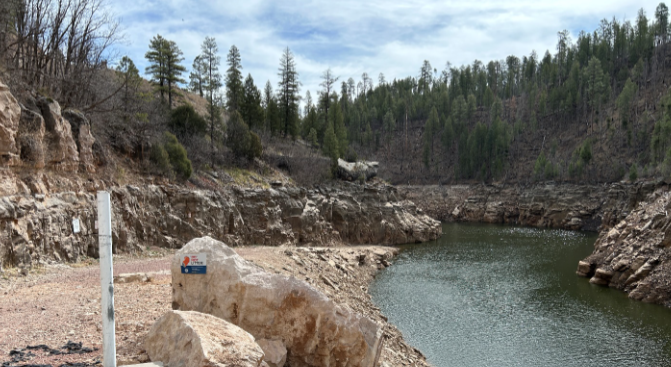
Blue Ridge/C.C. Cragin Reservoir - The Blue Ridge Campground is open. Only boats with a single 10-horsepower (or less) motor or a single electric motor are allowed on C.C. Cragin Reservoir. Green sunfish are unlimited and invasive; please remove them if caught. Reservoir elevation 6,657.44 ft, current volume is at 3,664 acre feet or 24% full and stable on 5/6/2025. The gate at the top of the boat launch is locked. Boaters can hand carry or drag small watercraft the ~100 yards down the boat launch to the water. Launching a boat becomes more difficult at the lake drops. Check with the Mogollon Ranger District of the Coconino National Forest for updates on access.
 |
Knoll Lake - Knoll Lake Campground is closed for the winter. Only boats with a single electric motor are allowed on the lake. The lake level is low and the boat launch is out of the water, making launching a boat difficult. No gas-powered motors. Green sunfish were illegally stocked into the lake, please lethally remove all green sunfish caught. Reminder, the statewide limit is 4 trout per licensed angler per day. Rainbow trout will be stocked this week.
Huffer Tank - The limit is 4 trout. The tank is very low.
WHITE MOUNTAINS
East Fork Black River, Silver Creek, West Fork Black River and West Fork Little Colorado River (Greer and Sheep's Crossing) are due to be stocked with Apache trout this week. Show Low Lake is due to be stocked with rainbow trout.
LEES FERRY/LAKE POWELL
Lees Ferry - Water Temperature: 49.8-51.6 F; Dissolved Oxygen: 8.1-10.3 mg/l; pH: 7.9-8.3 std units; Discharge Rate: 9,240-11,600 cfs; Turbidity at 0.4 FNU as of 5/6/2025.
Upriver fly-fishing report courtesy of Skip Dixon, Lees Ferry Angers (https://leesferry.com/river-report/). The river flows allow anglers a few different options. Drifting or anchoring on deeper shelves has been productive. With abundant midge hatches, we have seen some very beautiful and robust fish landed. Black and silver midges, along with Midge X in sizes #16 through #22, are recommended.
Some areas are currently wadeable. You will find the dry-dropper rig effective in these areas. For anglers who have difficulty seeing dries, a pinch-on foam indicator with two midge patterns below works nicely.
The sink-tip bite has also been productive, especially with olive woolly buggers on a 200-grain sink tip.
These flows are subject to change. In the event of rising water conditions, ginger scuds and larger San Juan Worm patterns are excellent choices.
At this time, the water seems to be dropping rather quickly around noon. Be sure to keep an eye on your vessel to avoid becoming stranded.
Also, be aware of changing weather conditions and dress appropriately. Sunscreen and floppy hats are highly recommended to protect against sun exposure.
Lake Powell - Water Temperature (Wahweap Bay) 66 F, Lake Elevation 3,557.85 MSL (and dropping) as of 5/5/2025. The most recent report was in April, courtesy of Dan Keller (www.wayneswords.net). The lake elevation at the end of March was holding around 3,559 feet. This elevation is very similar to this time last year, so with that in mind, areas that fished well last spring should also provide good fishing this year. Beginning in mid to late April, water levels will start to rise.
Morning water temperature in March was holding around 52 degrees, with afternoon water temperature exceeding 60 degrees (south end of the lake). Water temperatures were expected to consistently reach mid 60s by the second week of April. That temperature really wakes up Lake Powell fish. Here is what was expected for each species in April.
Largemouth bass: Bass seek out and reside in cover, this can take the form of brush, tumbleweed piles, and trees. Bass share cover and space with sunfish. As the water temperature warms, bass will begin chasing sunfish, so if largemouth bass is your quarry, be on the lookout for cover and sunfish schools. Doing so you will put you in the right areas to catch largemouth bass. It’s still too cold for fast-moving presentations, so the lure must be placed in or really close to cover. A weedless presentation is often best. Use a slow retrieve to allow more time to entice fish to bite.
Black crappie: Thanks to all the vegetation that was submerged in 2023, it won’t be difficult to find potential cover; however, it likely will take some time to find a good concentration of black crappie. Search the backs of canyons where water depth is 12-25 feet with nearby submerged trees or large boulders providing cover. Try using an eighth ounce jig (hair jig or plastic grub), or Gulp Minnow to target black crappie in the backs of canyons. I like to use a slip bobber rig. Adjusting the bobber stop allows suspending the jig right over the brush, maximizing the jig's time in the “strike zone” and avoiding snagging up in the cover. I often tip the jig with a red wiggler worm (or small piece of nightcrawler) to increase bites from both black crappie and bluegill sunfish.
Smallmouth bass: Smallmouth bass prefer rock structure for cover, so it is easier to locate them with plastic baits fished on rocky shelves, in boulder fields, or at the edge of drop-offs and other shallow areas from 30 feet deep to the shallow shoreline. The key to springtime bass fishing is to find the warmest water available. Often a tall rock, facing the mid-day sun, will heat a cove slightly warmer than the surrounding water. Fishing in that cove will be better than a cove in the shade or without a warming rock. Pay close attention to water temps as you move around a cove or work along a shoreline. Locating even slightly warmer water can make a big difference in the number of fish you catch.
Walleye: Walleye fishing at Lake Powell picks up in April, when walleye are post spawn and ready to feed. Start your search by looking for green to muddy water in the backs of canyons. If shad are present and swimming in open water, bigger walleye can be caught trolling deep divers, and casting shad-size baits (jerkbaits, lipless crank baits). The last few weeks of April and all of May is one of the best times to target walleye. When trolling for walleye, it is best to fish at a water depth where the lure occasionally hits bottom. The most effective trolling method may be a bottom bouncer that can hit bottom at various depths. Walleye are bottom oriented, so a very effective technique is to simply hook a piece of worm to a curly tail grub, tube jig, or Ned rig, and slowly work that along the bottom structure. If you randomly catch a walleye while bass fishing, mark the location and return at
dusk, as walleye are more active during low light.
Striped bass (stripers): You often will need to cover lots of fishless water before locating a school, so get comfortable behind your sonar and spend the required time locating a big school before working too hard at enticing them to bite. In springtime, stripers can often be caught in the backs of canyons chasing lures or in deeper water of the main channel using spoons or anchovies as cut bait. So far this spring, bait has been more effective on the south end of the lake as shad numbers are on the decline. Many stripers caught this spring have been eating crayfish. Stripers prefer shad; however, shad numbers are at a low point coming out of winter and hungry stripers will move shallow searching for crayfish. Anglers are finding success from Bullfrog up to Good Hope Bay with various methods, including spoons, jigs, trolling, and cut bait. Anglers fishing at the south end should try the back of Navajo Canyon, Warm Creek, and cliff walls around mile marker 25. Striper fishing with
anchovies at the dam is also picking up. The condition of stripers is mixed right now, with about half being in good condition and half in poor condition. Catching and keeping stripers helps to maintain forage fish at Lake Powell, so bring an ice chest, fillet knife, and be ready to fill up bags of fresh striper fillets.
WESTERN ARIZONA
At Lake Mohave (report courtesy of Nevada Department of Wildlife), stripers are taking anchovies and jointed rainbow trout pattern swimbaits. Some fish are reaching double-digits. Anglers are bringing in rainbow trout on PowerBait, worms and Rooster Tails early in the day below Willow Beach. Black bass are showing signs of spawning in coves. Smallmouth bass are taking plastics and jigs in coves with vegetation.
At Lake Mead (report courtesy of Nevada Department of Wildlife), fishing is described as good. Black bass are hitting drop-shot rigs with creature baits and deep-diving crankbaits. Stripers are hitting on anchovies from shore near Boxcar Cove and outside Hemenway Harbor. Crappie fishing is peaking in the Overton Arm. Anglers are finding success with chartreuse jigs and tubes. Catfish are becoming more active as water levels warm throughout the day. Sunset fishing seems to produce the most catches.
Along the Colorado River near Bullhead City (report courtesy of Rusty at Riviera Marina), the largemouth bass are in spawning mode—either on the nest or guarding fry (baby fish). While striped bass are being spotted, they’re not showing much interest in bait or lures right now. The bite should pick up soon, and shore fishing along the Colorado River below Davis Dam is shaping up to be excellent this year.
At Alamo Lake (report courtesy of Sportsmen's Warehouse), fishing is rated as very good. Bass are currently found at depths of 15 to 20 feet, particularly around structures and submerged trees. Effective techniques and baits include: Soft plastics, utilizing Crush City soft baits and Yamamoto large Senko worms (4.5 to 7 inches) rigged in Wacky, Carolina, or Texas styles; Drop shot rigs employing Robo Worms for drop shot setups; Reaction baits using Z-Man chatter baits, Strike King spinner baits, and Keitech swim baits; Jigs - effective techniques include using poppers, jerk baits resembling shad or perch, and 8-inch spoons. Crappie fishing is also productive, especially during the spring season when they move into shallower areas to spawn. Targeting vertical timber in depths of 10-20 feet can yield good results. Additionally, Alamo Lake supports healthy populations of channel catfish, tilapia, and sunfish, providing diverse angling opportunities. Please note that construction is currently in progress on the main side of the park, with machinery and personnel working from 6 a.m. to 4 p.m. Visitors should plan accordingly and exercise caution in construction areas.
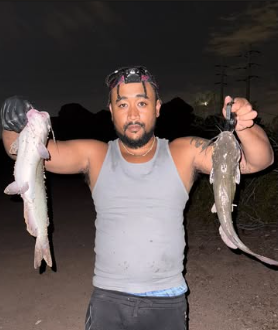
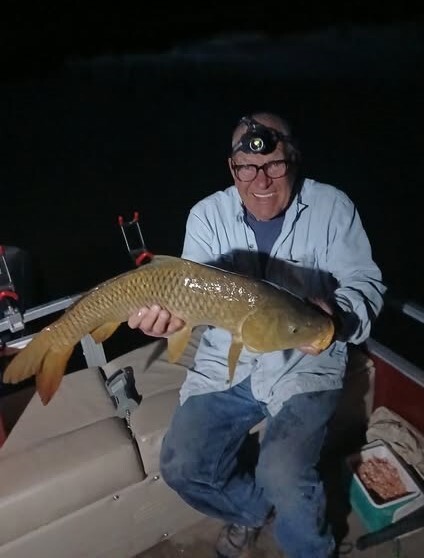
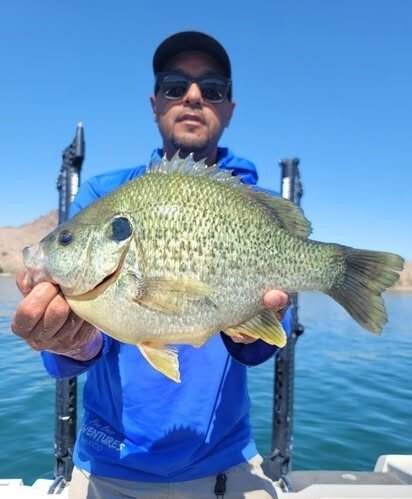
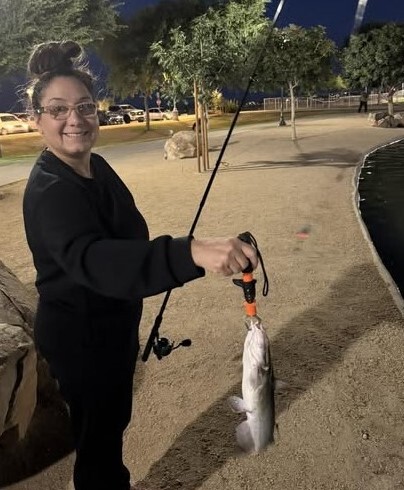
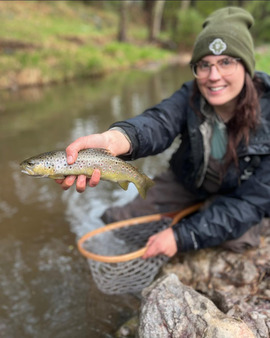
Angler posts
For each edition of the Fishing Report, we'll select some photos and reports submitted by members of the angling public either through the Fish AZ Facebook Group or through the bfishing@azgfd.gov email address. If you'd like your photo/report considered for publication here, please indicate the species, place, date, name (we only publish first name and last initial), and any other information you'd like to provide. For more photos (including new photos each day), visit the Fish AZ Facebook Group.
|