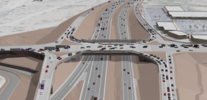
 TUCSON ‒ It may not be immediately apparent to those using the busy interchange
of Interstate 19 and Ajo Way (State Route 86), but a single set of signals will
soon control traffic in a configuration designed for efficiency and safety.
I-19 and Ajo Way soon will become the Arizona Department of
Transportation’s third single-point urban interchange in the Tucson area.
Others are at I-19 and Valencia Road, and at Kino Parkway and State Route 210 (Barraza-Aviation Parkway).
“We have an opportunity at Ajo Way and I-19 to use
a design that allows traffic to move more efficiently through the intersection
more quickly because drivers only have to move through one set of lights
instead of two,” said James Gomes, regional traffic engineer for ADOT’s South
Central District.
Temporary signals are in place at Ajo Way at this time. The new
signals are scheduled to begin operating in January.
Created in 1974 in Clearwater, Florida, the design is often used when
an interchange is being reconstructed. In a single-point urban interchange, left-turn
drivers from opposite directions can move through the intersection at the same
time. Among its other benefits, the design accommodates larger vehicles,
including trucks and recreational vehicles, even better than traditional
diamond interchanges.
This design has safety advantages as well. While the rate of
collisions is about the same, the single-point urban interchange has a lower
rate of injuries and fatalities.
After crews poured the new bridge deck over last weekend, the first
phase of the project, which also includes widening Ajo Way and improved exit
ramps at Ajo Way and Irvington Road, remains on schedule for completion in the
spring. The second phase, which hasn’t yet accepted bids from potential
contractors, will include widening southbound I-19, an additional transition
lane for northbound traffic between Irvington and Ajo Way and improvements on
Ajo Way that include a new bridge over the Santa Cruz River.
| 

