|
By DAVID RAINER
Alabama Department of Conservation and Natural Resources
One thing you will never find is a bass angler who is happy
with catching medium-sized fish. It is always bigger is better. That has been
the strategy for the Alabama Wildlife and Freshwater Fisheries (WFF) Division
for decades.
One method to achieve a larger bass is to introduce
different genetic traits into the population. That was what occurred recently
when Lake Jordan received its final stocking of Florida bass fingerlings.
The WFF’s Fisheries Section took the bulk of the Florida
bass production from the Marion and Eastaboga hatcheries and stocked the
fingerlings into Lake Jordan, a Coosa River impoundment.
“This is the third year where we have undertaken a
concentrated stocking of Florida bass in Jordan,” said Fisheries Chief Nick
Nichols. “Those stockings took place in the Bouldin impoundment. Those three
years of stockings at Jordan is just a continuation of a stocking strategy that
has gone on since the early 1990s.”
That strategy is to stock as many bass as the hatcheries can
produce in a given time frame into a single area of a single reservoir.
“The goal of that is not to increase the number of
largemouth bass in the lake,” Nichols said. “It’s simply an effort to introduce
Florida bass genetic material into that lake’s native bass population. We’ve
been doing this in reservoirs since the 1990s.
“We first attempted this at Lake Guntersville. We stocked
Florida bass in two or three distinct locations in the lake. Guntersville had
what we consider a true northern bass population. It’s on the Tennessee River
above the shoals. Even though we stocked fewer fish at Guntersville during that
time, the stocking of Florida bass on top of the native northern bass was
actually more effective. We were introducing a different set of genes into that
population.”
The result was the stocking efforts shifted the Guntersville
bass from a pure northern bass to an integrated population with Florida bass
traits. Later studies indicated that about 30 percent of the Guntersville bass population’s
genetic material came from the introduced Florida bass.
“This showed that the stocking was successful, and it had
some performance enhancement on the fishery,” Nichols said.
Fisheries biologists introduce Florida bass into a
population in areas where that subspecies will thrive, mainly the warmer waters
of the South and Southwest. Florida bass traits enhance performance, which
means larger numbers of trophy bass are being caught with a larger average
size.
“Florida bass are known to live a little longer, and they
have the genetic propensity to grow to a larger size,” Nichols said. “They
don’t necessarily grow faster, but they do seem to live longer, which allows
them to grow to a larger size. However, what has been observed in situations
where Florida bass have been stocked on top of northern bass is you get, at
least temporarily, a population-wide hybrid vigor. Hybrid vigor is when you cross
two closely related species and the offspring outperform the parents. We saw
some of that in Guntersville. They’re seeing the same thing at Chickamauga in
Tennessee.
“The downside is that once you’ve introduced that new genetic
material into the population and you’ve gotten that initial hybridization
response, you really can’t recreate that result again. In other words, you
can’t go in with another Florida bass stocking and expect to get the same
response you did with the initial stocking.”
Nichols said several years ago the Mobile River basin
received several Florida bass stockings, but the results were noticeably muted
compared to Guntersville.
“It gets more complicated,” he said. “As we learn more about
the genetics of the native bass in Alabama, it’s become very apparent that the
native bass in the Mobile basin naturally have a lot of the same genetic
material as Florida bass. They aren’t necessarily Florida bass, but they share
a lot of the same genome. We haven’t seen the same responses in the Mobile
basin that we saw at Guntersville.”
Farther up the Coosa River, WFF had significant success with
Florida bass stockings at Lay Lake several years ago.
“We were able to shift the population at Lay Lake to nearly
a 50-percent Florida bass population,” Nichols said.
Florida bass introductions have been conducted at lakes
throughout Alabama, including Wheeler, Lewis Smith, Martin, Logan Martin,
Demopolis and Aliceville.
“We’ve had mixed results,” Nichols said. “In some of those
places, we’ve been back to reevaluate the population post-stocking to see if
there have been shifts in the allele (genetic) frequencies. Even cases where we
have seen shifts, we haven’t seen the performance boost we saw at Guntersville.
It’s not the dramatic difference that a lot of people think. Depending on the
selective pressures in a body of water, you may not even see a response.”
In the Lake Jordan stocking effort, a total of about 900,000
Florida bass fingerlings were released in the three-year period. However,
Nichols said that’s not a huge introduction in the grand scheme of bass
reproduction.
“That actually works out to less than 100 fish per acre that
we stocked,” he said. “What we have a hard time explaining to folks is the
stocking is on top of the natural reproduction from the native fish that has
already taken place. That natural reproduction can be 10 to 20 times the number
of fish released in the stocking.
“If we were stocking 50 Florida bass on top of natural
reproduction, which could exceed 2,000 native bass fingerlings per acre per
year, only a small percentage of those fingerlings, both the Florida bass and
native fish, survive that first summer and recruit into the population. We don’t
expect a large percentage of the 300,000 fingerlings we stocked at Jordan to survive.
We hope a small percentage will spawn with native fish and get results a few
years down the road.”
Nichols said, for the last four to five years, that annual
production of Florida bass fingerlings at the hatcheries at Marion and
Eastaboga has been between 300,000-400,000. The hatcheries also produce striped
bass, hybrid bass and walleye fingerlings.
Even if the hatcheries were able to significantly boost
Florida bass production, Nichols said it still would have little impact on the
large reservoirs.
“It’s a numbers game,” he said. “Say we bumped up hatchery
production and were able to crank out 1 or 2 million Florida bass fingerlings,
and we took the entire production and stocked them in Guntersville. Guntersville
is a 70,000-acre reservoir. That works out to stocking less than 30 fish per
acre.
“If you go to any of our reservoirs, you’ve got natural bass
reproduction taking place every year where the natural reproduction is probably
between 2,000 and 3,000 fingerlings per acre. When you’re stocking 30
fingerlings on top of that, it’s not going to have that much of an impact. Because
we have already introduced significant Florida bass genetics into the
population, adding a few more is not even going to be measurable.”
A couple of years ago, Guntersville bass anglers and
homeowners were afraid the bass fishery was in dire straits because of a
reduction in the number of quality bass that were being caught. Nichols said
that is just part of the cyclical nature of any large body of water.
“Everything hinges on recruitment, and that’s not just for bass,
but largemouth bass is a poster child,” he said. “Each year, bass are going to
spawn and produce millions of fry and eventually hundreds of thousands of
fingerlings. If most of those fingerlings survived, the lake would quickly
become overpopulated with bass. Only a small percentage recruit into the
population for a variety of reasons.
“Guntersville is a great bass reservoir. The habitat is
great. It’s almost the perfect largemouth bass reservoir. But what happened on
Guntersville is we had these great year-classes with very high recruitment that
occurred around 2008. Once those fish recruit into a population, they’re going
to grow and be caught by anglers. So for several years we had this boom up
there because we had those super-strong year-classes. That’s when everybody was
super happy. Big tournaments were coming to the lake, and everybody was
catching bass.”
Then that cyclical nature of reservoirs kicked in, and those
fish spawned during the super year-classes started to die out or were caught.
Those anglers and homeowners used to the fantastic fishing imagined the worst
and called for more fish stockings.
“People had the perception that the lake was collapsing,”
Nichols said. “But it wasn’t collapsing. It was just going back to normal. As
we have discussed over the past couple of years, we told everybody the lake was
going to recover.
“And we’ve just recently had another bump in the
Guntersville bass fishing. It’s not because of stocking; it’s because we’ve had
a couple of strong year-classes that are just coming into the fishery.”
###
 |
|
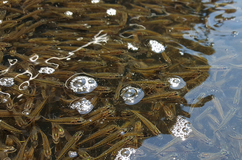
About 300,000 Florida bass fingerlings were stocked in Lake Jordan recently.
WFF Photo
|
You are receiving this message as a subscriber to DAVID RAINER'S WEEKLY COLUMN.
Manage Subscriptions to change your preferences.
|