|
By DAVID
RAINER
Alabama
Department of Conservation and Natural Resources
Honestly, I’m
not surprised that Alabama saltwater anglers caught so many red snapper in
six-plus weeks that the private recreational season had to close earlier than
planned.
Thankfully,
the Alabama Deep Sea Fishing Rodeo (ADSFR), with its Red Snapper Jackpot, managed
to squeeze in its final day of competition before the season ended Sunday, July
22. The season for the charter-for-hire boats fishing the rodeo ended at
midnight on July 21.
The unbridled
enthusiasm anglers exhibited for snapper fishing this year surpassed anything
I’ve witnessed in my 26 years of covering the outdoors in Alabama.
Alabama Marine
Resources Director Scott Bannon said the angler effort surprised everyone.
“On the
weekend of June 9, there were more people snapper fishing than I have seen in
my 21 years with Marine Resources, including on rodeo weekend,” he said. “The
effort was tremendous. Our Chief of Enforcement, Jason Downey, was on patrol,
and he said there were 200 boats surrounding him on the Bridge Rubble.
“The number of
people who went fishing this year has been phenomenal. And it’s good that
people had the opportunity to fish.”
The motivation
to catch snapper likely came from the dire situation that snapper anglers faced
in the spring. Without some kind of relief from NOAA Fisheries, the possibility
of even a short snapper season looked grim.
Instead, the
five Gulf states came together to request an exempted fishing permit (EFP) that
would allow each state to set its season under an approved system that allowed
each state to catch a certain quota of snapper.
The Alabama
Marine Resources Division’s mandatory Red Snapper Reporting System, better
known as Snapper Check, allows Marine Resources officials to monitor the
harvest on a near real-time basis, one of the reasons NOAA Fisheries approved
the EFP for the 2018 and 2019 seasons.
Marine
Resources based its proposed 47-day season on the data gathered from last
year’s snapper season. That data included daily catch rate, size of the fish
and the amount of angler effort (man-days fishing for snapper).
When the 2018
season was set, Bannon repeatedly used the word “potential” when discussing the
length of the season. It could be longer or shorter, depending on the daily
catch rate and weather.
The weather
turned out to be a factor, but not because it was bad. It was so good that
anglers only had a couple of days with rough seas during the 28 days of the
private recreational season.
“Without the
EFP, there may not have been a federal fishing season,” Bannon said. “The individual
state seasons could have consumed all of the total allowable catch.”
Based on the
2017 daily harvest rate of red snapper, Bannon said Marine Resources considered
a 50-day season, but reduced it to 47 days because they anticipated a “little
bit” of increased effort to catch Alabama’s quota of 984,291 pounds of red
snapper.
Bannon said
when the snapper harvest numbers for June were published, he knew the season
would have to be closed before Labor Day.
With the
unparalleled artificial reef habitat off the Alabama coast and good weather,
anglers of all skill levels were able to enjoy great snapper fishing. Huge red
snapper were posted on social media every day during the season.
Last year, the
data indicated an average of 1,770 anglers fished for snapper per day. In 2018,
preliminary data showed that the average anglers per day was much higher than
in 2017. The increased number of anglers, along with an increase in size of the
fish being landed, resulted in higher daily landings for the 2018 season.
“We don’t like
working with pounds,” Bannon said. “We’ve seen with the evolution of the
snapper seasons that with larger fish you obviously reach the total allowable
catch quicker. The product of our management efforts in the Alabama reef zone
is the increased abundance and size of fish being caught.”
Bannon said
the downside of the 2018 season is anglers have not fully embraced the benefits
of reporting their catches through Snapper Check. He said the 2018 reporting
rate is between 35 and 36 percent, up from last year’s 30 percent, but still
disappointingly low.
“I still feel
that people don’t fully understand how much better data we could get if we have
a higher compliance rate with Snapper Check,” he said. “Real numbers make a
difference in the landings estimate. With the state programs, we can maintain
greater awareness on the fishing effort and landings allowing us to maximize
the days of fishing.”
“The purpose
of the EFP is to show that states can manage their fishery to a quota, and that
we would manage it effectively to prevent overfishing and set seasons that work
for our anglers and are guaranteed a certain amount of fish. If you just open a
federal season, it’s a free-for-all across the Gulf. If the weather was bad in
our part of the Gulf we lose those days while others are fishing.”
The weather
was so good that one charter-for-hire captain told Bannon that he had never
been able to fish the entire month of June before this year.
“The positives
we see are, one, we had an allocation higher than what we caught last year.
And, two, we saw an increase in the number of people who were able to
fish,” Bannon said. “We opened for a season we thought would benefit the
largest number of people, and the data shows a lot of people went fishing.”
Dr. Sean
Powers, head of Marine Sciences at the University of South Alabama and one of
the ADSFR judges last weekend, said the good news is the red snapper fishery in
the Gulf of Mexico continues to get better.
“About five
years ago, the Gulf Council removed the overfishing (catch rate too high)
status from red snapper,” Powers said. “Just recently, the Council removed the
overfished status. Based on the numbers in the stock we are not in an
overfished status, meaning the biomass is no longer below the threshold we
think jeopardizes the stock. Although we want to rebuild the stocks a little
further, it is no longer overfished.
“That means
the seasons and bag limits will stay relatively constant for a while. The
(computer) models show an increase in the number of fish over the next couple
of years. The stock is very healthy right now, especially off Alabama. Every
year we seem to get good recruitment (juvenile fish entering the fishery), and
those recruits have that artificial reef habitat. Plus, there is a lot of
natural habitat in the deeper water that acts as a reserve, because people
don’t have to go that far to catch their limit of snapper.”
Bannon said if
the red snapper fishery continues to be managed by the states it will reduce
the chances that overfishing will become a problem again.
“The takeaway
is we had 28 days of incredible red snapper fishing that a tremendous number of
people took advantage of,” Bannon said. “And we have shown that the states can
responsibly manage the red snapper fishery. The sustainable management of
this red snapper season will go a long way to ensuring continued and expanded
state control of this fishery.
“But folks need to know there are a lot of other
fish in the Gulf to catch now that red snapper season is closed. You can catch
beeliners (vermilion snapper), king mackerel and Spanish mackerel, and the
triggerfish and amberjack seasons open back up the first of August.”
 |
|
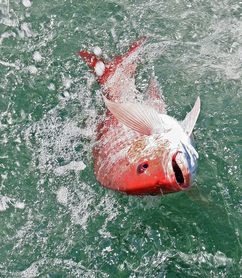
Anglers fishing in Alabama's artificial reef zones found plenty of red snapper to catch during the 2018 season, which ended on July 22.
Photo by David Rainer
|
You are receiving this message as a subscriber to DAVID RAINER'S WEEKLY COLUMN.
Manage Subscriptions to change your preferences.
|