|
By DAVID RAINER
Alabama Department of Conservation and Natural Resources
From a shaded retreat on John’s Bay in the Mobile-Tensaw
Delta to the boardwalk atop the highest mountain in the state, the Alabama
State Parks System offers an incredible diversity of nature’s wonders to
explore.
Just north of the point where the Mobile-Tensaw Delta and
Mobile Bay converge, Meaher State Park offers a respite from the hustle and
bustle that can be seen in the distance on the Bayway crowded with frustrated travelers.
Tall pine trees blanket the 1,300-acre park that borders the
Delta’s biologically rich John’s Bay to the south and Ducker Bay to the east.
According to Anna Bryant, Meaher’s new park superintendent,
visitors head to the park with their travel trailers in tow, attracted to the
shade on the water’s edge.
A native of Auburn, Bryant came to love the area while
teaching environmental education for two conservation organizations and jumped
at the Meaher job about a year ago.
“I enjoy being in the outdoors,” Bryant said. “I love the
water. I didn’t grow up near the beach. But the water and flora and fauna here
at Meaher is a very therapeutic place for me. That is a bonus of this job for
me.”
Callie Thornton, the assistant park superintendent at Cheaha
State Park, finds her therapy in the mountains, and Cheaha, completely
surrounded by the Talladega National Forest in northeast Alabama, is the
perfect location for her.
Already a dedicated backpacker before she took the job at
Cheaha a year ago, Thornton now gets to share her love of hiking with an
abundance of park visitors and fellow hikers.
“What attracted me to Cheaha was the mountain and the
Pinhoti Trail,” said Thornton, the former Town Clerk at Rockford, Ala. “I
wanted to be able to teach others how to backpack, the importance of being
outdoors and inspiring others to love the outdoors.
“I’ve been backpacking for about 12 years now, doing
anything and everything adventurous. I’ve done more than 1,000 miles backpacking,
so now I teach backpacking courses. And a lot of people are scared of camping.
My goal is to teach people to not be afraid of being in the outdoors.”
Thornton’s instructions include camp cooking, first aid, what’s
needed in your backpack and, possibly more important, what’s not.
“I’ve been able to get my backpack down to 27 pounds for a
seven-day trip,” she said. “If people will bring me their backpack, I will go
through it and divide and conquer, as I say. I advise them on what kind of gear
they need as far as shoes and clothing. A lot of people think they need to take
multiple days of clothes. If you pick the right gear, you might need an extra
pair of socks, but you don’t need anything else.
“I had a friend with me on one trip who had 60 pounds in her
backpack. She was really suffering. While we were on the trip I went through
her bag. When we got to the next station, I told her to take this and that out
and put it in the hiker box or mail it home. I’ve learned through experience
about a lot of things, like blisters and how to deal with them and how to
protect your feet. A lot of it is simple stuff that I want to pass on to make the
person’s trip a lot better the next time around.”
At one time, Cheaha was the southern terminus of Thornton’s
beloved Pinhoti Trail. That terminus has since been moved about 60 miles south
to Flagg Mountain. The Pinhoti Trail covers about 170 miles in Alabama and 166
miles in Georgia before it connects with the Appalachian Trail. Hikers can also
gain access to the Eastern Continental Trail that transits the entire eastern
U.S.
Thornton, also president of the Alabama Pinhoti Trail
Association, hopes to bring more exposure to Alabama’s Pinhoti segment.
“We don’t get a lot of publicity on the Alabama Pinhoti
Trail,” she said. “Georgia’s trail gets a lot, but Alabama’s doesn’t. It could
be a big tourism booster for Alabama.
“My goal is to raise the awareness of the Alabama section of
the trail. People don’t know that it also is a connector from Key West (Fla.)
all the way to Maine.”
On a hot summer day, a bonus of being at Cheaha is the
weather.
“It’s about 10 degrees cooler on the mountain,” Thornton
said. “Sometimes it’s more than that, depending on the wind. When I got here
last May (2017), I was freezing to death. We can sit in the restaurant and see
the weather around us. If I see a storm coming and we’ve got people in the
pool, I can go get them out. The good thing is, most of the time, the bad stuff
goes around us.”
Another attraction for Cheaha visitors is the solitude of
the mountain, which is 2,407 feet above sea level, the highest in the state. A
variety of accommodations await, from cabins and chalets to improved and
primitive camping.
“A lot of people come to Cheaha to disconnect,” Thornton
said. “If you want to get away from it all, if you want to get away from your
telephone, your Wi-Fi, this is where you come. Once you come around the curves
on (Hwy.) 281, you lose your connections. I just got a call from a man who said
he was ready to get away from work. People disconnect and they go hiking, swimming
and enjoy the restaurant. They come to hike. They come to see the wildlife, the
deer and turkeys. We have a lot of birdwatchers who come to the park. We have
gem-mining for the kids and a lot of interpretive nature programs for the whole
family.”
Now hop in your vehicle, come down the mountain and head
south about 260 miles to Meaher State Park to experience Alabama’s coastal
plains and the expansive Mobile-Tensaw Delta.
Meaher offers 61 improved campsites, 10 improved tent sites,
a couple of primitive tent sites and four cabins. Two more cabins will be
available later this year.
Bryant said Meaher appeals to campers in a couple of
different ways.
“We’re kind of a quiet park,” she said. “We don’t have a
pool or tennis courts or facilities that some of the bigger parks have. The
fact that people can come and relax, see the sunsets and see the water is a big
attraction for our overnight guests. But we also have a lot of day visitors who
love to fish. We have a fishing pier and a boat launch. They can canoe and
kayak or take their motor boat into the Delta or Mobile Bay. We also have the Gateway
to the Delta boardwalk that allows visitors to see the Delta from a different
perspective.
“Part of the draw is we have easy access to the Delta and
being able to stay overnight between Mobile and Baldwin counties.”
Because of its size, Meaher doesn’t have a park naturalist,
but Bryant has been able to utilize the environmental programs from Gulf State
Park and 5 Rivers – Alabama Delta Resource Center, which is located directly
across the Mobile Causeway from Meaher.
“The last program we had was a reptile show that 5 Rivers
conducted,” Bryant said. “They brought native snakes and turtles to show our
guests.”
Bryant will soon be involved in a park expansion, thanks to
a $3.5 million award from the Deepwater Horizon’s oil spill through the RESTORE
Act.
“Our hope is to expand not only RV sites but add a couple
more cabins and possibly another fishing pier,” she said. “We’re still in the
process of finalizing our plans. We want to offer our visitors a gamut of options
from just relaxing to enjoying the Delta.”
Visit www.alapark.com/cheaha-state-park
and www.alapark.com/meaher-state-park
for more information.
###
 |
|
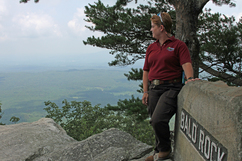
Callie Thornton at Cheaha State Park
takes in the vista at Bald Rock.
Photo by David Rainer
|
You are receiving this message as a subscriber to DAVID RAINER'S WEEKLY COLUMN.
Manage Subscriptions to change your preferences.
|