|
By DAVID RAINER
Alabama Department of Conservation and Natural Resources
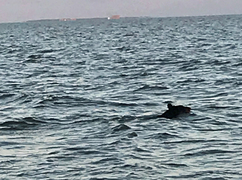
When the photo popped up on my smartphone, I wasn’t sure
what it was. Something was swimming in the south end of Mobile Bay, and I
facetiously asked, “Killer whale?”
The reply came back, “Black bear.” I expanded the photo,
and, yep, there was a telltale round, black ear. I knew this photo, taken by
inshore fishing guide Patrick Hill, would go viral.
However, as rare as this sighting may be, this is not the
first time it’s happened. About 20 or so years ago, a black bear swam the south
end of Mobile Bay, hung out on the Eastern Shore a little while, and swam back
to where he came from, probably headed toward a population of black bears in
the Grand Bay area.
Alabama Wildlife and Freshwater Fisheries Division Large
Carnivore Coordinator Thomas Harms was not really surprised that a black bear
took a shortcut recently, headed west from the Fort Morgan area.
“We have bear pictures from Orange Beach and Fort Morgan and
the Weeks Bay area,” Harms said. “I think there is a corridor there. These
bears sometimes just make a big loop.
“Bears are excellent swimmers. It was probably just a young
male on the move.”
If anyone should see a bear, Harms said the main course of
action is to remain calm and let the bear leave the area.
“There’s no need to freak out if you see a bear,” he said.
“It’s kind of like my father taught me about chainsaws. He said don’t be scared
of them but respect them. It’s the same thing with animals. If you’re scared of
it, just like chainsaws, it has the potential to hurt you. With a bear, don’t
fear it. When you see one, give it space and let it go away on its own.
“We’ve never had a bear attack in Alabama. It’s even rare in
the states where the population densities of bears are much higher. Just give
them space, and let them know you’re there. They don’t see very well and don’t
hear very well. Say whatever you want to, just be loud and let them know you’re
there. They will typically turn around and leave.”
Harms said the black bear males in Alabama can reach weights
of 250-300 pounds and live to be 15-20 years old. Females usually weigh 150-200
pounds. Harms said the likely adult population of bears for the entire state is
estimated at 300-400 animals. The population in northeast Alabama has a Georgia
ancestry, while the southwest population has Florida roots.
He said a new small population has popped up in Conecuh
National Forest in Escambia County.
“I’ve got pictures of a sow with cubs in Conecuh National
Forest,” Harms said. “If you have a sow with cubs, you know you have a viable population
of bears living there.”
Harms said the annual cycle for black bears starts in February
when the sows drop their cubs. In April and May, the males start expanding
their home range first, followed by the females with the yearling cubs. The
year-old females will settle on the fringes of the mother’s home range, but the
yearling males are run completely out of the area, which is when the bulk of
the human contact occurs.
“These young males get pushed out by their mothers, and then
they get pushed even farther by the adult males,” Harms said. “These males are
young and dumb. If they detect a dominant male, usually by smell, they’ll keep
moving until they find a place where they don’t detect any other males. These
are typically the ones that get turned around and into the suburbs and cities.
“The bulk of the calls we get this time of year is these
young males passing through people’s yards in downtown Birmingham. It happens
every year. We had one in downtown Daphne. One went from Georgia, through
Alabama, all the way to Mississippi. That bear may stay there, but it could
turn around and come back.”
Right now, June and July is the breeding season for Alabama
bears, which means the adult males will be on the move.
“The large adult males are looking around for receptive
females this time of year,” Harms said. “June and July is when the adult males
are moving the most. The home range for an adult male can be up to 59 square
miles, depending on the habitat. For females, the home range is about 20 square
miles.
“Habitat in the southwest part of the state is a lot better,
which makes the home range smaller than in northeast Alabama. It’s just the
type of habitat. You go from mountainous habitat in the northeast to
bottomlands in the southwest with tons of fruits, berries and vegetation. The
bears live in the bottomlands and use them for corridors. They go to the
uplands to eat. But they’re never too far from water. In the southwest, they
don’t have to go too far to the next drainage. In the northeast, they may have
to cross a mountain. They have to go much longer distances to get the same
benefits.”
Harms said the bears in Alabama have a 94-percent vegetarian
diet. Because Alabama does not have harsh winters, the bears can thrive with
much less protein in the diet. He said bears are opportunistic meat eaters if
they stumble onto a whitetail fawn or surprise a rabbit.
“Bears can’t chase down a rabbit, and once a fawn is able to
get up and run, the bear can’t chase it down,” he said. “Bears can reach speeds
of 35 miles per hour, but only for very short distances. They are not very good
predators. They will take advantage of any dead animals they come across, sometimes
called carrion. Deer that succumb to the
rigors of winter and the rut often become the main course for a lucky bear.”
Harms said bears in Alabama don’t really hibernate. During
the few cold days of winter, he said bears will do like humans and stay inside,
sleeping in their dens until the weather warms up again. The bears have put on
the fat for the winter and rarely travel far from the den area until spring.
In areas where known bear ranges are adjacent to suburban
subdivisions, Harms said homeowners need to make sure they don’t entice the
bears to venture onto their property.
“In some of these subdivisions, people like to put up
feeders so they can watch wildlife, like deer,” he said. “But there is a danger
of bringing a bear near your house. You need to make sure that feeder is a few
hundred yards away from the house. Make sure the bears can’t get to dog food or
anything like that. If a bear constantly comes close to a house, it’s going to
lose that fear of humans. Most bear attacks happen with bears that have lost
their fear of humans. We need to avoid that.”
In instances when it’s not practical to keep food sources
from the bears, Harms suggests using hot-wire fencing to deter the bears. Dogs
bred to be guard dogs can also help keep bears at bay.
“But, you don’t want a dog that will chase the bear,” Harms
said. “The dog will eventually catch up with the bear and may end up getting
hurt when the bear turns around to defend itself.”
Harms said there is a common myth a bear will stand on its
hind legs before attacking.
“The only reason bears get on their hind legs is to get
their noses high in the air so they can smell you,” he said.
Harms said anyone with an interest in black bears can visit www.bearwise.org. The website is supported
by the Southeastern Association of Fish and Wildlife Agencies (SEAFWA). The
Alabama Division of Wildlife and Freshwater Fisheries is a member of SEAFWA.
“The Bearwise website
is a very good resource,” Harms said. “Any questions you have about black bears
will be answered on that website.”
 |
|
A black bear decided to take a shortcut across Mobile Bay recently.
Photo by Patrick Hill
|
You are receiving this message as a subscriber to DAVID RAINER'S WEEKLY COLUMN.
Manage Subscriptions to change your preferences.
|