|
By DAVID RAINER
Alabama Department of Conservation and
Natural Resources
If the plan works out, Alabama red snapper anglers will have
access to the prized reef fish for more days than last year’s extended season.
The plan entails exempted fishing permits (EFPs) that allow
the five Gulf states to set seasons that will keep the snapper harvest within
the overall quota for the recreational fishery in the Gulf.
If approved, the EFPs will be used until the Gulf of Mexico
Fishery Management Council has time to go through the process to approve state
management plans for the Gulf states.
Commissioner Chris Blankenship of the Alabama Department of
Conservation and Natural Resources said approval for the state management plans
would likely not happen before 2020, and the EFPs would be in place during the
2018 and 2019 seasons.
“We were working with (Alabama) Sen. (Richard) Shelby and
talking with him last year about the possibility of Marine Resources managing
the red snapper fishery in the artificial reef zones off Alabama,” Blankenship
said. “We have more than 1,000 square miles of permitted reef zones, the
largest in the country, and we wanted to be able to manage the fishery inside
there.”
Sen. Shelby added language in the 2016 appropriations bill
that allowed NOAA (National Oceanic and Atmospheric Administration) to
establish a pilot program for state management in designated artificial reef
zones.
“That was the genesis of the exempted fishing permits,”
Blankenship said. “Alabama submitted our proposal to NOAA. They were concerned
if only one state did it, it wouldn’t be fair and the states wouldn’t have the
same opportunity. That’s where the idea for exempted fishing permits came from.
NOAA suggested that instead of a pilot program we do exempted fishing permits
for state management in each of the five Gulf states.
“Last week at the Gulf of Mexico Fishery Management Council
meeting, the Council voted to approve exempted fishing permits for the five
Gulf states. Although Council approval wasn’t required, the states and NOAA
wanted the Council’s blessing before proceeding. The exempted fishing permits
can be issued by NOAA, but the federal people and the Gulf states felt it would
be best to go to the Gulf Council so they could review the permits, ask
questions and make comments.”
Alabama Congressman Bradley Byrne, who has been at the
forefront of the effort to improve access to the red snapper fishery, thanked
the Gulf Council for supporting the EFP program.
“As I have always said, this issue is about so much more than
just our fishermen,” Byrne said. “A full red snapper season is good news for
the hotels, restaurants, gas stations, and other small businesses in our
coastal communities. I also want to thank Senator Richard Shelby, Alabama
Department of Conservation and Natural Resources Commissioner Chris
Blankenship, and our other Gulf Coast colleagues for working together to ensure
our fishermen and coastal communities have a full and adequate red snapper
season.”
After a 30-day public comment period, NOAA will consider
comments and take one of three routes – issue the permits, not issue the
permits or make changes to the permits before they are issued to ensure the
states don’t go over the quotas. A decision is expected in mid-April. Blankenship
said the five Gulf states worked together to come up with a plan to divide the
overall quota to try to minimize the chances the states would exceed the
recreational fishing quota for the year.
“Alabama’s portion of the quota would give us a season very
similar to what we had last year,” Blankenship said. “We thought that was a
good result last year. The people really enjoyed it, and we wanted to make sure
we had something at least that good this year and in 2019.
“I feel confident from the Gulf Council reaction that the
plan was prudent and had a lot of support. More important, in a letter from Chris
Oliver, head of the National Marine Fisheries Service (NMFS), in response to a
letter of support from Congressman Byrne, Oliver stated he and NOAA were very
supportive of the in-state management of the red snapper fishery. The leadership
at NOAA is supportive, the Gulf Council is supportive and the states are
supportive; we feel it was a well-reasoned plan for these exempted fishing
permits for the next two years.”
Alabama Governor Kay Ivey also applauded the support shown
by the Gulf Council.
“Alabama and the other four Gulf states worked diligently to
put forth comprehensive proposals that correspond to the geography and red
snapper populations off their states,” Governor Ivey said. “I am confident that
this EFP will demonstrate Alabama’s ability to effectively manage recreational
red snapper fishing in waters adjacent to our state.”
Based on the effort shown through the Red Snapper Reporting
Program, otherwise known as Snapper Check, from last year’s extended season of
42 days, Marine Resources Division Director Scott Bannon said the proposed 2018
season would be 47 days long. The snapper season would be on each Friday,
Saturday and Sunday starting on June 1 and ending on the Monday of Labor Day
and including the full week of the Fourth of July.
Alabama’s charter-for-hire sector is not included this year
in the EFP. The charter industry voted and opted to stay with the federal charter
season this year.
“For the recreational anglers, we used a population method
for the Alabama reef zone,” Bannon said. “The initial request from Senator
Shelby’s office in the appropriations bill was to create a plan for the reef
zone. Since we have some very specific science from our coordination with the University
of South Alabama and Dr. Sean Powers’ work, we utilized their research and population
estimates to come up with the plan.
“Based on the participation effort and harvest recorded
through Snapper Check, we can assure that we don’t exceed our allocation. We
could potentially close early, or we could add days in October if we don’t meet
the quota. We have that flexibility.”
The two-fish bag limit with a 16-inch minimum total length
will remain in effect.
Bannon said the reason Alabama decided to go with a
predominantly weekend season was because the format received favorable feedback
from the anglers who participated in last year’s extended season.
“We are trying to maximize the benefit for the most anglers,
and we felt like that was the best plan,” he said. “We realize there are still
some limitations to the state-licensed party boats because they are still held
to the 9-mile (state waters) limit. And we know during the tourist season, the
change-over is on the weekend. It does make it a little difficult for them, but
for the largest number of people, this is the greatest access we could provide.
“What we’ve seen is that, when you spread the season out,
you don’t have the intense efforts you have with a short season. People can
pick their weather days, which is better. People can pick days that work better
for their families and their schedules. Hopefully it will reduce the stress at
the boat ramps, and I think it helps the economy when you spread it out and
have people coming throughout the summer. Plus, we have the flexibility in
2019, if this goes well, that we could go to a different format that would
better accommodate the anglers.”
Bannon said all those plans and permits are predicated on
anglers’ participation in Snapper Check.
“That’s a vital component in making this a successful
program,” he said of Snapper Check. “Some people feel that not reporting works
to their advantage, and that is not true. It’s better to have real numbers
entered into the system. There is an algorithm we use that calculates the
compliance rate. Then it calculates the season, harvest and participation. If
our compliance is high, it’s closer to the real number and not an estimation.
“And remember, this a short-term effort. We’re still working
on a long-term solution through the Council or potential legislation in
Congress.”
Marine Resources plans to hold town hall meetings the last
week of April and first week of May, two in Mobile County, two in Baldwin
County and one in Birmingham. A Facebook Live session is also planned.
###
 |
|
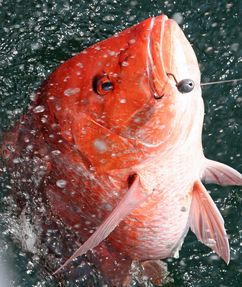
Alabama's extensive artificial reef zones produce huge red snapper on each trip offshore.
Photo by David Rainer
|
You are receiving this message as a subscriber to DAVID RAINER'S WEEKLY COLUMN.
Manage Subscriptions to change your preferences.
|