|
By DAVID RAINER
Alabama Department of Conservation and Natural Resources
Interaction between humans and black bears saw an uptick
last year, and that will likely be the trend for the near future, at least in
one corner of the state, according to Dr. Todd Steury of Auburn University.
Funded by the Alabama Department of Conservation and Natural
Resource’s Wildlife and Freshwater Fisheries (WFF) Division’s State Wildlife
Grants Program, Professor Steury, along with graduate students John Draper and
Chris Seals, recently completed a multiple-year study of the black bear
population in Alabama.
The basic conclusions were that Alabama has two populations
of black bears, one in northeast Alabama and one in southwest Alabama, and each
population has a different legacy as well as likely future.
The population in northeast Alabama, with roots from the
mountains of northeast Georgia, has the potential for significant expansion.
Hence, the likelihood that black bear sightings will become more common in the
future.
The population in southwest Alabama, which appears to be an
encapsulated population, is relatively stagnant, but significantly more
difficult to monitor.
“We think that most of Alabama, at one time, had black
bears,” Steury said. “We believe two of the sub-species kind of met in Alabama,
the American sub-species from the North and the Florida sub-species from the
South. Of course, black bears were pretty much hunted to extinction in the
state with one very small population remaining near Mobile.”
Steury said the Auburn study was prompted by the fact the
black bears in the Mobile-Tensaw Delta hadn’t been studied since 1992 and by an
increase in the number of bear sightings in the Little River area in northeast
Alabama.
“In that study in the Delta in 1992, it was a very small
population,” he said. “There was some concern about inbreeding because of how
small it was. Part of our goal was to reexamine this population to see how they
are doing. The other reason for the study was the increased sightings around
Fort Payne, and we wanted to know if there is a viable population up there or
just an occasional bear traveling through the area.”
Bear sightings in Heflin and Oxford made headlines last year
and prompted residents in those areas to voice concerns about the animals being
close to public recreation areas.
Steury said his team, which included Thomas Harms, WFF’s
Large Carnivore Coordinator, used a variety of methods to gather bear data. The
population density numbers were derived from a DNA study.
“We used two methods to gather the DNA information,” Steury
said. “One was eco-dogs. These dogs are trained to find bear scat. We took them
into areas where we knew there were populations of bears – Mobile, Saraland and
the Celeste Road areas. The eco-dogs are expensive to run, but they can get us
a lot of data. I think it was about 1,000 samples in two months of work.
“But the dogs are not cost-effective if you’re looking in
areas where you’re not sure about the presence of bears. For that, we used hair
snares. It’s basically a barbed-wire fence surrounding bait. The bear crosses
the barbed wire to get to the bait and the barbs pull a little hair out. Then
we get DNA from the hairs.”
Steury said the team erected hair snares in virtually every
township in Mobile County, about half of Washington County and most of Baldwin
County in the southern end of the state. In the north, hair snares were placed
in almost all townships between Interstates 59 and 20. The National Park
Service helped the team erect snares all over Little River National Preserve.
“We were sampling very widely,” Steury said. “We chose
townships because that’s about the size of a male home range. Overall, we had
about 300 hair snares in southwest Alabama and another 100-150 in northeast
Alabama.”
After all the data was collected, the analysis started. The
results gave researchers population numbers, genetic diversity, points of
origin and connections to other bear populations.
Steury said the DNA data indicated that the population in
northeast Alabama more than doubled, going from about 12 bears to 30.
“We know those bears came from north Georgia,” he said. “We
originally thought they might be from central Georgia around Macon, but the DNA
showed they came right down the mountain from Georgia.”
The results from southwest Alabama were not as conclusive
because of the requirements to meet the DNA profiling.
“We only got a good estimate from 2015,” Steury said. “We
estimated there were 85 bears, but the estimate said there could be as many as
165. So it’s still a fairly small population. Obviously, that is not a great
estimate, but we’d be very surprised if there are 200 bears down there. They
seem to be very localized between Wagarville and Chatom and the Celeste Road
area northwest of Saraland.
“The interesting thing is Chris Seals, the graduate student
working that area, said there are what he calls bear superhighways, these
riparian areas, rivers and corridors where these bears move. So we can get a
lot of DNA in those areas. So we’re very confident about the bears in those
areas. But in those areas in between, it’s much harder for us to figure out how
many bears are there.”
The story in northeast Alabama is that bears are finding
suitable habitat to establish home ranges and expand the population.
“The bears are breeding,” Steury said of northeast Alabama.
“We have seen numerous examples of sows with two or three cubs on our game
cameras. We feel like the population there is going to grow, and there are
still bears coming in from Georgia.
“We’re going to have more bears up there. There is lot of
great habitat in Jackson County and Talladega National Forest. It’s just a
matter of time for the population to expand.”
The prognosis for the southwest Alabama bear population is
not so optimistic.
“The habitat in southwest Alabama is disappearing,” Steury
said. “And, the population is not growing like it should. That is the next
question we have to answer. We have some hypotheses. Those bears seem to be
having good litters, but Chris is not seeing those cubs make it to adulthood.
One of the aspects we’re exploring is den sites. When you think of bear dens in
cold weather, what do you think about – caves or holes in the ground. In north
Alabama, you’ve got bunches of caves or holes in the ground.
“In southwest Alabama, bears don’t have that. We will
occasionally see denning in tree roots. What we see a lot of are nests. What we
don’t know is how much protection from the elements and predators those really
provide. Is the reason cubs are not making it to adulthood that they don’t have
good dens?”
Another concern of the researchers is the lack of new genes
in the southwest population.
“The genetic diversity in the southwest is really bad,”
Steury said. “It’s worse than any bear population in the Southeast United
States. Normally, to differentiate between brothers and sisters, you need eight
chunks of DNA. We couldn’t tell the difference between brothers and sisters
with our eight chunks of DNA. It took 14 to 15 chunks of DNA to tell the
difference between brothers and sisters in that population. So they’ve got
really low genetic diversity. We don’t really know how low that genetic
diversity has to get to affect the population. We’ve captured a lot of bears,
and we haven’t seen any deformities or other effects.”
The other conclusion derived from the DNA studies is the
connection of the specific populations with other populations in the Southeast.
“The northeast population is still pretty well connected
with the north Georgia population,” Steury said. “The southern population does not
appear to be connected with bears from Florida or western Mississippi. The DNA
suggests there is basically no movement of bears into the southwest population.
Bears come from Florida. We know because we track them. But they seem to get to
the rivers in the Mobile-Tensaw Delta and turn around and go back.
“We do catch and collar bears. The largest bear we have
caught weighed 308 pounds. Chris said he has seen one that he estimates at 400
pounds. But most of our bears average 150 pounds.”
When it comes to bear-human interactions, Steury said a
mailer was sent out to judge the public perception of bears.
“What we found out is that people like bears,” he said.
“They want to have bears in Alabama. Generally, they were not supportive of
lethal management controls except in extreme situations, where there was clear
danger to people.”
Steury said it is rare when large predators do anything
other than flee when they come in contact with humans.
“They can’t risk being injured,” he said. “If they’re
injured, they can’t hunt. They can’t feed themselves and they’re going to die.
They have no idea how hard or easy we would be to kill. They have no idea how
dangerous we are, which is what basically keeps us safe.”
Steury said the sightings that happened in Oxford and Heflin
last year were young male bears that had been kicked out of the mom’s
territory. Those 2-year-old males were roaming to find new home territories.
“They can cover thousands of miles,” he said. “That’s why we
see bears where they’re not supposed to be. They are juvenile males that are
exploring for a place to settle down. The thing is they never stay around. When
I got the call from Heflin about what they should do, I told them to just leave
it alone. In a day or two, it’ll be gone.
“If they get into somebody’s food or people start feeding
them, that’s when they become problems.”
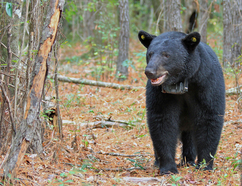
PHOTOS: (Courtesy of Auburn University) Black bears in
Alabama are being studied by using DNA collection devices, like barbed wire
around a bait, as well as collaring adult bears. One question researchers hope
to answer is whether bear nests in southwest Alabama provide enough protection
for cubs.
###
 |
|
Researchers have collared numerous bears in Alabama to determine home ranges and seasonal movement.
Photo courtesy of Auburn University
|
You are receiving this message as a subscriber to DAVID RAINER'S WEEKLY COLUMN.
Manage Subscriptions to change your preferences.
|