|
With
the holiday season upon us, plenty of people will be traveling around the
state. Usually there is a bit of “down” time during the holidays, and a new
exhibit on the Alabama coast should be on everybody’s must-see list.
It’s
called the GulfQuest National Maritime Museum of the Gulf Coast on the banks of
the Mobile River in downtown Mobile.
I
need to add one cautionary note: Allow plenty of time to enjoy the enormous
museum. An hour or two is just not going to be enough time. Plan to spend at
least four hours or more to do justice to the bountiful knowledge and
experience that can be gained from exploring the five decks of a simulated
sea-going vessel. The 90 exhibits, many of them interactive, provide examples
of the shipping industry, the ship-building industry, marine recreational
opportunities and the natural resources utilized to make life on the Gulf Coast
so enjoyable and important to our nation’s economy.
Other
than the exhibits, the 120,000 square-foot GulfQuest includes a museum store, a
museum café and event space. In addition to the excellent entertainment value,
the museum provides a major educational attraction for Mobile and the state of
Alabama.
Mike
Beasley, GulfQuest’s Development Director, and Diana Brewer, the museum’s
Marketing and Public Relations Director, shared the history behind the genesis
of the museum idea and how it was accomplished.
“Even
in the gift shop, we have screens that are tracking the ships coming up and
down the bay and the river, whether it’s tugboats or barges or container
ships,” Beasley said. “It tells you where they’re coming from and what they’ve
got on board. We get ships from all over the world.”
And
at the entrance of the museum, the café and gift shop are open to the public
without paying the museum fee.
“People
don’t have to have a ticket to come have lunch and enjoy the view of the
river,” Beasley said. “They can watch the river traffic with the best seats in
Mobile.”
For
those who buy a ticket to the museum, visitors are urged to sit in the
state-of-the-art theater and watch an introduction video that highlights life
on the Gulf Coast, from harvesting oysters to the Alabama Deep Sea Fishing
Rodeo to loading enormous container ships for voyages to the far side of the
world.
After
the video, visitors walk into the main exhibit and look up four decks at the
stern of a container ship with stacks and stacks of simulated containers.
“The
idea is that the museum is a container ship docked along the Mobile River,”
Beasley said. “The first deck is designed for kids and adults to learn about
the basic concepts and history of navigation, how propulsion works on a ship
and how sails propel vessels. There are interactive stations where visitors can
load barges and containers. It shows them just how hard it is to do this.”
One
exhibit is a joint effort with NOAA (National Oceanic and Atmospheric
Administration) that is called “Science on a Sphere.” Images are projected onto
the carbon fiber sphere from a wide variety of datasets, including shipping
activity, commercial airline traffic, current weather pattern, as well as
historic weather events like hurricanes Ivan and Katrina.
The
middle decks include exhibits about what goes on in the container shipping
industry, loading and unloading processes and artifacts and tools used in
stevedoring. One deck highlights the seafood industry and recreational fishing
opportunities. A video shows the oyster-tonging process with a familiar face on
the Alabama coast – Avery Bates of the Organized Seafood Association of Alabama.
For
history buffs, an awesome theater setting features a video on how World War II
impacted Mobile and the Gulf Coast in terms of construction of vessels and
other equipment for the war effort. The theater provides a Disney-like
experience with vibrating seats during explosions on the screen.
“The
board spared no expense to immerse the visitor in the experience,” Brewer said.
Another
interactive exhibit provides a detailed overview of the oil and gas industry in
Mobile Bay and the Gulf of Mexico as well as a look at the impact of the
Deepwater Horizon oil spill.
At
the top of the museum are the bridge and observation decks where visitors can
look north at the city of Mobile and Mobile River and then south into Mobile
Bay.
One
of the main attractions of the bridge is a simulator that lets the pretend
pilot choose from three vessels to navigate. The choices are towboat with
barges, container ship or U.S. Coast Guard patrol boat. Naturally, I chose the
Coast Guard vessel because it goes the fastest. The scenario provided was a
response to a ship entering the port of Mobile that was not responding to radio
messages. I chased down the ship at 46 knots, pulled alongside with sirens and
lights flashing. The vessel then responded according to protocol, and the Coast
Guard vessel made a quick turn and headed back down the Mobile Ship Channel.
The multiple screens and responsive controls added to the realism of the
experience. The hard turn almost had me believing the room was moving.
The
museum opened in September and has seen more than 15,000 visitors in short
order, according to Brewer, who said they had a soft opening with a number of
school groups to determine the capacity of the museum.
“We
had 700 kids at one time in the museum during that soft opening. That’s when we
decided we would cap the number at 500 with school groups,” Brewer said with a
laugh. The museum uses a team of 170 or so volunteers to accommodate the large
crowds.
Tony
Zodrow, GulfQuest Executive Director, was hired 10 years ago to make the
GulfQuest board’s vision a reality. Zodrow personally developed an exhibit to
detail the history of the Gulf Coast from 10,000 B.C. to present day.
“The
board traveled around the nation and overseas to look at different museums,”
Beasley said. “From what they saw in the United State as well as Europe, the
board knew this museum would have to be interactive, and it had to have a
regional focus to draw people in. What we wound up with here is something that
doesn’t exist anywhere else in the world.”
I’ve
barely touched the surface of the educational and recreational opportunities
available at the $60 million facility. You’ll just have to see it to believe
it. The museum is open from 9 a.m. to 5 p.m. Tuesday through Friday, 9 a.m. to
6 p.m. on Saturday and 11 a.m. to 6 p.m. on Sunday. Ticket prices range from
$14 for kids from 5-12 to $18 for adults. Group rates are available as well as
annual memberships. Go to www.gulfquest.org
for details.
Because
it is located on the riverfront, it takes a little maneuvering to get to the
museum. Coming from I-10, take the Water Street exit. “The best way is to come
down Water Street to Government. Turn left on Government, then a left on Royal
and a left on Monroe,” Brewer said. “That will take you straight into our
parking lot.”
 |
|
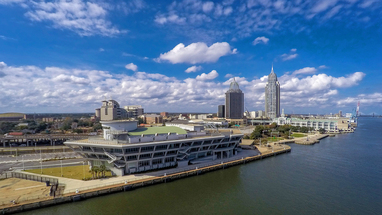
Located in downtown
Mobile on the banks of the Mobile River, the GulfQuest National Maritime Museum
offers an impressive array of fun and educational ways to learn about the culture,
economy and natural resources of the Gulf of Mexico and Alabama inshore waters.
Photo courtesy of GulfQuest.
|
You are receiving this message as a subscriber to DAVID RAINER'S WEEKLY COLUMN or KIDS LEARNING.
Manage Subscriptions to change your preferences.
|