| Having trouble viewing this email? View it as a Web page.
Alaska’s upcoming Youth Risk Behavior Survey helps teens be heard
 Many high school students struggled with remote learning, missed opportunities and isolation from friends this past year. Following this hard pandemic year, it is more important than ever to understand the challenges teens face and how to help them. Schools, districts and organizations across the state will be addressing these challenges using information collected from the upcoming Alaska Youth Risk Behavior Survey.
Typically, the Youth Risk Behavior Survey is given every two years in the spring of odd-numbered years. Due to challenges during the pandemic, the survey will be given the first semester of this fall. The survey, also called the YRBS, was developed by the U.S. Centers for Disease Control and Prevention (CDC) and was first conducted in Alaska in 1995. High school students in most states across the nation take the survey.
Alaska high school students’ participation in the upcoming 2021 YRBS is important, but voluntary. The survey includes randomly selected high schools and classes across the state. Students’ answers cannot be linked to them in any way.
This survey creates a snapshot of student experiences across Alaska, focusing on short- and long-term health trends. Survey questions ask teens about their experiences in a wide variety of areas, like physical activity and nutrition, alcohol and drug use, and bullying. This information helps many people — like parents, schools, districts, communities, organizations, and elected representatives — identify top priority issues, direct resources, and create programs to improve the health of all Alaska high school students.
“It’s important to understand what teens are experiencing so we can help them thrive, both inside and outside of school,” said Tazlina Mannix, the State of Alaska Youth Risk Behavior Survey Data Manager.
Benefits for all Alaska high school students
Participating allows students to be a voice for teens in their school, community and state. Districts and schools use YRBS results to set health goals and to inform health curriculum. Communities use YRBS results for grant applications and community needs assessments, which identify strengths as well as available and needed resources. The Alaska Department of Health and Social Services uses YRBS results to create and measure Alaska health goals and objectives in Healthy Alaskans 2030, and to help provide funding directly to schools and communities.
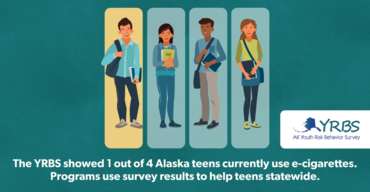
The most recent YRBS in 2019 showed that 1 out of 4 Alaska teens used e-cigarettes during the past 30 days. This new information allowed schools, organizations, and state programs to respond. For example, the Alaska Tobacco Prevention and Control program launched a statewide public education campaign to help parents talk to teens about the health harms of e-cigarette use. The program also created an e-cigarette educational module for school administrators and teachers to help them address rising e-cigarette use in schools.
 The YRBS also shows Alaska’s strengths. Past results tell us many Alaska teens make healthy choices. The majority don’t drink, have never tried cigarettes, and get As and Bs in school. These findings help parents, educators and organizations working to improve teen health understand both the strengths and needs of high school students.
Anonymous, Voluntary, Informed Participation
All steps are taken to ensure student privacy during the YRBS. Teachers or proctors of the survey follow strict guidelines and sign confidentiality agreements. Students seal their completed answer sheet in a privacy envelope, and these are sent directly to the Alaska Department of Health and Social Services. Students do not sign their names or include any identifying information on the surveys.
Active consent is needed for Alaska’s YRBS. That means parents and legal guardians must sign a permission form for students under age 18 to participate. Parents also have access to information about the survey. Every survey question is voluntary for students. Even with parent or guardian consent, students make the choice to participate.
A survey for the state, by the state
The Alaska Youth Risk Behavior Survey team has worked with many school districts and community organizations to develop survey questions and priorities.
“We want to make sure we’re collecting information that communities need and want,” Mannix said. “Not everyone is a data scientist, but this survey makes it easier to understand how everyone can best help Alaska teens.”
The goal is to have high participation from students across the state so the results represent all Alaska high school students. This is called a representative sample. Getting a representative sample can be difficult, especially in harder-to-reach communities. It takes support from families, schools, districts and communities to make this happen. If families want their experiences and perspectives represented, it is important to encourage their teens to participate.
For more information about the Alaska Youth Risk Behavior Survey, go to our website or email us.
|