
COVID-19 Alaska Daily Clinical Update, June 13
Alaska Department of Health sent this bulletin at 06/13/2020 05:27 PM AKDT
Saturday, June 13, 2020
Liz Conway Ohlsen, MD
With information from Anne Zink, MD, FACEP, Alaska Chief Medical Officer
|
How is Alaska really doing with case numbers?
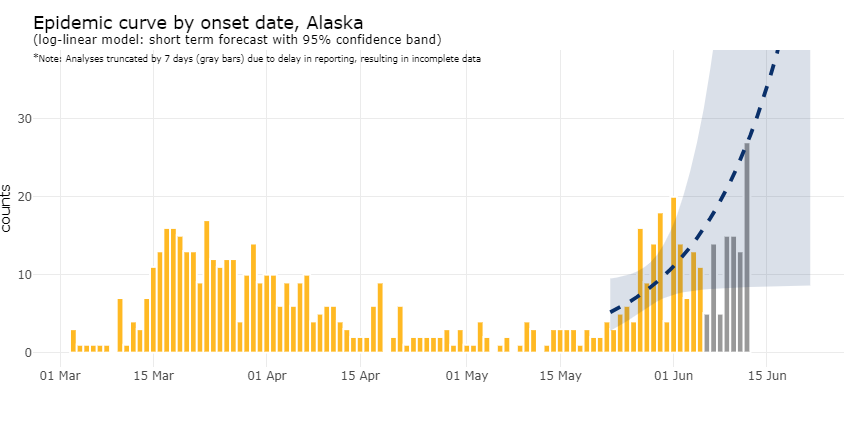
The graph above shows our current case trend, with a dotted line projection of future cases and the 95% confidence interval in projected cases in light grey. A week ago, our cases were doubling about every 11 days. Our current rate has new cases forecast to double about every 4.9 days. This is an estimate and the 95% confidence interval is between 3.15 and 10.99 days. Since, on average, people who have symptoms with COVID-19 develop symptoms around day 5.8, to prevent exponential spread we need to make sure that cases double slower than every 5.8 days. (If we double every 5.8 days, we have a reproductive number of 1; doubling faster and the Rt is more than 1, double slower and it is less than 1. This is shown in the graph below.) Broadly speaking, we had a doubling time slow enough to prevent exponential spread from about the end of March until around the last 1-2 weeks of May. Our doubling time has been getting a little faster every few weeks since the end of April.

To put these numbers in context, one major concern in other states is running out of hospital beds and ventilators. Twelve Alaskans have known or suspected cases of COVID-19 and are needing hospitalization right now, and two are requiring a ventilator, meaning we are still well under our maximum capacity to care for patients with severe COVID-19. 770 hospital beds and 325 ventilators are available. However, every new case is a missed opportunity. We are still close to getting cases to rise slowly enough to avoid exponential spread, but we have more transmission than we did a month ago. Encouraging our patients to continue physical distancing, hand hygiene and wearing face masks in public is even more important with our increased case transmission rates.
What has changed?
Alaska has had a few case clusters in the weeks since starting the reopening process. After Memorial Day, several case clusters were found associated with gatherings on the Kenai Peninsula. Additionally, an outbreak in an Anchorage nursing home has resulted in 44 cases: 18 patients and 26 staff. Unfortunately, in association with this outbreak, two Alaskans have died, the first COVID-19 associated deaths in the state in over a month. Simultaneously, we have had outbreaks on a ferry and associated with seafood industry workers, some of whom have come in from out of state.
New cases in the US were decreasing. What happened nationally?
While the overall national curve started to decline before Memorial Day, this was largely impacted by the massive outbreak in the NYC area finally coming under control. Meanwhile, smaller outbreaks occurred in large and small communities across the United States. Since there is up to a 14 day incubation period for the virus, and some states additionally have an extra lag of several days due to testing delays, there may be up to a two week lag in true detection of new cases. This means that decisions we make now have a bigger impact on what our curve will look like two weeks from now than they do on our curve today. We are just now starting to see the effects of decreased physical distancing in other states that occurred with reopening over the last few weeks.
With outbreaks increasing in other states, we may see increased transmission in the coming weeks elsewhere in the US. Alaska’s efforts to test or quarantine everyone entering the state as well as expanding testing of Alaskans will be critical in keeping our case numbers low.
What are the chances that Alaska is missing a bigger problem? For instance, some states have seen a bigger spike in mortality since late February than is explained by their reported COVID-19 cases.
Recently released information from the Bureau of Vital Statistics analyzed deaths in Alaska between January and April 2020. Compared to average deaths in the same periods of 2017-2019, all-cause mortality and mortality rates were slightly lower than in previous years, including for specific causes such as influenza/pneumonia, lower chronic respiratory disease, heart disease, suicide, homicide and unintentional injuries. A lower cancer death rate was also observed in this period. While this methodology cannot prove that there are no COVID-19 deaths that have been missed, it is reassuring that Alaska has not seen a spike in all-cause mortality or in respiratory-related deaths since the beginning of the pandemic.
|
STAY CONNECTED:


SUBSCRIBER SERVICES:
Manage Preferences | Unsubscribe | Help
Update your subscriptions, modify your password or email address, or stop subscriptions at any time on your Subscriber Preferences Page. You will need to use your email address to log in. If you have questions or problems with the subscription service, please contact subscriberhelp.govdelivery.com.
This service is provided to you at no charge by the Alaska Department of Health and Social Services.
For general COVID-19 questions, email covidquestions@alaska.gov.