|
Child and Adult Care Food Program (CACFP)
2027-01
|
|
Alaska Department of Education and Early Development
Division of Finance and Support Services
Child Nutrition Programs
P.O. Box 110500
Juneau, AK 99811 |
|
Subscription Management
Are you receiving this message but don't want to receive it? Is there someone in your organization that should receive this but isn't? Manage your subscription on GovDelivery.
This newsletter contains hyperlinks to information created and maintained by other public and private organizations. These links are provided for the reader’s convenience. DEED does not control or guarantee the accuracy, relevance, timeliness, or completeness of this outside information. Furthermore, the inclusion of links is not intended to reflect their importance, nor is it intended to endorse any views expressed, or products or services offered, on these sites, or the organizations sponsoring the sites.
|
|
 Sponsoring organizations and institutions are required by regulation to keep Bulletins, Instructions, and USDA Policy Memorandums for reference and to apply immediately the appropriate instruction to agency programs. The latest policy memos are found on the USDA FNS policy page. Call Child Nutrition Programs if you need further clarification.
There are new policy memos at this time.
|
|
Additional Topics
Grant Opportunity for CACFP Operators in Alaska
DEED CNP is excited to announce a new competitive grant that aims to fund technology upgrades for Alaskan Child & Adult Care agencies operating USDA food programs. To qualify for funding, organizations must participate in the Child & Adult Care Program (CACFP) in Alaska.
Grants are limited to a maximum of $10,000.
Proposals must clearly outline in the Grant Narrative section how the project will improve student experience, nutrition, or innovate service for the organization. Successful applications should also draw a clear connection between purchases and the project's stated goal.
The performance period for this grant is February 1, 2027 to September 30, 2027. All requests for reimbursement must be submitted to the state agency by October 29, 2027.
Late or incomplete applications will not be considered for funding. Applications must be submitted by 4:30 PM on January 8, 2027.
Interested parties can visit our application page for more details.
Non-Profit Food Service Report Due
Program operators are reminded to turn in your Non-Profit Food Service (NPFS) Report for PY2026. This is required for all for-profit, nonprofit, and public agencies operating the CACFP, and was due on November 1.
When completing the report, please double check your NPFS figures against the figures in CNP Web by going into the claims tab (YTD Claim Totals and YTD Center Expenditures). Listing those amounts on the NPFS Report lets you compare what you have reported with your actual numbers.
Make sure to submit your September claim first before submitting the NPFS via email or through your CNP Web checklist tab. You can email eed.cnp.cacfp@alaska.gov any relevant documents (like a detailed ledger or an income-expense report) to support your NPFS.
 New Oversight Tool: Product-Based Sugar Limits
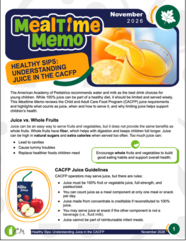
The American Academy of Pediatrics recommends water and milk as the best drink choices for young children. While 100% juice can be part of a healthy diet, it should be limited and served wisely. The latest Mealtime Memo from the Institute of Child Nutrition (ICN) reviews the CACFP juice requirements and highlights what counts as juice, when and how to serve it, and why limiting juice helps support children’s health.
The issues includes a comparison of juice vs. whole fruits, CACFP juice guidelines, creditable and noncreditable juice options, juice limits, smoothies, and others.
|
Free Webinar: Navigating the Holidays

Easy Bites is hosting a free webinar on holiday mealtimes with sensory-sensitive and autistic children. Learn how sensory processing, anxiety and development shape eating, and why holidays can be harder for some children. You will learn:
- A clear explanation of why some children eat the way they do, and how the holidays makes it even harder, including how sensory processing, anxiety, and neuro-development shape food behavior in ways that have nothing to do with pickiness or bad habits
- Strategies to reduce sensory overload and excitement during holiday mealtimes, while keeping the magic of the season
- Fun ways to engage with holiday foods beyond the table
- Strategies to share with families on bringing family and friends on board to reduce mealtime stress
Date: Dec 2, Wednesday
Time: 6-7 am Alaska
|
|
|
Contact Us
Child and Adult Care Food Program
School Meals
Summer Meals
Food Distribution Program
Fresh Fruit & Vegetable Program
|
Farm to School
The Emergency Food Assistance Program
Child Nutrition Grants
Child Nutrition Financial Management
|
|
|
USDA Nondiscrimination Statement (English)
In accordance with federal civil rights law and USDA civil rights regulations and policies, the USDA, its agencies, offices, employees, and institutions participating in or administering USDA programs are prohibited from discriminating based on race, color, national origin, religion, sex, disability, age, marital status, family/parental status, income derived from a public assistance program, political beliefs, or reprisal or retaliation for prior civil rights activity, in any program or activity conducted or funded by USDA (not all bases apply to all programs). Remedies and complaint filing deadlines vary by program or incident.
Persons with disabilities who require alternative means of communication for program information (e.g., Braille, large print, audiotape, American Sign Language, etc.) should contact the state or local agency that administers the program or contact USDA through the Telecommunications Relay Service at 711 (voice and TTY). Additionally, program information may be made available in languages other than English.
To file a program discrimination complaint, complete the USDA Program Discrimination Complaint Form, AD-3027, found online at How to File a Program Discrimination Complaint and at any USDA office or write a letter addressed to USDA and provide in the letter all of the information requested in the form. To request a copy of the complaint form, call (866) 632-9992. Submit your completed form or letter to USDA by:
Mail: U.S. Department of Agriculture Office of the Assistant Secretary for Civil Rights, 1400 Independence Avenue, SW Washington, D.C. 20250-9410;
Fax: (202) 690-7442; or
Email: program.intake@usda.gov.
This institution is an equal opportunity provider.
|
|
|
|
|