|
A single cup of cooked pumpkin provides over 200% of which essential mineral/nutrient?
Answer found below!
|
|
 |
Local Highlights!
Kodiak Island Borough School District
Listening to Students, Removing Barriers, and Increasing Meal Participation at KIBSD
Jerilyn Urban
Last year, we knew we had a problem. Breakfast participation District wide was low, with only 7% of students taking advantage of school breakfast. At the same time, many students were stopping by school nurses' offices later in the morning because they were hungry.
We knew we had to do something differently.
We began by looking at the barriers that might be keeping students from eating breakfast at school. One significant factor was a change in the bus schedule. Students were arriving approximately 10 minutes before the start of class, compared with 20 minutes the previous year. For many students, that simply wasn't enough time to wait in line, eat breakfast, and get to class on time.
But rather than assuming we knew all the answers, we asked our students.
Five students from each school joined our Student Food Council to tell us what they liked, what they didn't like, and what they wanted from their school meal program. We began offering taste tests for potential new menu items and, most importantly, we listened to their feedback. As students began seeing their suggestions turn into actual changes, they became more invested in the program.
One of our first successes was bringing back strawberry milk—and we made sure students knew their Food Council representatives had helped make it happen.
Students also helped us better understand the breakfast problem. They told us the lines were a deterrent. With only a few minutes before class, they would rather spend that time talking with friends than standing in a breakfast line. Others told us they simply weren't hungry when they first arrived at school—but about an hour later, they were.
So, we changed the way we serve breakfast.
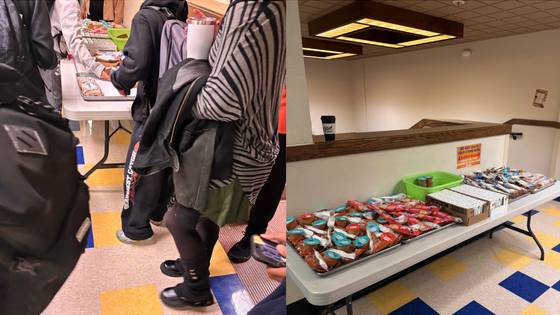
We created a grab-and-go breakfast that students can pick up quickly and take with them. Each morning, students can choose from several options, such as mini waffles, shelf-stable yogurt, a bagel with cheese, apple strudel, or cereal. Each breakfast is paired with fresh fruit and milk.
At Kodiak Middle School, breakfast is now available near the student entrance. Students can grab what they want as they arrive and then head to class or the cafeteria. The goal is simple: make eating breakfast easy and remove as many barriers as possible.
At the same time, we reviewed our schools' eligibility for the Community Eligibility Provision (CEP). We were able to add three of our five town schools to CEP, while three of our village schools continued their participation in the program. At CEP schools, every student can receive one breakfast and one lunch each school day at no charge.
Training, communication, and administrative support have also been critical. Our superintendent provided an opportunity for Child Nutrition to meet with all district administrators, explain our goals, and discuss the important role school leaders can play in increasing student participation.
Now, just one week into the school year, we are already seeing exciting results.
At Kodiak Middle School alone, breakfast participation has increased from 11 students per day to 127 students per day. Last year, just 2.76% of the school's enrollment participated in breakfast. Today, that number has climbed to 31.28%.
Other schools are seeing strong results as well, and participation continues to improve. At schools where administrators are actively engaged in supporting the program, participation numbers have improved by approximately 1000%.
We still have work to do. Our goal is to have 60% of students participate in breakfast and 50% participate in lunch. Those are ambitious goals, but our early results demonstrate what can happen when we stop asking, “Why aren't students eating?” and start asking, “What is getting in their way?”
Sometimes the solution is a different menu item. Sometimes it's moving breakfast closer to the front door. Sometimes it's eliminating a line.
And sometimes it's as simple as asking students what they need—and then listening to what they tell us.
When we listen to students, remove barriers, and work together, we don't just increase meal counts. We make it easier for students to come to class ready to learn.
|
 |

Southwest Region School District
Bringing Local Foods to Our Students Through Freeze‑Drying: A Rural Alaska Story
Jania Stephen
As a small rural Alaska district made up of eight K–12 schools across Togiak, New Stuyahok, Manokotak, Twin Hills, Clarks Point, Aleknagik, Ekwok, and Koliganek, we’re used to working with limited time, limited staff, and long supply chains. Last year, when the Local Foods for Schools grant was offered, our district received the funding later than expected—toward the very end of the school year. With only a short window to act, we purchased over 2,300 pounds of locally grown potatoes and carrots from DiTomaso’s and shipped them out to our district office.
But once those vegetables arrived, a new challenge became clear: summer break was almost upon us. How do you keep over 2,300 pounds of fresh produce from spoiling over months without students or staff around?
For us, the answer was to freeze‑dry everything.
Freeze‑drying turned out to be the perfect solution for our rural context. It offers an extremely long shelf life and preserves 90–97% of the food’s nutritional value. Vitamins C, B1, B9, B12, and B6 remain intact, and the lightweight results cut down on shipping costs. Even better, freeze‑drying let us season the vegetables ourselves, helping us stay compliant with National School Lunch Program sodium guidelines. And honestly? Our students love how different and interesting freeze‑dried foods are.
Of course, freeze‑drying in a small operation isn’t simple. It requires specialized equipment, proper facilities, staff willing to put in a lot of hands‑on work, and—most of all—time. For us, this was a two‑person project that took months.
To freeze‑dry fresh produce, every batch had to be washed, cut, chopped, or shredded first. Then we spread the vegetables across trays and froze them for 24 hours in a commercial freezer. After that, the freeze dryer prepared itself before we loaded the trays for a 36‑hour run. Each cycle could handle about 50 pounds of produce. Starting in May and working through August, we kept multiple sets of trays rotating—some freezing, some freeze‑drying, some being packaged.
Once batches were complete, we sealed them in Mylar bags, labeled them, and shelved them. Preparing the produce took additional steps: carrots had to be washed, sliced, and seasoned for carrot chips, while potatoes had to be peeled and blanched to prevent discoloration. Their high starch content meant extra maintenance, including more frequent oil changes for the freeze dryer. We used a brand‑new meat grinder to process the rest of the carrots and potatoes into forms like “mashed carrots.”
In total, we sliced roughly 300 pounds of carrots just for carrot chips.
As school started up again, we began traveling to our sites and introduced students to their new freeze‑dried options—starting with carrot chips. At first, students were unsure, but curiosity won. Nearly every student we’ve offered them to has tried them, and they’ve quickly become a favorite, especially among teenage boys. Many ask for seconds. They’re unlike anything the students have had before, yet familiar enough in texture to remind them of potato chips.
For smaller school sites with limited staff, they’re incredibly helpful. If a cook calls out and a principal or teacher has to step in to prepare lunch, freeze‑dried vegetables make it easy to meet required red/orange vegetable servings without complicated prep.
Even now, freeze‑drying continues—though at a slower pace since the school year has begun and it’s become a solo project. We’ve started working with corn, and the approach remains sustainable, cost‑saving, and waste‑reducing. Students also enjoy the novelty, which is a bonus.
Looking forward, we hope to try freeze‑drying a wider variety of fruits and vegetables, and possibly salmon or other meats. It’s time‑intensive and labor‑intensive, but it’s worth every hour. Better nutrition for our students will always be worth the effort.
|
Alaska School Meals Program Reminders
October 1 - Verification for pricing schools
October 14 @ 2:00 PM School Meals Monthly Call
- Buying Local Foods (District insight requested! Bring your ideas to the table.)
- Please email cnp.eed.schoolmeals@alaska.gov for link if you don't already have it
November 11 @ 2:00 PM School Meals Monthly Call
- (guest speaker, topic TBD)
- Please email cnp.eed.schoolmeals@alaska.gov for link if you don't already have it
February 1, 2027 - FNS-742 (verification report) due to DEED
Technology Innovation Grant
The purpose of this grant is to fund technology upgrades for Alaskan schools and RCCIs operating USDA food programs. Applications due October 16, 2026 by 4:30 PM.
Apply HERE!
Equipment Assistant Grant
The purpose of this grant is to fund food service equipment for Alaskan schools and RCCI operating USDA food programs (must operate NSLP to qualify for this grant). Applications due October 16, 2026 by 4:30 PM.
Apply HERE!

Claims - Submit claim data online through the CNP Web Database.
- August Claim Month - Submit to DEED by September 30, 2026. Late submissions will be accepted until October 30, 2026.
- September Claim Month - Submit to DEED by October 30, 2026. Late submissions will be accepted until November 29, 2026.
The final claim will not be accepted if it is not in the Pending Approval status within 60 days of the last day of the claim month. Upward amended claims may be submitted throughout the 60-day period but no later than 60 days. Be aware, claims in Error status cannot be paid and if help is needed from Child Nutrition the sponsor must contact Child Nutrition well in advance of the 60-Day Deadline.
|

Verification Begins October 1!
It is that time of year again! For all pricing schools, it is a requirement per 7 CFR 245.6a to verify a sample of free and reduced-price applications. CEP schools are not required to do verification, though they must complete the FNS-742 (verification report) before February 1, 2027.
- All activities should be concluded by November 15 (you MUST request an extension from eed.cnp.schoolmeals@alaska.gov if you exceed this date)
- Standard sample size is the lesser of:
- three (3) percent of all applications approved as of October 1, 2026 or
- 3,000 error prone applications approved as of October 1, 2026.
- If the number of error-prone applications exceeds the required sample size, the LEA shall select them for verification at random.
- In addition to the required verification sample, LEA must verify any questionable applications, such as a zero-income household or when there is reasonable evidence to believe the income reported on the application was incorrect for the household. These are not considered part of the required sample size.
|
Alaska School Nutrition Association
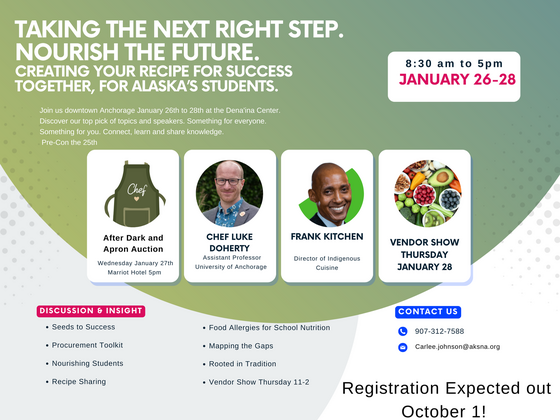 Hotel(s) offering your special group rate:
Marriott Anchorage Downtown for 189.00 USD per night - Last Day to Book : Monday, January 11, 2027
Book your group rate for AKSNA Annual Conference 2027
Alaska Team Nutrition grant information coming soon!
Other Program Updates and Resources

Defining Evidence for Programs to Ensure Nutrition for Development (DEPEND) Grant
Nutritious school meals support child health and development, yet school systems face persistent operational, workforce, infrastructure, procurement, and financial constraints. This funding opportunity is designed to answer the overarching question: What procurement, infrastructure, workforce, operational, and student-centered strategies enable schools to provide healthier, appealing meals at scale within existing recurring school-meal resources?
School districts, School Food Authorities (SFAs), district/SFA-wide or multi-district consortia or individual schools will implement strategies to address school-meal challenges at a scale sufficient to generate credible evidence.
DUE OCTOBER 13!
DEPEND application: https://redcapedc.rti.org/depend/surveys/?s=WF8CXA94M4PHWEK4
|
Promoting Real Food in Child Nutrition Programs
USDA’s Team Nutrition is pleased to announce the release of nutrition education and training resources designed to help Child Nutrition Program operators to promote the clear, common-sense message of the Dietary Guidelines for Americans, 2025-2030: Eat real food.
These resources focus on eating whole, nutrient-dense foods. These foods include protein foods, dairy, healthy fats, vegetables, fruits, and whole grains. Additionally, it highlights the importance of limiting the intake of highly processed foods, added sugars, and refined carbohydrates.
Resources for Schools
Resources for Child Care Organizations
Are you real food-savvy? Test your knowledge with the Eat Real Food Web Quiz!
Food Recalls
USDA sends out frequent communications about food recalls. If you are interested in receiving these communications, please click here to manage your subscription.
|
 |
|
Chef Ann Foundation 2027 Grant Applications for Salad Bars to Schools Deadline: March 31, 2027
Salad Bars to Schools (SB2S) is a grant program that provides schools and districts with everything needed to implement salad bars effectively as a part of a reimbursable meal, while supporting a journey to more scratch cooking and values-aligned procurement. Our Salad Bars to Schools program grants K–12 schools everything needed to install a salad bar — including salad bar equipment and all accessories, marketing materials, and comprehensive online training courses through the School Food Institute. Open to: K-12 school districts that participate in the National School Lunch Program with an enrollment of at least 100 students per school site. Learn more here.
|
Federal Updates
💡USDA’s Food Nutrition and Administration released a study examining how school districts are using scratch cooking and identifying factors that affect implementation. The report also highlights opportunities for state agencies and child nutrition partners to support these efforts.
Key details:
• Participating SFAs cited the same implementation barriers SNA members continue to raise: staffing shortages, training needs, procurement requirements, aging equipment, and limited budgets, reinforcing the need for increased federal reimbursements and operational support.
• The study underscores that program revenue, including federal reimbursements and a la carte sales, covered an average of only 81% of SFA expenses, requiring districts to rely on other funding sources to close the gap.
• The report also points to the importance of sustained investments in local foods, USDA Foods, technical assistance, peer learning and clear communication supports that can help schools change menus and food preparation practices, but only if districts have the resources and flexibility to implement them.
Want more?
Stay up to date with the latest bills related to School Nutrition by subscribing to the "Tuesday Morning" newsletter by SNA! It is very informative and a good read.
|


Team Nutrition
Sign up to receive Team Nutrition updates in English and in Spanish.
|
 DEC Food Worker Card Test Now Available! DEC Food Worker Card Test Now Available!
School Food Service Directors may request no-fee tests for their food service staff via email at decfwc@alaska.gov. For additional information, reach out to Laura Nielson at 907-269-6289.
https://dec.alaska.gov/eh/fss/food-worker-card/
|
|
 |
USDA POLICY MEMOS
Regulation requires sponsoring organizations and institutions to keep Bulletins, Instructions, and USDA Policy Memorandums for reference and to apply immediately the appropriate instruction to agency programs. Please call Child Nutrition Programs, if further clarification is needed.
All Policy Memos from USDA can be located here:
SP 10-2026 Fresh Fruit and Vegetable Program: Allocation of Funds for FY 2027
SP 09-2026 Buy American Accommodation Process for School Year 2026-2027
SP 08-2026 Expanding Fluid Milk Options in Child Nutrition Programs
SP 07-2026 School Meal Programs: Reviewing Product-Based Added Sugars Limits for Breakfast Cereals, Flavored Milk, and Yogurt
SP 06-2026 Paid Lunch Equity: Guidance for School Year 2026-2027
SP 05-2026 Appropriations Act: Effect on Child Nutrition Programs
SP 04-2026 Community Eligibility Provision: Election Deadline and Annual Notification and Publication Requirements
SP 03-2026 Incorporating Local Beef into Child Nutrition Program Meals
SP 02-2026 Dietary Guidelines for Americans, 2025-2030 Promoting Real Food In Child Nutrition Programs
SP 01-2026 Whole Milk for Healthy Kids Act
Alaska Department of Education and Early Development
Division of Finance and Support Services
Child Nutrition Programs
P.O. Box 110500
Juneau, AK 99811
Contact Us
School Meals
Program Coordinator: Rachel Spencer
Program Assistant: Rachel Negron
Email: EED.CNP.SchoolMeals@alaska.gov
Food Distribution Program (FDP), Fresh Fruits and Vegetables Program (FFVP), and The Emergency Food Assistance Program (TEFAP)
Program Coordinator: Sue Lampert
Program Assistant: Ilia Loper-Ford
FDP Email: EED.CNP.FDP@alaska.gov
FFVP Email: EED.CNP.FFVP@alaska.gov
TEFAP Email: EED.CNP.TEFAP@alaska.gov
Farm to School Program
Program Coordinator: Waverli Stowe
Email: EED.CNP.FTS@alaska.gov
Financial Management
For questions related to the non-profit food service account, procurement, and the Uniform Administrative Requirements (Uniform Grant Guidelines-UGG)
Financial Management lead contact: Adrianne Schwartz
Email: EED.CNP.FM@alaska.gov
Civil Rights
Training: Questions about civil rights training should be directed to your designated program lead
Complaints: Contact your designated program lead or the Child Nutrition Program Manager directly.
Trivia Answer: Beta-carotene, a type of carotenoid your body needs to convert into Vitamin A
|
Community Meals
Child and Adult Care Food Program
Program Coordinator: Chris Mariano
Program Assistant: Jennifer Cherian
Email: EED.CNP.CACFP@alaska.gov
Summer Meal Programs
Summer Meal Programs Specialist: Shari Taylor
Program Assistant: Jennifer Cherian
Email: EED.CNP.Summer@alaska.gov
Grants
Grants Administrator: Vacant
Email: EED.CNP.Grants@alaska.gov
Program Manager
Child Nutrition Programs Manager: Adrianne Schwartz
Email: adrianne.schwartz@alaska.gov
|
 |
Disclaimer
This newsletter contains hyperlinks to information created and maintained by other public and private organizations. These links are provided for the reader’s convenience. DEED does not control or guarantee the accuracy, relevance, timeliness, or completeness of this outside information. Furthermore, the inclusion of links is not intended to reflect their importance, nor is it intended to endorse any views expressed, or products or services offered, on these sites, or the organizations sponsoring the sites.
Confidential Information
Confidential information should never be shared via email outside of the SFA’s email system. Since email can easily be transmitted to the wrong recipient or intercepted by a third party, it could lead to a breach of confidential information. When emailing Alaska Child Nutrition Programs, sponsors are encouraged to make arrangements with the recipient(s) to email documents with Zend To (https://drop.state.ak.us/drop/). Please contact DEED CNP for further information.
Nondiscrimination Statement
In accordance with Federal civil rights law and U.S. Department of Agriculture (USDA) civil rights regulations and policies, the USDA, its Agencies, offices, and employees, and institutions participating in or administering USDA programs are prohibited from discriminating based on race, color, national origin, religion, sex, disability, age, marital status, family/parental status, income derived from a public assistance program, political beliefs, or reprisal or retaliation for prior civil rights activity, in any program or activity conducted or funded by USDA (not all bases apply to all programs). Remedies and complaint filing deadlines vary by program or incident.
Persons with disabilities who require alternative means of communication for program information (e.g., Braille, large print, audiotape, American Sign Language, etc.) should contact the State or local Agency that administers the program or contact USDA through the Telecommunications Relay Service at 711 (voice and TTY). Additionally, program information may be made available in languages other than English.
To file a program discrimination complaint, complete the USDA Program Discrimination Complaint Form, AD-3027, found online at How to File a Program Discrimination Complaint and at any USDA office or write a letter addressed to USDA and provide in the letter all of the information requested in the form. To request a copy of the complaint form, call (866) 632-9992. Submit your completed form or letter to USDA by: (1) mail: U.S. Department of Agriculture, Office of the Assistant Secretary for Civil Rights, 1400 Independence Avenue, SW, Mail Stop 9410, Washington, D.C. 20250-9410; (2) fax: (202) 690-7442; or (3) email: program.intake@usda.gov.
This institution is an equal opportunity provider.
|