|
Child and Adult Care Food Program (CACFP)
2026-05
|
|
Alaska Department of Education and Early Development
Division of Finance and Support Services
Child Nutrition Programs
P.O. Box 110500
Juneau, AK 99811 |
|
Subscription Management
Are you receiving this message but don't want to receive it? Is there someone in your organization that should receive this but isn't? Manage your subscription on GovDelivery.
This newsletter contains hyperlinks to information created and maintained by other public and private organizations. These links are provided for the reader’s convenience. DEED does not control or guarantee the accuracy, relevance, timeliness, or completeness of this outside information. Furthermore, the inclusion of links is not intended to reflect their importance, nor is it intended to endorse any views expressed, or products or services offered, on these sites, or the organizations sponsoring the sites.
|
|
 Sponsoring organizations and institutions are required by regulation to keep Bulletins, Instructions, and USDA Policy Memorandums for reference and to apply immediately the appropriate instruction to agency programs. The latest policy memos are found on the USDA FNS policy page. Call Child Nutrition Programs if you need further clarification.
Policy Memo CACFP 03-2026: 2026 Appropriations Act: Effect on Child Nutrition Programs
This memorandum reminds program operators that the 2026 Appropriations Act (or the Continuing Appropriations, Agriculture, Legislative Branch, Military Construction and Veterans Affairs, and Extensions Act, 2026) was enacted on Nov 12, 2025, and affects Child Nutrition Programs. Of the provisions mentioned, the provision that affects CACFP particularly is the Prohibition of the Use of Chicken and Seafood from China (effective through Sept 30, 2026).
USDA Guidance Documents Portal
The USDA Guidance Portal is a searchable, indexed database that contains guidance documents issued by USDA and its agencies that are in effect today. You can filter your search by issued year, issuing agency, and topic.
Please note that the guidance documents contained herein lack the force and effect of law, unless expressly authorized by statute or incorporated into a contract.
USDA Office of the Information (OIG) General Hotline
You can report violations of laws and regulations relating to USDA programs through the OIG hotline. Visit https://usdaoig.oversight.gov/resources/hotline-information to submit a complaint, particularly if you witness or have knowledge of any of the following:
- Criminal activity, such as: bribery, smuggling, theft, fraud, endangerment of public health or safety
- Mismanagement / waste of funds
- Animal fighting crimes
- Workplace violence
- Employee misconduct
- Conflict of Interest
|
|
Additional Topics
Please submit any program or civil rights complaints to the grievance email below:
Mid-Year Reminders
Please take this time to review your operations and make adjustments where necessary.
Review your budget:
- Have you been tracking and recording proper expenses?
- Are you on track? Do you need to revise your approved budget?
- Do you need to revise the expenses reported on your monthly claims?
Check for any planned spring/summer field trips.
For At-Risks: Please check if you have any planned school closures when you will be serving alternate meals (other than PM Snack/Supper) before the school year ends
For Sponsors with Vended Meal Contracts: Please use the new template when contracting with a vendor
You can use your own template but make sure that it contains all the required elements; an FSMC Checklist has been uploaded to your Checklist Tab
 New Oversight Tool: Product-Based Sugar Limits
USDA is sharing an oversight tool to help program operators check the sugar limits for breakfast cereals and yogurt. While the tool was created with school food authorities in mind, child care centers and other CACFP operators can use it.
This tool was developed to help compliance with Child Nutrition Programs: Meal Patterns Consistent With the 2020-2025 Dietary Guidelines for Americans final rule (89 FR 31962), which was published on April 25, 2024, and includes product-based added sugars limits for flavored milk, breakfast cereals, and yogurt.
Please note, with the release of the Dietary Guidelines for Americans, 2025-2030, the Food and Nutrition Service (FNS) will work to update regulations through the rulemaking process. In the interim, program operators may elect to reduce sugar beyond the maximum limits included in the 2024 final rule. Until FNS updates the meal patterns, school food authorities must provide meals that meet current nutrition requirements.
On-Demand Webinar: Serving Vegetables in the CACFP

This on-demand webinar focusses on creative and appealing ways to offer vegetables at meals and snacks in the CACFP. It also highlights current CACFP meal pattern requirements and demonstrates how these standards align with the 2025-2030 Dietary Guidelines for Americans and the Real Food Pyramid. The webinar discusses menu planning flexibilities, strategies for offering a variety of vegetables, and includes a Frequently Asked Questions section addressing common issues related to serving vegetables in the CACFP.
Visit the “Serving Vegetables in the CACFP” webpage to get the training worksheet and recorded webinar.
To receive a certificate of participation after viewing this webinar, please visit the National CACFP Sponsor Association Learning Center and complete the post-webinar practice questions. It may take a few days to receive your certificate.
|
Now Available: Revised CACFP Crediting Handbook
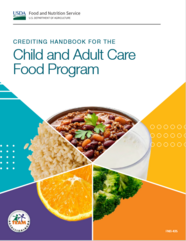
The revised Crediting Handbook for the Child and Adult Care Food Program is now available online! This updated resource will help CACFP operators serve meals and snacks that encourage healthy choices, healthy families, and healthy outcomes.
The Crediting Handbook is a technical assistance resource that helps CACFP operators plan menus that meet current USDA meal pattern requirements. The handbook works with the Food Buying Guide for Child Nutrition Programs to help with crediting foods and planning meals.
This resource provides information on the current CACFP meal patterns, crediting guidance for each meal component, a “Crediting in Action” section to practice crediting skills, and a list of helpful resources. The handbook was recently revised to make the guidance clear and consistent, add new crediting examples, and update the words we use to match current policy.
Note: The Crediting Handbook does not contain any new policy or guidance related to the “Dietary Guidelines for Americans, 2025–2030.” CACFP meal pattern requirements remain unchanged, as no updates to the regulations have been made.
|
|
|
Contact Us
Child and Adult Care Food Program
School Meals
Summer Meals
Food Distribution Program
Fresh Fruit & Vegetable Program
|
Farm to School
The Emergency Food Assistance Program
Child Nutrition Grants
Child Nutrition Financial Management
|
|
|
USDA Nondiscrimination Statement (English)
In accordance with federal civil rights law and USDA civil rights regulations and policies, the USDA, its agencies, offices, employees, and institutions participating in or administering USDA programs are prohibited from discriminating based on race, color, national origin, religion, sex, disability, age, marital status, family/parental status, income derived from a public assistance program, political beliefs, or reprisal or retaliation for prior civil rights activity, in any program or activity conducted or funded by USDA (not all bases apply to all programs). Remedies and complaint filing deadlines vary by program or incident.
Persons with disabilities who require alternative means of communication for program information (e.g., Braille, large print, audiotape, American Sign Language, etc.) should contact the state or local agency that administers the program or contact USDA through the Telecommunications Relay Service at 711 (voice and TTY). Additionally, program information may be made available in languages other than English.
To file a program discrimination complaint, complete the USDA Program Discrimination Complaint Form, AD-3027, found online at How to File a Program Discrimination Complaint and at any USDA office or write a letter addressed to USDA and provide in the letter all of the information requested in the form. To request a copy of the complaint form, call (866) 632-9992. Submit your completed form or letter to USDA by:
Mail: U.S. Department of Agriculture Office of the Assistant Secretary for Civil Rights, 1400 Independence Avenue, SW Washington, D.C. 20250-9410;
Fax: (202) 690-7442; or
Email: program.intake@usda.gov.
This institution is an equal opportunity provider.
|
|
|
|
|