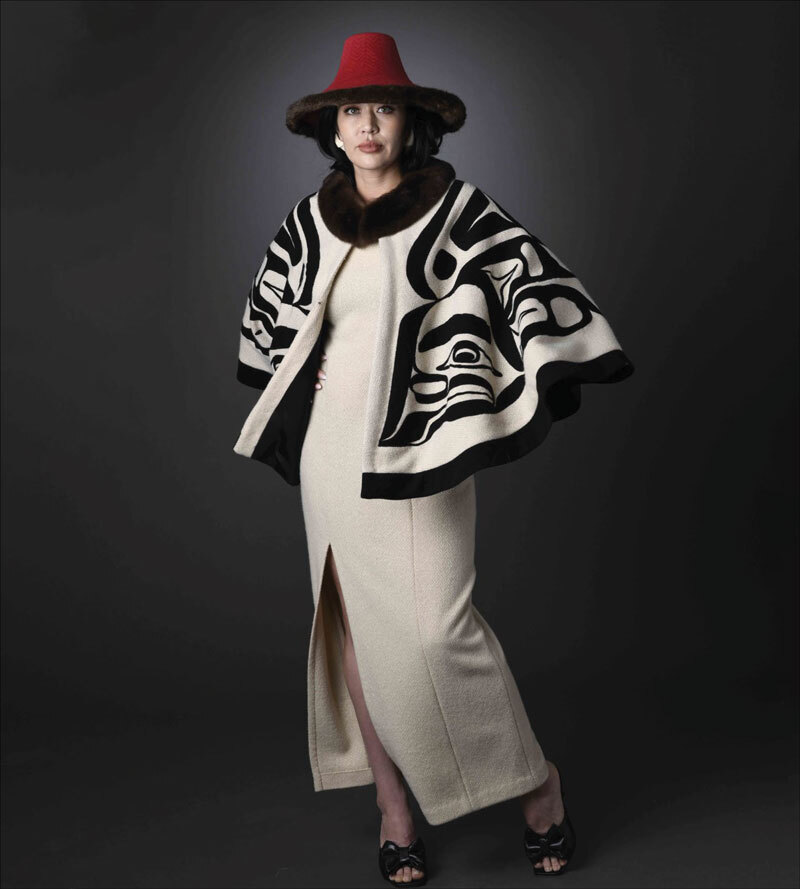
Raven Cape with One-Shoulder Dress by Dorothy Grant, photo: Farah Nosh.
Dorothy Grant Retrospect: Raven Comes Full Circle opens Friday
Celebrating 40 years of Haida Haute Couture
EXHIBIT OPENING Friday, May 1 at 5:00 pm Introduction by Rosita Kaaháni Worl Followed by the Yées Ku.oo Dance Group
LECTURE WITH DOROTHY GRANT Saturday, May 2 at 1:00 pm in the APK Lecture Hall
This exhibit showcases internationally renowned fashion designer Dorothy Grant’s 40-year career in haute couture, from traditional regalia to contemporary fashion and her critical role in bringing Indigenous fashion to the world stage.
Skil Da ‘Yuuwans Dorothy Grant (born Hydaburg, Alaska) belongs to the Yahgw Janáas clan of the Haida Nation.
Grant's work has graced countless international runways and prestigious art and fashion exhibitions. Her garments, imbued with the Haida philosophy of yahguudang (respect for the land and those living upon it), are worn by people from all experiences in a variety of settings, from Potlatches to the Oscars. Her creations are also part of global museum and gallery collections, including the Museum of Anthropology at UBC, the National Gallery of Canada, and the Smithsonian National Museum of the American Indian, with Grant’s Shark Button Robe currently showing at the MET in New York.
Throughout her career, Grant has received numerous accolades, including the Order of Canada in 2015 for her contributions to Canada's fashion industry as an artist, designer, and mentor, and an honorary doctorate from Simon Fraser University. She continues to be celebrated for her lasting legacy in art, fashion, and business, and for her role in opening the door for future Indigenous fashion designers.
Additional programming to be announced at a later date.
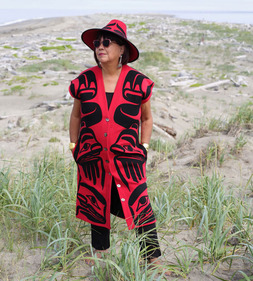
Image: Dorothy Grant models a Raven Creation Tunic, FEASTWEAR, 1986/1990. Farah Nosh photo.
Dorothy Grant Retrospect: Raven Comes Full Circle was organized by the Haida Gwaii Museum, curated by Taa.uu ‘Yuuwans Nika Collison
Thank you to the Friends of the Alaska State Library, Archives, and Museum for sponsoring borrowing "Raven Takes the World" Haida Wedding Dress, headdress, and “Raven's Beak” shoes; courtesy of the National Museum of the American Indian, Smithsonian Institution.
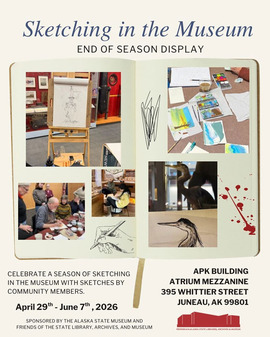
Sketching in the Museum End of Season Display
April 29-July 7, 2026 APK Atrium Mezzanine
Celebrate a season of sketching in the museum with sketches by community members.
Sponsored by the Alaska State Museum and Friends of the Alaska State Library, Archives, and Museum.
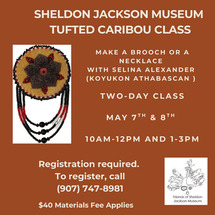
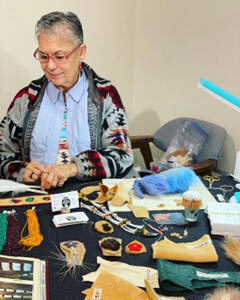
Tufted Caribou Class with Selina Alexander
May 7-8, 10 am-12 pm and 1-3 pm Sheldon Jackson Museum
Artist-in-residence Selina Alexander (Koyukon Athabascan) will teach a caribou tufting class and demonstrate how to make a tufted caribou brooch or necklace. The class is for all ages and class size will be limited to 8 people. Please sign up in advance by calling 907-747-8981 and include a check to Selina Alexander for $40 to cover the materials cost. Students should bring a lint roller and static guard spray to class.
May 15, 2 pm Sheldon Jackson Museum and Online (Zoom)
Artist-in-residence Selina Alexander (Koyukon Athabascan) will give an artist talk entitled “Koyukon Athabascan Art & Culture.”
During her presentation, Alexander will share information about her family, her upbringing in the remote village of Huslia, her culture, Athabascan art, and how her life and art are inextricably connected to her subsistence lifestyle. She will share reflections and examples of how” the woods” are her “church” and how “everything” she sees “is art.”
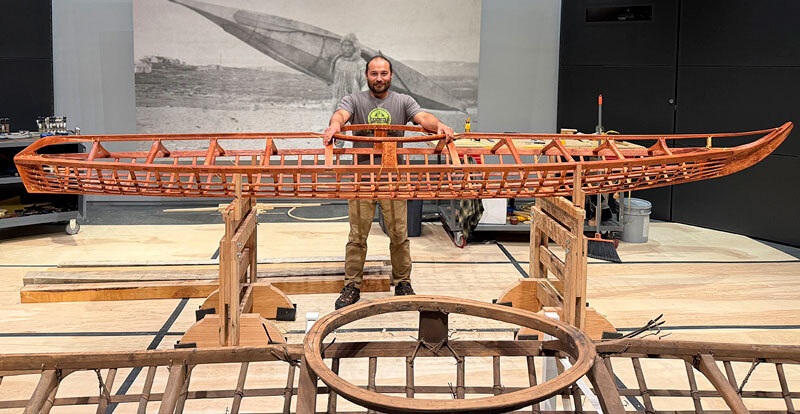
From April 2024 to October 2025, Logan spent hundreds of hours making a traditional Inupiaq qayaq at the Alaska State Museum.
The Inupiaq Qayaq project grew from Logan’s meticulous research of the literature and growing realization that Inupiaq qayaq construction is less than fully documented. He would need to learn directly from old qayyat and his own efforts at making one.
Studying qayyat became a way for Logan to expand his knowledge about his own Inupiaq heritage. Logan’s grandmother was from Kiŋigin (Wales), Alaska, one of the oldest communities in the Bering Strait region.
While making his qayaq at the museum, Logan worked next to a qayaq frame collected from King Island in 1928. Along with the successes he experienced throughout the qayaq’s construction, Logan faced setbacks that required adaptation, creative solutions, and even starting over again. In his presentation, Logan will describe what makes a qayaq a qayaq and will give a brief qayaq history and typology. He’ll offer some personal insights into why and how to build a qayaq and describe the building process.
What Does Independence Mean to You?
Through 2026 Alaska State Museum
The Spirit of Independence: Kent Bicentennial Portfolio, part of the 1976 U.S. Bicentennial celebration, features work from 12 artists who were asked to create pieces that answered one question: "What does independence mean to you?"
Artists in the portfolio include Alex Katz, Audrey Flack, Colleen Browning, Edward Ruscha, Fritz Scholder, Jacob Lawrence, Joseph Hirsch, Larry Rivers, Marisol Escobar, Red Grooms, Robert Indiana and Will Barnet.
As we near the 250th anniversary of the United States Declaration of Independence, another look at this portfolio from 1976 invites us to re-engage with the central questions and founding ideology of American democracy. Works in the exhibition ask us to reflect on social issues of the 1970s that, in many ways, continue to challenge us fifty years later. What does freedom look like? Who is it for? Who has it? Who doesn’t? How does it function in your daily life?
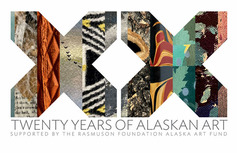
XX: Twenty Years of Alaskan Art
Ongoing at the Alaska State Museum
XX: Twenty Years of Alaskan Art features the work of contemporary Alaskan artists.
The museum acquired these pieces over the last twenty years though the generosity of the Rasmuson Foundation’s Alaska Art Fund.
Initiated in 2003, the Alaska Art Fund provides grants for Alaska museums to purchase current work by practicing Alaskan artists.
Thanks to the Fund, the Alaska State Museum has brought over 200 works of art valued at nearly half a million dollars into its permanent collection—the most significant donation over time, in terms of dollar value, in the museum’s 124-year history.
Gerald Breckenridge does for adventure what the early Hardy Boys books did for mystery, with an extra boost for the use of amateur radio. Though geared to youth, this book should provide a light start for the group, in contrast to the non-fiction we've been reading recently. As with all of the reading we've been doing, please note that these works reflect their time and may include language that is now recognized as insensitive or even offensive.
Summer Hours & Holiday Closure
Summer hours and admission rates start May 1. All division facilities are closed May 25.
Alaska State Museum Summer Hours
Monday, 1-4 pm Tuesday-Sunday, 9:00 am-4:30 pm
Sheldon Jackson Museum Summer Hours
Monday-Saturday, 9:00 am-4:30 pm Sunday, 1-4 pm
Fr. Andrew P. Kashevaroff Bldg (APK)
395 Whittier St, Juneau (907) 465-4837
Hours & Admission
Alaska State Museum (907) 465-2901
Through April 30 Tuesday-Saturday, 10 am-4 pm $9 adults, $8 seniors (65 and older) Free: Age 18 and younger
Starting May 1 Tuesday-Sunday, 9 am-4:30 pm Monday, 1-4:30 pm $14 adults, $13 seniors (65 and older) Free: Age 18 and younger
Alaska State Library (907) 465-2920 Monday-Friday, 10 am-4 pm. No admission fee.
Alaska State Archives (907) 465-2270 Appointment suggested. Monday-Friday, 10 am-4 pm. No admission fee.