|
Summer Food Service Program (SFSP)
February - 2026
|
|
Alaska Department of Education and Early Development
Division of Finance and Support Services
Child Nutrition Programs
P.O. Box 110500
Juneau, AK 99811 |
|
Subscription Management
Are you receiving this message but don't want to receive it? Is there someone in your organization that should receive this but isn't? Manage your subscription on GovDelivery.
|
|
USDA Policy, Information, and Implementation Memos |
|
|
Sponsoring organizations and institutions are required by regulation to keep Bulletins, Instructions, and USDA Policy Memorandums for reference and to apply them immediately to the appropriate agency programs. Call Child Nutrition Programs if you need further clarification.
To view the USDA SFSP policy memos, visit: DEED Child Nutrition Programs website or the USDA Policy Memorandum webpage by clicking on the links provided.
Waivers:
All USDA Waivers for the SFSP can be found here.
SFSP 01-2026: Dietary Guidelines for Americans, 2025-2030 - Eat Real Food
This memorandum and its attachments provide information and guidance on the updated Guidelines. These Guidelines place real food, defined as whole, nutrient-dense and naturally occurring, back at the center of our diets.
USDA Food Nutrition Service (FNS) is actively developing a proposed rule to update child nutrition program nutrition standards and meal requirements in the Code of Federal Regulations to align with the goals of the updated Guidelines. However, regulatory updates can take significant time to publish, review, and finalize. Until a final rule implementing changes to meal requirements is complete, all child nutrition program operators should continue meeting current requirements. Operators are still strongly encouraged to familiarize themselves with the key recommendations and consider how these Guidelines can be incorporated into program meals and snacks to promote healthy outcomes and healthy families.
Scroll down for more information on the updated Guidelines.
SFSP 02-2026: Incorporating Local Beef into Child Nutrition Program Meals
This memorandum provides helpful resources and strategies for Child Nutrition Program (CNP) operators and ranchers to incorporate local beef into school meals. Resource topics cover procurement, funding resources, food safety, crediting, and technical assistance contacts from the Farm to School Program. It supports Secretary of Agriculture Brooke Rollins’ commitment to American beef and the recently published USDA Plan to Fortify the American Beef Industry.
|
|
2026 SFSP Reimbursement Rates (Alaska)
The 2026 reimbursement rates are presented as a combined set of rates to highlight simplified cost accounting procedures. Reimbursement is based solely on a “meals times rates” calculation, without comparison to actual or budgeted costs. Sponsors receive reimbursement that is determined by the number of reimbursable meals served, multiplied by the combined rates for food service operations and administration. However, the combined rate is based on separate operating and administrative rates of reimbursement, each of which is adjusted differently for inflation.
| |
Rural or Self-Prep Sites
|
All other types of Sites
|
|
Breakfast
|
$5.1775
|
$5.0800
|
|
Lunch or Supper
|
$9.0800
|
$8.9325
|
|
Snack
|
$2.1525
|
$2.1050
|
Additional information on 2026 reimbursement rates can be found here.
Dietary Guidelines for Americans, 2025-2030
On January 7, 2026, the USDA released the Dietary Guidelines for Americans, 2025-2030. These Guidelines have been updated by:
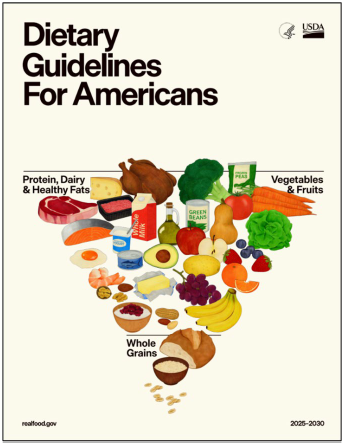
• Prioritizing a variety of high quality, nutrient-dense protein foods at every meal from animal sources, including eggs, poultry, seafood, and red meat, as well as a variety of plant-sourced protein foods including beans, peas, lentils, legumes, nuts, seeds, and soy;
• Encouraging a variety of dairy fat options, including whole and reduced-fat milk;
• Promoting the consumption of vegetables and fruits of all types, including fresh, frozen, canned, juiced, and dried, throughout the day;
• Incorporating healthy fats from whole foods such as meats, poultry, eggs, seafood, nuts, seeds, full-fat dairy, olives, and avocados;
• Prioritizing fiber-rich whole grains while significantly reducing refined grains, especially those high in added sugars; and
• Limiting certain highly processed foods, added sugars, and refined carbohydrates.
|
The Guidelines also include updates for serving infants and other special populations and considerations. More information is available at https://realfood.gov/.

Intent to Operate
Please submit your Intent to Operate (ITO) for Summer 2026 here.
The ITO gives us a picture of the site(s) you plan to operate this summer. This allows us to get a head start on planning and address any potential overlap or other issues.
Please submit an ITO by March 1, 2026, for all sites you hope to operate in Alaska for summer 2026. Completing the ITO does not guarantee site approval.
|

2026 SFSP Training
SFSP regulations require that all sponsors annually attend State Agency training, and also requires that they must train all administrative staff and site staff before they undertake their responsibilities.
For Summer 2026, training will be held in 3, 1.5 hour online sessions March 3-5:
- March 3, 2:30-4pm AKST: Applications and Claims
- March 4, 1-2:30pm AKST: Compliance, Best Practices, and Administrative Reviews
- March 5, 1-2:30pm AKST: Non-Congregate Meal Service (only required if operating non-congregate sites)
- An additional training session may be added March 2 for any new sponsors (this will be offered as-needed)
Please email eed.cnp.summer@alaska.gov if you are unable to make the trainings above.
Calendar invites for this training have been sent out - please email us if you have not received an invitation.
Sponsors will be expected to have current AK DEED Civil Rights training. This can be done through the link (please see January 2026 Bulletin for instructions), or we will offer a Teams viewing of the training on March 4 from 2:30-4pm AKST. A current certificate from another Child Nutrition program (July 29, 2025, training or more recent) will meet this requirement. Similarly, Procurement Training is available online (see January 2026 Bulletin for instructions), or we will offer a Teams viewing of this training (TBD).
Any new sponsors or staff will also be expected to complete the SFSP eLearning trainings listed below:
- SFSP Administration Basics
- SFSP Operation Basics
|
 |
|
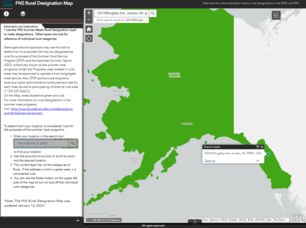
2026 Rural Designation Map
USDA has updated the Rural Designation Mapper. When taking screenshots for site eligibility, please ensure the date is visible in the screenshot (click on the "i" to display map information, and include the "Note: The FNS Rural Designation Map was updated ..." and the proposed site address as shown in photo.
|
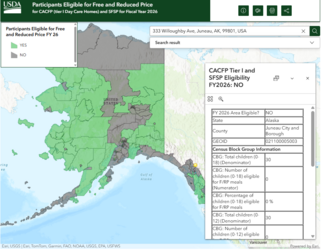
2026 Area Eligibility Mapper for Summer Meals
USDA has updated the Area Eligibility Mapper for 2026. When taking screenshots for site eligibility, please be sure the following are included:
- The key indicating "Participants Eligible for Free and Reduced Price FY 26"
- Site address (this must match the site address on the application submitted to DEED)
- GEOID - this is displayed by clicking on the pin
Photo included shows an example with all data displayed.
|
|
|
Summer Food Program Resources
|
|
Disclaimer
This newsletter contains hyperlinks to information created and maintained by other public and private organizations. These links are provided for the reader’s convenience. DEED does not control or guarantee the accuracy, relevance, timeliness, or completeness of this outside information. Furthermore, the inclusion of links is not intended to reflect their importance, nor is it intended to endorse any views expressed, or products or services offered, on these sites, or the organizations sponsoring the sites.
USDA Nondiscrimination Statement (English)
In accordance with federal civil rights law and USDA civil rights regulations and policies, the USDA, its agencies, offices, employees, and institutions participating in or administering USDA programs are prohibited from discriminating based on race, color, national origin, religion, sex, disability, age, marital status, family/parental status, income derived from a public assistance program, political beliefs, or reprisal or retaliation for prior civil rights activity, in any program or activity conducted or funded by USDA (not all bases apply to all programs). Remedies and complaint filing deadlines vary by program or incident.
Persons with disabilities who require alternative means of communication for program information (e.g., Braille, large print, audiotape, American Sign Language, etc.) should contact the state or local agency that administers the program or contact USDA through the Telecommunications Relay Service at 711 (voice and TTY). Additionally, program information may be made available in languages other than English.
To file a program discrimination complaint, complete the USDA Program Discrimination Complaint Form, AD-3027, found online at How to File a Program Discrimination Complaint and at any USDA office or write a letter addressed to USDA and provide in the letter all of the information requested in the form. To request a copy of the complaint form, call (866) 632-9992. Submit your completed form or letter to USDA by:
-
Mail: U.S. Department of Agriculture, Office of the Assistant Secretary for Civil Rights, 1400 Independence Avenue, SW, Mail Stop 9410, Washington, D.C. 20250-9410;
-
Fax: (202) 690-7442; or
-
Email: program.intake@usda.gov.
This institution is an equal opportunity provider.
|
|
|
|
|