Additional Topics
Participating in the Summer Food Service Program (SFSP)
Are you interested in participating in the Summer Food Service Program (SFSP)?
SFSP was established to ensure that low-income children continue to receive nutritious meals when school is not in session. Free meals that meet Federal nutrition guidelines are provided to all children at approved SFSP sites in areas with significant concentrations of low-income children.
Please note that only CACFP institutions which have sufficient changes in their activities or enrollment or develop a separate food service program for children who are not enrolled in their CACFP, and meet SFSP eligibility criteria, may be approved to participate in SFSP.
|
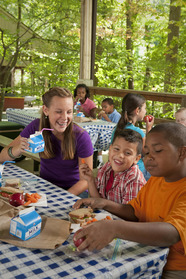
Because most at-risk programs do not receive reimbursement during the summer, CACFP operators that run At-Risk Afterschool Care programs may also choose to participate in SFSP. They can convert to SFSP and serve the same children that they serve during the regular school year.
Institutions which are approved for both CACFP and SFSP must ensure that the same children are not served meals in both programs, and separate records must be kept for each program. These institutions are not allowed to switch back and forth between participation in CACFP and SFSP to serve the same children.
However, CACFP institutions which have not substantially changed their program activities or have not significantly increased their enrollment may not be approved to participate in SFSP. In addition, it is recognized that CACFP institutions are set up to provide organized and structured activities to enrolled children as well as providing a food service. Therefore, it is reasonable that such institutions should remain in CACFP.
For additional information, please view Pages 30-31 of the SFSP Administration Guide.
|
Q&As
Are there any Federal regulations that prohibit freeze dried or dehydrated foods in child nutrition programs?
Freeze Dried Fruits and Vegetables:
Freeze dried fruits and vegetables are only creditable in CNP based on volume served in a rehydrated state. Freeze dried fruits and vegetables are not included in the Food Buying Guide for Child Nutrition Programs (FBG). The FBG states that yields of vegetables and fruits vary according to the form of the food when purchased. For example, reconstituted dehydrated vegetables yield more servings per pound than fresh, frozen, or canned because they gain weight and volume as they absorb water during soaking and cooking. Yield information for all vegetables and fruits in the FBG are based on volume, not weight. USDA guidance states that to use freeze-dried foods, they must be rehydrated with water. These freeze-dried foods retain their original flavor, texture, and nutrients.
Dehydrated and Other Dried Foods (excluding freeze dried):
Similar to freeze dried fruits and vegetables, the FBG yield information for dried or dehydrated fruits and vegetables is based on volume, not weight. Please note, that the FBG does indicate that snack-type foods made from vegetables, such as potato chips, and fruits, such as banana chips, do not meet the requirements to be creditable in CNPs.
Regarding technical advice:
The Meats/Meat Alternates section of the FBG contains information that some dried and semi-dried meat, poultry, and seafoods products may not be listed in the FBG; however, they still may be creditable with proper documentation, such as a Child Nutrition (CN) label or manufacturer’s Product Formulation Statement (PFS). These processed products do not require a minimum amount of meat by USDA, Food Safety and Inspection Service (FSIS) Labeling Standards of Identity. There is no standard yield data for these food items and the product formulations may vary widely. For more information on CN Labels and PFS, please see https://www.fns.usda.gov/cn/manufacturer-documentation.
When a PFS is provided for a dried meat, poultry, or seafood M/MA product, it should be evaluated to ensure the following crediting principles are followed:
- The creditable meat ingredient listed on the PFS must match or have a similar description as the ingredient listed on the product label (e.g., ground beef, no more than 30% fat).
- The creditable meat ingredient listed on the PFS must have a similar description to the food item in this FBG (e.g., Beef, Ground, fresh or frozen, Market Style, no more than 30% fat).
- The creditable amount cannot exceed the finished weight of the product.
Are homemade cheeses creditable? Why are Queso Blanco and Fresco cheeses the only cheese varieties in the CACFP Crediting Handbook that state homemade versions are not allowed?
No. Homemade cheese is not creditable. There are potential safety concerns with these products. The information about homemade cheeses not being creditable will be added to the next update of the Crediting Handbook for CACFP. Queso blanco and queso fresco are highlighted in the Crediting Handbook for CACFP because these products are more commonly homemade than other cheese varieties and this type of soft cheese is at higher risk for safety issues.
Webinars & Conferences
Farm to ECE Webinar Series: The Synergy of Farm to ECE & SNAP-Ed
April 30, Wednesday | 10:00 - 11:00 am AKT
The Supplemental Nutrition Assistance Program - Education (SNAP-Ed) and Farm to ECE have long had synergistic benefits in part due to their shared aims in nutrition promotion, long-term health outcomes, and systems change. Speakers from the National Farm to School Network team will present on Policy, Systems, and Environmental Change, an approach that is at the core of SNAP-Ed work and the way in which Farm to ECE operates. The webinar will also highlight how SNAP-Ed can be leveraged to promote and sustain Farm to ECE efforts.
This free webinar is hosted by the Association of State Public Health Nutritionists (ASPHN).
CACFP Roundtable: Deep Dive on Infant and Toddler Nutrition
May 14, Wednesday | 7:30 am - 3:00 pm AKT
CACFP Rountdable is hosting their virtual summit, Roundtable Deep Dive on Infant and Toddler Nutrition.
This virtual learning event will provide attendees the practical and timely information needed to operate the CACFP for young children through two disciplinary tracks: (1) infant nutrition (ages 0-12 months), and (2) toddler nutrition (ages 12-36 months). Sessions will be live with opportunities to directly engage with the speakers
Registration costs $150 for CACFP Roundtable members and $200 for general admission. Last day to register is on May 9. Registration includes access to the Roundtable Deep Dive online platform for live sessions and 12 months of ongoing on-demand viewing.
|
May 14, Wednesday | 7:00 am - 1:00 pm AKT
The National CACFP Association (NCA) shines a spotlight on the "A" in CACFP by recognizing the vital role adult care plays in supporting health and nutrition. Join the CACFP Boot Camp on Adult Care so you can walk away with fresh ideas, practical solutions, and the confidence to elevate the care you provide to older adults.
This webinar is delivered via Zoom. Standard registration fee for NCA members is $149 and $199 for non-members. Your registration includes access to watch all sessions on demand through May 28, 2025.
National CACFP Association: CACFP Meal Pattern Boot Camp
June 12, Thursday | 7:00 am - 1:00 pm AKT
This boot camp from the National CACFP Association (NCA) explores each meal component. Learn from the experts, bring your questions, and discover creative ways to incorporate these components into your menus. Whether you’re just getting started or need a refresher, this event will give you the knowledge you need to serve up great nutrition with confidence.
This webinar is delivered via Zoom. Standard registration fee for NCA members is $149 and $199 for non-members. Your registration includes access to recordings, available to view through June 26, 2025.
|