|
Child and Adult Care Food Program (CACFP)
2025 - 06
|
|
Alaska Department of Education and Early Development
Division of Finance and Support Services
Child Nutrition Programs
P.O. Box 110500
Juneau, AK 99811 |
|
Subscription Management
Are you receiving this message but don't want to receive it? Is there someone in your organization that should receive this but isn't? Manage your subscription on GovDelivery.
This newsletter contains hyperlinks to information created and maintained by other public and private organizations. These links are provided for the reader’s convenience. DEED does not control or guarantee the accuracy, relevance, timeliness, or completeness of this outside information. Furthermore, the inclusion of links is not intended to reflect their importance, nor is it intended to endorse any views expressed, or products or services offered, on these sites, or the organizations sponsoring the sites.
|
|
USDA Policy, Information, and Implementation Memos |
|
|
Sponsoring organizations and institutions are required by regulation to keep Bulletins, Instructions, and USDA Policy Memorandums for reference and to apply immediately the appropriate instruction to agency programs. The latest policy memos are found on the USDA FNS policy page. Call Child Nutrition Programs if you need further clarification.
CACFP 08-2025: Rescission of Guidance on Promoting Access to Voting through the Child Nutrition Programs
The Food and Nutrition Service (FNS) rescinds, effective immediately, the memorandum SP 07-2022, CACFP 06-2022, SFSP 02-2022, Promoting Access to Voting through the Child Nutrition Programs, issued on March 23, 2022.
This recission memorandum updates program policy to reflect current priorities and guidance under Executive Order 14148.
|
|
Q&As
Do the USDA MyPlate Recipes meet the crediting requirements for child nutrition programs, and specifically CACFP?
MyPlate Recipes is a great resource for recipes; however, MyPlate food groups listed on each MyPlate.gov recipe do not indicate meal pattern contribution for the USDA’s Child Nutrition Programs. Please use the Food Buying Guide for Child Nutrition Programs’ Recipe Analysis Workbook (RAW) to calculate the meal pattern contribution of standardized recipes.
May a sponsor purchase formula for a child from another country if the request is supported by a doctor’s recommendation? Could the family provide this formula, and may it be served for a reimbursable meal?
Since the child’s medical provider has recommended this specific formula per the signed medical statement, the operators could purchase this formula, or the family could provide this, and it may be served as a part of a reimbursable meal.
Imported infant formulas may be served in the CACFP to meet the requirements of a reimbursable meal as described in CACFP 01-2023. On January 9, 2023, FDA indicated the intention to continue exercising enforcement discretion beyond January 6, 2023, as described in its September 2022 guidance. Infant formulas approved for enforcement discretion by the FDA may be used to meet the requirements of a CACFP reimbursable meal, as long as they are available for sale in the U.S. retail market, are iron fortified, and utilized prior to the formula expiration date.
Webinars & Conferences
In this webinar, the Institute of Child Nutrition (ICN) and the Friends of the Earth highlight practical strategies for school nutrition professionals to incorporate plant-based, minimally processed standardized recipes that showcase a variety of flavors while aligning with the USDA meal pattern requirements
This webinar will be held on March 27, 2025, Thursday, 11:00 am - 12:00 noon (AKT).
2025 National Child Nutrition Conference
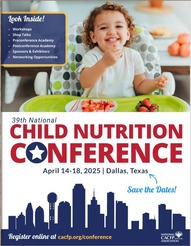
The 39th National Child Nutrition Conference, provided by the National CACFP Sponsors Association (NCA), is now open for registration.
The National Child Nutrition Conference is an annual event that brings together professionals from child care centers, home providers, sponsoring organizations, school districts, afterschool programs, Head Start programs, Food Banks, tribal nations and State Agencies.
The 2025 National Child Nutrition Conference will be held April 14-18, 2025, in Dallas, Texas.
This information is shared on behalf of the NCA. DEED is neither endorsing or is responsible for third party content.
|
|
|
Resources
Mealtime Memo: Benefits of CACFP
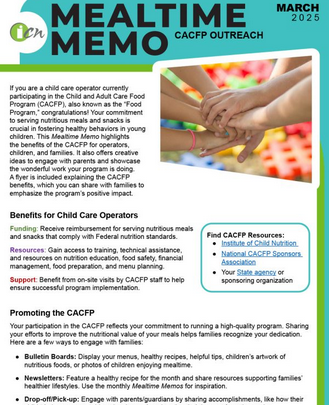
Learn more about promoting CACFP and the benefits for child care operators by reading the March issue of Mealtime Memo, a monthly newsletter from the Institute of Child Nutrition (ICN). Mealtime Memo is focused on nutrition and wellness in child care settings and provides research-based best practices for planning, preparing, and/or serving nutritious, safe, and child-friendly meals in child care settings operating the CACFP.
You can subscribe on the ICN page to receive the monthly Mealtime Memo newsletter and other updates.
|
Farm to ECE Resources

Farm to Early Care and Education (ECE) programs are an innovative evidence-based approach that give young children increased exposure and access to local produce, opportunities to learn about nutrition and agriculture, and hands-on learning through gardening.
Learn more about these efforts and the many benefits they provide through the Association of State Public Health Nutritionists (ASPHN) Farm to ECE Initiatives.
|
Team Nutrition Resources
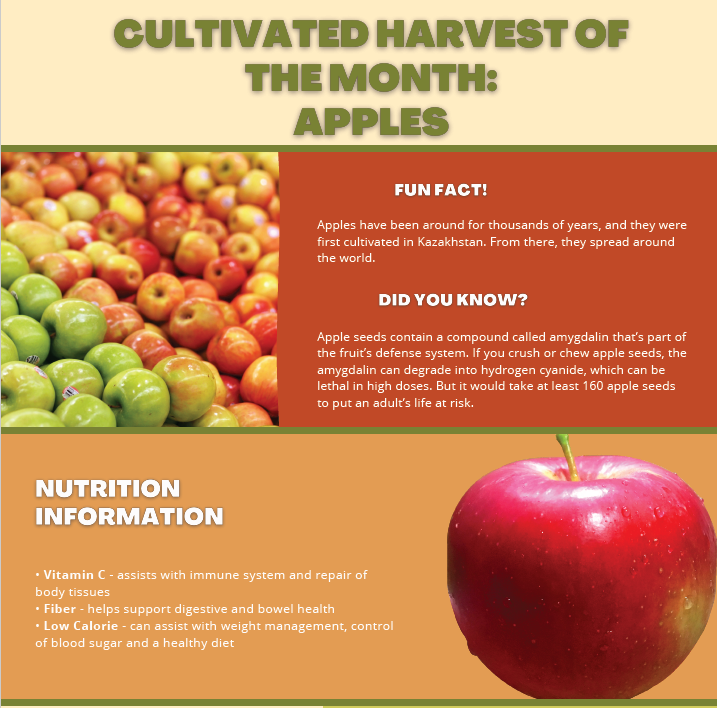 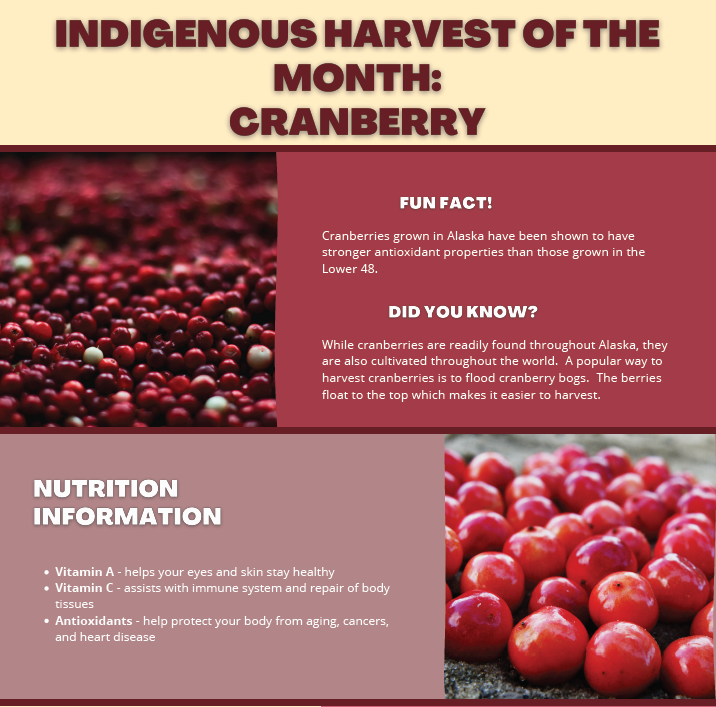
|
|
Contact Us
Child and Adult Care Food Program
School Meals
Summer Meals
Food Distribution Program
Fresh Fruit & Vegetable Program
|
Farm to School
The Emergency Food Assistance Program
Child Nutrition Grants
Child Nutrition Financial Management
|
|
|
USDA Nondiscrimination Statement (English)
In accordance with federal civil rights law and U.S. Department of Agriculture (USDA) civil rights regulations and policies, this institution is prohibited from discriminating on the basis of race, color, national origin, sex (including gender identity and sexual orientation), disability, age, or reprisal or retaliation for prior civil rights activity.
Program information may be made available in languages other than English. Persons with disabilities who require alternative means of communication to obtain program information (e.g., Braille, large print, audiotape, American Sign Language), should contact the responsible state or local agency that administers the program or USDA’s TARGET Center at (202) 720-2600 (voice and TTY) or contact USDA through the Federal Relay Service at (800) 877-8339.
To file a program discrimination complaint, a Complainant should complete a Form AD-3027, USDA Program Discrimination Complaint Form which can be obtained online at: https://www.usda.gov/sites/default/files/documents/USDA-OASCR%20P-Complaint-Form-0508-0002-508-11-28-17Fax2Mail.pdf, from any USDA office, by calling (866) 632-9992, or by writing a letter addressed to USDA. The letter must contain the complainant’s name, address, telephone number, and a written description of the alleged discriminatory action in sufficient detail to inform the Assistant Secretary for Civil Rights (ASCR) about the nature and date of an alleged civil rights violation. The completed AD-3027 form or letter must be submitted to USDA by:
-
mail: U.S. Department of Agriculture Office of the Assistant Secretary for Civil Rights 1400 Independence Avenue, SW Washington, D.C. 20250-9410; or
-
fax: (833) 256-1665 or (202) 690-7442; or
-
email: program.intake@usda.gov
This institution is an equal opportunity provider.
|
|
|
|
|