|
Child and Adult Care Food Program (CACFP)
2025 - 05
|
|
Alaska Department of Education and Early Development
Division of Finance and Support Services
Child Nutrition Programs
P.O. Box 110500
Juneau, AK 99811 |
|
Subscription Management
Are you receiving this message but don't want to receive it? Is there someone in your organization that should receive this but isn't? Manage your subscription on GovDelivery.
This newsletter contains hyperlinks to information created and maintained by other public and private organizations. These links are provided for the reader’s convenience. DEED does not control or guarantee the accuracy, relevance, timeliness, or completeness of this outside information. Furthermore, the inclusion of links is not intended to reflect their importance, nor is it intended to endorse any views expressed, or products or services offered, on these sites, or the organizations sponsoring the sites.
|
|
USDA Policy, Information, and Implementation Memos |
|
|
Sponsoring organizations and institutions are required by regulation to keep Bulletins, Instructions, and USDA Policy Memorandums for reference and to apply immediately the appropriate instruction to agency programs. The latest policy memos are found on the USDA FNS policy page. Call Child Nutrition Programs if you need further clarification.
There are no new policy memos at this time.
|
|
Additional Topics
For At-Risk Sites: Updated Free & Reduced Price EAT Report
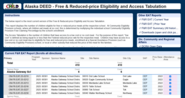
The Alaska Department of Education and Early Development (DEED) is pleased to release the latest Free & Reduced-price Eligibility Access Tabulation (EAT), previously known as the Free and Reduced Price Report, on our Smartsheet dashboard here:
This page will soon be added to DEED's web page; in the meantime, it is publicly accessible from the above link.
This year, the EAT includes several enhancements:
- Online web view (if you need to quickly look for a number)
- Download the current and prior year report
- Download a report that includes all historical data from School Year 2010-2011 through present (note that SY 2020-2021 data is incomplete as a result of COVID-19 school operations)
- The datasets include the Division of Community and Regional Affairs Community ID number (found in right cluster of columns), this can be used to connect this data to DCRA's Open Data set (see link in dashboard)
There is a table describing each of the headers in EAT report, you can find this table at the bottom of the dashboard or download it from the "Downloads" link under "Other EAT Reports".
DEED utilizes a small-numbers policy to prevent releasing PII at small schools. In such cases, DEED will release as much information as possible; for example, we may state the F&R percentage is “≥50%” rather than providing a specific percentage.
If you operate an At-Risk Afterschool Site: You can use this information to find out if your site is located in the attendance area of a public school in which at least 50 percent of the enrolled children are certified eligible for free or reduced-price school meals under the National School Lunch Program (NSLP). A site's area eligibility determination made under CACFP is valid for 5 years. Using the latest information allows you to extend your area eligibility determination (e.g. If not updated, an area eligibility determination made in 2020 ends in 2025; however, updating that in 2025 means your eligibility determination is valid for another five years).
|
 The U.S. Department of Education's Food and Nutrition (FNS) seeks public comments on Request for Information: Child Nutrition Programs Tribal Pilot Projects, published December 23, 2024, at Federal Register: Request for Information: Child Nutrition Programs Tribal Pilot Projects.
The public is invited to submit comments to www.regulations.gov through March 24, 2025.
FNS also released Request for Information: Grain-Based Desserts and High-Protein Yogurt Crediting in Child Nutrition Programs. This aims to obtain input to help inform future policymaking, guidance, and technical assistance related to grain-based desserts and high-protein yogurt crediting in Child Nutrition Programs (CNP).
The public is invited to submit comments to www.regulations.gov through March 26, 2025.
Comments may be submitted by either of the following methods:
2025 CACFP Week is on March 16-22
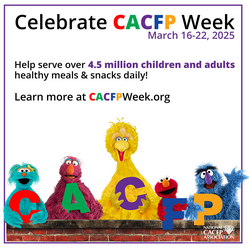
The CACFP brings healthy foods to tables across the country for children in child care centers, homes, and afterschool programs as well as adults in day care. To raise awareness of how the CACFP works to combat hunger, the National CACFP Sponsors Association (NCA) is sponsoring CACFP Week, a national education and information campaign. This year, CACFP Week will be celebrated from March 16-22, 2025.
The NCA invites CACFP operators to celebrate and raise awareness within your network during this week-long campaign. You can explore the resources found on their website.
The NCA recently held a webinar on CACFP Week. You can watch a recording here.
|
|
|
Webinars & Conferences
Nurturing Diversity in School Gardens

This webinar, sponsored by the School Garden Support Organization (SGSO) Network, will explore the transformative power of inclusivity and representation in educational gardening programs. This session will dive into the importance of intentional representation, uncovering and addressing unexamined practices, and celebrating the rich tapestry of cultural backgrounds within our school communities. Learn practical strategies to create a welcoming and inclusive garden space that honors and reflects the diverse identities of your students.
The SGSO Network is an open peer-to-peer learning network with the goal of growing,
sustaining and elevating a movement of equitable garden-based education.
This webinar will be held on February 19, at 10:00 AM AKST.
|
2025 National Child Nutrition Conference
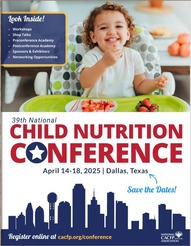
The 39th National Child Nutrition Conference, provided by the National CACFP Sponsors Association (NCA), is now open for registration.
The National Child Nutrition Conference is an annual event that brings together professionals from child care centers, home providers, sponsoring organizations, school districts, afterschool programs, Head Start programs, Food Banks, tribal nations and State Agencies.
The 2025 National Child Nutrition Conference will be held April 14-18, 2025, in Dallas, Texas.
This information is shared on behalf of the NCA. DEED is neither endorsing or is responsible for third party content.
|
On-Demand CACFP Halftime Webinar: Choose Yogurt that is Lower in Added Sugars in the CACFP
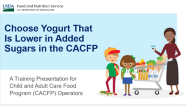
Beginning Oct. 1, 2025, CACFP operators must offer yogurt that contains no more than 12 grams of added sugars per 6 ounces. To help you out, don't forget to visit USDA’s Team Nutrition's recorded webinar on “Choose Breakfast Cereals That Are Lower in Added Sugars in the Child and Adult Care Food Program (CACFP).”
This on-demand webinar highlights the new added sugars limit for yogurt and how to identify products that meet this limit.
Visit the webpage titled “Choose Yogurt That Is Lower in Added Sugars in the CACFP” to get the training worksheet, training slides, and recorded video. Also, check out the “Calculating the Added Sugars Limit for Yogurt in the CACFP” training worksheet.
For more information, please visit the CACFP Halftime: Thirty on Thursdays webpage.
|
|
|
Recipes & Resources
Mealtime Memo: Fibers
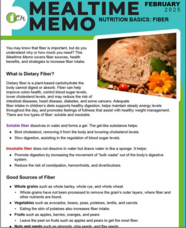
Learn more about fiber sources, health benefits, and strategies to increase fiber intake by reading the February issue of Mealtime Memo, a monthly newsletter from the Institute of Child Nutrition (ICN). Mealtime Memo is focused on nutrition and wellness in child care settings and provides research-based best practices for planning, preparing, and/or serving nutritious, safe, and child-friendly meals in child care settings operating the CACFP.
You can subscribe on the ICN page to receive the monthly Mealtime Memo newsletter and other updates.
|
Added Sugars Worksheets
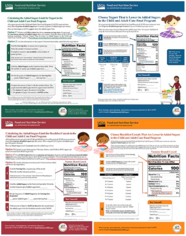
Updated to align with the Final Rule, “Child Nutrition Programs: Meal Patterns Consistent With the 2020-2025 Dietary Guidelines for Americans,” these materials can be used to empower CACFP providers and operators with the knowledge, skills and expertise to implement CACFP meal pattern requirements.
Beginning Oct. 1, 2025, CACFP operators must offer breakfast cereals that contains no more than 6 grams of added sugars per dry ounce and yogurt that contains no more than 12 grams of added sugars per 6 ounces.
Choose Yogurt That Is Lower in Added Sugars
|
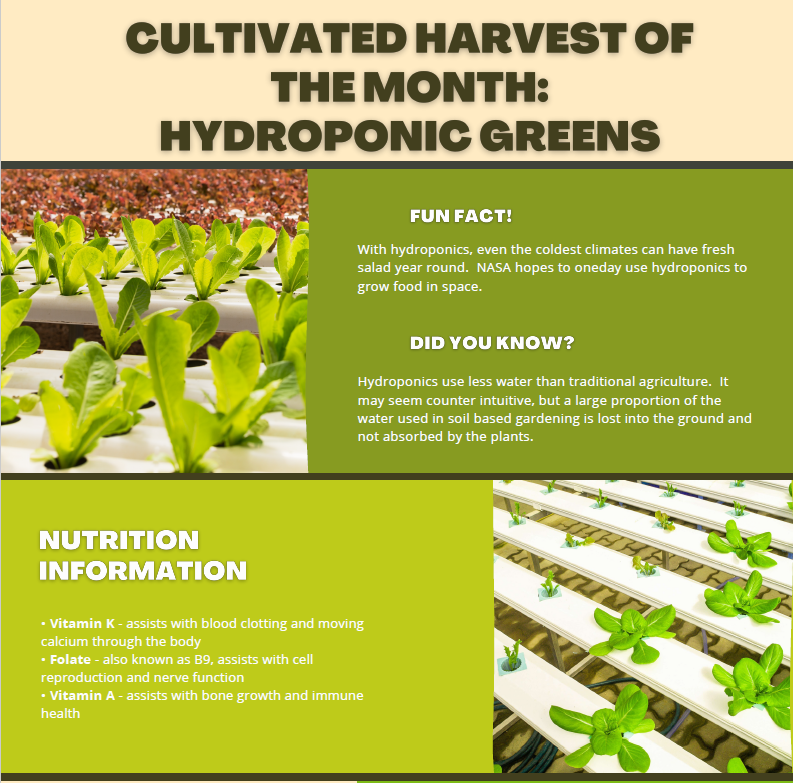
Team Nutrition Resources
|
|
Contact Us
Child and Adult Care Food Program
School Meals
Summer Meals
Food Distribution Program
Fresh Fruit & Vegetable Program
|
Farm to School
The Emergency Food Assistance Program
Child Nutrition Grants
Child Nutrition Financial Management
|
|
|
USDA Nondiscrimination Statement (English)
In accordance with federal civil rights law and U.S. Department of Agriculture (USDA) civil rights regulations and policies, this institution is prohibited from discriminating on the basis of race, color, national origin, sex (including gender identity and sexual orientation), disability, age, or reprisal or retaliation for prior civil rights activity.
Program information may be made available in languages other than English. Persons with disabilities who require alternative means of communication to obtain program information (e.g., Braille, large print, audiotape, American Sign Language), should contact the responsible state or local agency that administers the program or USDA’s TARGET Center at (202) 720-2600 (voice and TTY) or contact USDA through the Federal Relay Service at (800) 877-8339.
To file a program discrimination complaint, a Complainant should complete a Form AD-3027, USDA Program Discrimination Complaint Form which can be obtained online at: https://www.usda.gov/sites/default/files/documents/USDA-OASCR%20P-Complaint-Form-0508-0002-508-11-28-17Fax2Mail.pdf, from any USDA office, by calling (866) 632-9992, or by writing a letter addressed to USDA. The letter must contain the complainant’s name, address, telephone number, and a written description of the alleged discriminatory action in sufficient detail to inform the Assistant Secretary for Civil Rights (ASCR) about the nature and date of an alleged civil rights violation. The completed AD-3027 form or letter must be submitted to USDA by:
-
mail: U.S. Department of Agriculture Office of the Assistant Secretary for Civil Rights 1400 Independence Avenue, SW Washington, D.C. 20250-9410; or
-
fax: (833) 256-1665 or (202) 690-7442; or
-
email: program.intake@usda.gov
This institution is an equal opportunity provider.
|
|
|
|
|