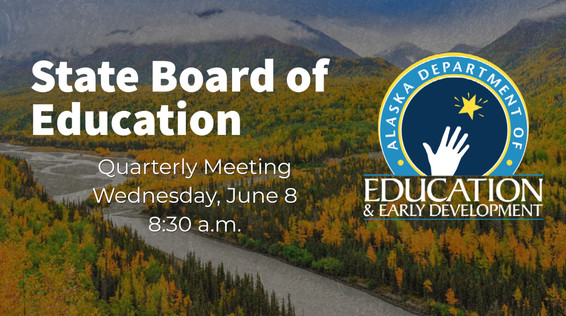
 The State Board of Education and Early Development will hold a regular quarterly meeting and professional development workshop next Wednesday and Thursday in Anchorage.
A work session and business meeting will begin at 8:30 a.m. on Wednesday, June 8 in the first floor conference room of the Robert B. Atwood building at 550 W. 7th Ave. in Anchorage. Public comment will be heard beginning at approximately 8:45 a.m. and can be made either in-person or via phone. The meeting will be live-streamed by the Legislative Information Office on the LIO's YouTube channel. The meeting agenda and call-in details for public comment are available online.
Topics at the workshop include discussing board resolutions, State Board committee meetings, and committee reports and discussion. Topics at the work session include legislative and budget update, charter school renewal and approval, regulations for adoption in the areas of facilities publications, alternate assessment scores, and seal of biliteracy, and discuss the Mt. Edgecumbe High School (MEHS) school advisory board appointments.
Topics at the business meeting include discussions regarding the approval of the FY2023 budget, charter school renewal and approval, regulations for adoption, and approvals of the MEHS school advisory board appointments, Deputy Commissioners, MEHS Superintendent, and MEHS Principal.
 Children at Cook Inlet Head Start in Anchorage enjoy reindeer stew for lunch.
Celebrating what's served on the plate: Serving the youngest Alaskans local, traditional foods
From Play Every Day
Children as young as 3, 4 and 5 eat duck soup for lunch at King Cove’s Head Start. In Chevak, these preschoolers eat caribou stew. In the Bristol Bay Borough School District, the little ones’ families sit at the table to eat traditional foods together.
That’s how child care and preschool programs are introducing Alaska foods and traditions to children at very early ages. That helps kids learn about and celebrate their cultures, and at the same time serves nutritious meals to children who are still exploring food and drink options.
Young children feel their best when served healthy foods and drinks with little or no added sugars, and traditional Alaska foods meet that need. Serving local, regional foods to children as early as possible can help them learn to love eating these healthy foods for the rest of their lives.
Traditional foods have become less familiar to children
Tracy Stewart is the Traditional Foods Program Coordinator with the Aleutian Pribilof Islands Association (APIA). According to Stewart, a survey conducted by APIA in 2002 showed a decline in the use of traditional foods, while obesity and diabetes increased.
Traditional Alaska foods — such as fish, wild game and berries — are great sources of nutrients and healthy fats with no added sugars. Store-bought foods, on the other hand, are often highly processed with lower amounts of nutrients and higher amounts of unhealthy fats and sugars.
“The nutritional value and benefit from traditional foods is important for the people in the region,” said Sue Unger, Wellness Lead at APIA. “It’s important for them to get healthy foods.”
Stewart and Unger helped develop a traditional food curriculum for its Head Start programs.
“We got feedback from the Head Start programs that a lot of the nutritional materials that were being used weren’t applicable to our region,” Stewart said. “It would give examples of a star fruit or a passion fruit, something that these kids had no access to and had never seen before.”
Fish, however, is available at all Head Start sites in Stewart’s region, so she includes fish on lunch plates and in lesson plans.
“The kids have really enjoyed the salmon unit and doing projects with them, like painted fish prints,” Stewart said.
Families: Check Eligibility for Internet Discount Through the Affordable Connectivity Program
The Affordable Connectivity Program (ACP) is a U.S. government program run by the Federal Communications Commission (FCC) program to help low-income households pay for internet service and connected devices like a laptop or tablet.
You are likely eligible if your household’s income is below 200% of the Federal Poverty Line, or if you or someone you live with currently receives a government benefit like SNAP, Medicaid, SSI, WIC, Pell Grant, or Free and Reduced-Price Lunch.
If your household is eligible, you could receive:
- Up to a $30/month discount on your internet service
- Up to a $75/month discount if your household is on qualifying Tribal lands
- A one-time discount of up to $100 for a laptop, tablet, or desktop computer (with a co-payment of more than $10 but less than $50)
- A low cost service plan that may be fully covered through the ACP*
Learn more and check your eligibility at https://www.affordableconnectivity.gov/
|