 DEQ NEWS
Nov. 2, 2026 Vol. 5, No. 9
Comment on Changes to Enforcement Manual

DEQ is providing an opportunity for the public to comment on DEQ's revisions to Chapter 4 (Civil Charges and Civil Penalties) of the Enforcement Manual. This chapter addresses how DEQ staff calculate appropriate civil charges and civil penalties in administrative enforcement actions. A notable change is removing the discretionary 30% reduction for cooperation and quick settlement.
In addition to the revised chapter, a redlined version of the changes from the current version is also available. DEQ will use comments to help finalize the document.
DEQ accepts comments by mail, email, and through public comment form. DEQ is accepting comments until Nov. 9. All comments must be in writing and received by DEQ by the last day of the informal comment period.
To learn more and to comment, visit DEQ’s Informal Comment Period webpage.
Changes to Stormwater Fee Collection Procedures

New amendments to the Virginia Erosion and Stormwater Management Regulation took effect on Oct. 22. These amendments improve fee collection procedures, clarify regulatory requirements, and provide greater consistency with the regulation applicable to fees for permits and certificates.
A key change affects when fees must be paid for issuance or modification of construction stormwater permits. Under the amended regulation, the full fee for coverage under the Construction General Permit (CGP) must be paid at the time of application.
When a stormwater management plan or erosion control and stormwater management plan is required, the applicable permit fee must be paid when that plan and Registration Statement are submitted.
For localities where DEQ is the Virginia Stormwater Management Program authority, 100% of the fee is due upon submission.
For localities who submit to local Virginia Erosion and Stormwater Management Program (VESMP) authorities, the "full fee" means 70% of the total fee as listed in applicable regulation. DEQ will collect the remaining 30% from applicants, when the Registration Statement information is submitted to DEQ by the VESMP authority for CGP Issuance.
The amendments also clarify payment due dates for:
- Annual maintenance fees
- Applications for individual and general MS4 permits
- Requests to transfer or modify MS4 permits and CGP coverage
Applicants, permittees, and VESMP authorities should now be using the revised fee procedures for all applicable submissions.
For more information, visit DEQ's Stormwater Fees webpage.
Renewable Energy Regulatory Revisions

The Renewable Energy Permit by Rule (PBR) program recently completed three regulatory revisions to address a change in state law (Chapter 710 of the 2025 Acts of Assembly, also known as House Bill 2426), which expands small renewable energy projects to include dedicated interconnection facilities. In addition, the revisions address several errors identified after publication of some of these PBR regulations.
Updates to Renewable Energy PBR Regulations (9VAC15‑40, 9VAC15‑60, 9VAC15‑70, and 9VAC15‑100)
DEQ updated the four PBR regulations to incorporate a new statutory definition of “Interconnection Facilities” from § 10.1‑1197.5 of the Code of Virginia. DEQ also integrated this term into the broader definition of “small renewable energy project” for each renewable energy type — solar, wind, combustion, and energy storage. “Interconnection facilities” now refers to the physical infrastructure needed to connect a project to the electric grid, such as transmission lines, switch gears, and related facilities necessary for safe and reliable interconnection. The action also updates the “small renewable energy project” definitions in the Wind and Combustion PBR regulations to ensure full alignment with the definitions already used in the Solar and Energy Storage PBR programs. The revisions became effective on Sept. 9.
Updates to Small Energy Storage Facilities PBR Regulation (9VAC15‑100)
DEQ addressed three technical corrections to the Small Energy Storage Facilities PBR regulation. The corrections include a revision to the definition of “rated power capacity.” The previous definition referenced stored energy units (kWh/MWh), which conflicted with the statute and industry standards. The updated definition accurately describes the instantaneous discharge capability of energy storage systems in kilowatts (kW) or megawatts (MW). In addition, DEQ revised two certification requirements — 9VAC15‑100‑30 A.5 and 9VAC15‑100‑130 B.4 — to replace “maximum storage capacity” with “rated power capacity,” ensuring applicants certify the correct metric as required by law. The revisions became effective on Aug. 12.
Updates to Small Renewable Energy Projects (Solar) PBR Regulation (9VAC15‑60)
DEQ amended the Small Renewable Energy Projects (Solar) PBR regulation to correct errors identified in the definition of “mitigation district.” The amendment adds the omitted Crater Planning District Commission to the Richmond-Hampton Roads mitigation district and assigns the Commonwealth Regional Council specifically to the Southside mitigation district. Additionally, DEQ revised planning district commission names to match the official legal titles established by the Virginia Department of Housing and Community Development. The revisions became effective on Oct. 8.
Apply for 2027 Governor's Environmental Excellence Awards

The Virginia Governor's Environmental Excellence Awards celebrate successful, creative, and impactful environmental programs and projects across Virginia. Organizations of all types are encouraged to share their achievements and highlight their work that protects and enhances our natural resources. Categories include:
- Environmental and Sustainability - Program
- Environmental and Sustainability - Project
- Green Commonwealth
- Land Conservation
-
Virginia Outdoors Plan Implementation
Instructions and applications for each category are available on the Governor's Environmental Excellence Program webpage.
Applications are due Dec. 8.
Award recipients will be recognized at a special ceremony on Earth Day 2027 in Richmond, where leaders from across the Commonwealth will gather to celebrate environmental excellence and innovation.
Showcase your organization’s leadership — submit your application and help inspire others across the Commonwealth.
Refreshed Storymap Shows Brownfields Success
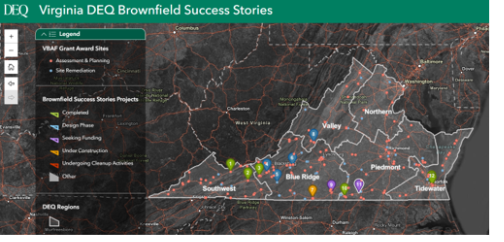
Brownfields are properties that have a presence or potential presence of hazardous substances, pollutants, or contaminants which complicates redevelopment.
Redeveloping brownfields is a vital step in strengthening communities across Virginia. It transforms underutilized and unused properties into places that support economic growth while addressing underlying environmental conditions. DEQ’s Brownfield Success Stories Storymap has been refreshed to showcase recent standout brownfields projects across the Commonwealth.
From an old industrial building turned restaurant and brewery to a former school converted into needed housing — the Storymap is a user-friendly platform that highlights a variety of different brownfield success stories.
The updated Storymap includes a visual layer identifying awarded Virginia Brownfields Restoration and Economic Redevelopment Fund grants from 2012 to the present. Individual site stories reference other grants and financial investments that contributed to the success of each site.
To learn more and submit your own brownfields story, contact Karen Weber, DEQ’s Brownfields Coordinator.
DEQ Email Size Limit Reduced Starting Nov. 30

The Virginia Information Technologies Agency (VITA) is implementing a statewide change on Nov. 30 that will reduce the maximum email size, including attachments, from 60 MB to 20 MB for all agencies. DEQ recognizes that this adjustment may create challenges for business processes and customer service as DEQ staff often send and receive large documents. DEQ is working closely with VITA to evaluate potential impacts and identify options to minimize disruptions
To account for these changes and help staff continue sharing documents efficiently and securely, DEQ is preparing to deploy Box, a new secure tool to support large file sharing.
Box provides several advantages that directly address the new email size limit:
- Send and receive large files without relying on email attachments.
- Share with external partners safely, using secure links and configurable permissions.
- Maintain data protection through encryption, access controls, and auditing features.
- Collaborate in real time with version tracking and activity history.
- Reduce inbox storage by eliminating oversized attachments.
-
Accessible through a web browser, desktop integration, and mobile apps, making it easy to upload, share, and manage documents from any work environment.
DEQ is committed to ensuring continuity of operations and supporting employees and customers throughout this change. Learn more and get the most up-to-date information by visiting the File Sharing with DEQ webpage. For further questions about Box, contact John Garafola.
Drought: Western Virginia Improves; Southeast Worsens
On Oct. 23, DEQ and the Drought Monitoring Task Force recommended both escalations and de-escalations of drought status in the
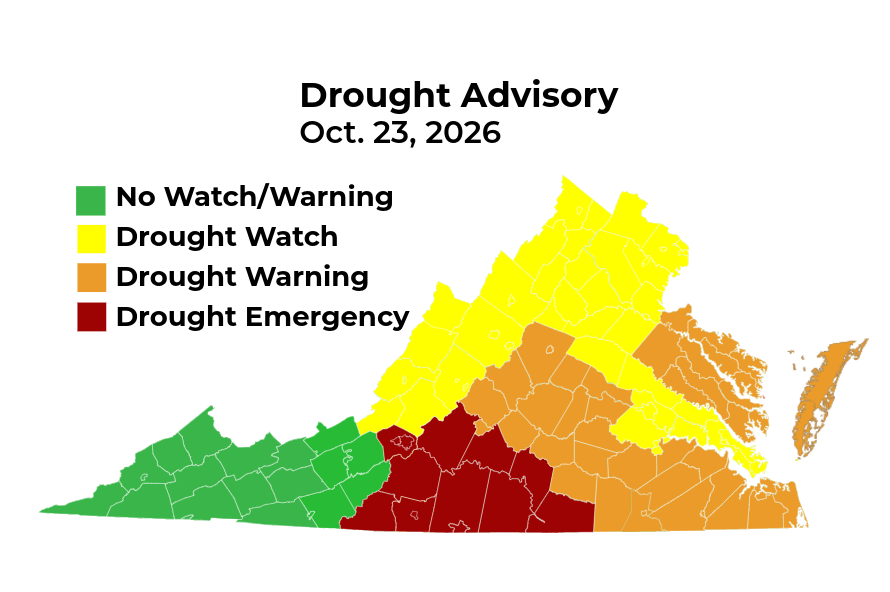
Commonwealth. These changes were the result of variable rainfall across Virginia and persistent dry conditions This change marks the first time the Southeast region has been in a drought warning in at least 16 years.
Escalating from a drought watch to a drought warning:
·Southeast Virginia: Isle of Wight County and the cities of Chesapeake, Norfolk, Portsmouth, Suffolk, and Virginia Beach
De-escalating from a drought watch to no advisory:
·New River: Bland, Carroll, Floyd, Giles, Grayson, Montgomery, Pulaski, and Wythe counties and the cities of Galax, and Radford
De-escalating from a drought warning to a drought watch:
·Upper James: Alleghany, Bath, Botetourt, Craig, Highland, and Rockbridge counties and the cities of Buena Vista, Covington, and Lexington
·Shenandoah: Augusta, Clarke, Frederick, Page, Rockingham, Shenandoah, and Warren counties and the cities of Harrisonburg, Staunton, Waynesboro, and Winchester
For more information on the ongoing drought, visit DEQ's Drought webpage and the Drought Dashboard.
Permit Review System Is Adding Construction Stormwater

DEQ is excited to announce that its Permit Review System (PRS), an artificial intelligence tool to check administrative and technical completeness of permit applications and other submittals, will include construction stormwater starting in mid-November.
DEQ uses PRS to ensure completeness and technical sufficiency, but its use is two-fold — PRS is also publicly available for applicant use when preparing submissions.
Improved applications mean quicker permit decisions by DEQ — meeting a major agency goal of further reducing permit application processing times. Specifically, PRS will facilitate the review of administrative completeness for construction projects, including erosion and sediment control, and stormwater management plans. PRS is free for applicants to use through December. After the trial period, there will be a cost to use the system on a per-review basis. Use of the system by applicants is optional, however the cost should be well-worth the reduced processing times. Details concerning PRS pricing will be provided in a future DEQ News article.
For more information, visit DEQ’s PRS webpage.
Technology Updates: DEQAct Preview and Taxpayer Identification Numbers

DEQAct Preview:
On Dec. 1, DEQ will begin a partial launch of the new DEQAct system for external customers. This early release will give users the opportunity to become familiar with DEQAct.
During this partial launch, customers will be able to:
• Register and log in to DEQAct
• Create and set up their user profile
• Explore the system’s layout and navigation
• Get comfortable with how DEQAct will support future permit activity – including searching for and viewing permits
To learn more about DEQAct and what is coming next, sign up for our DEQAct webinar on Nov. 19.
DEQ to Use Taxpayer Identification Numbers:
In an effort to improve customer information management, starting in mid-November DEQ will use Taxpayer Identification Numbers (TINs) to ensure internal records are accurate and complete. TINs will serve as the unique identifier for entities with whom DEQ conducts business. For individuals, this number would be a Social Security Number, whereas businesses would use an Employer Identification Number. DEQ will also work directly with applicants to obtain TINs securely if they are not already provided in the application or permit fee forms.
For more information view the DEQ memorandum that explains this decision in detail and outlines the justification for this agency-wide update.