 DEQ NEWS
July 28, 2026 Vol. 5, No. 6
Drought In Roanoke Region
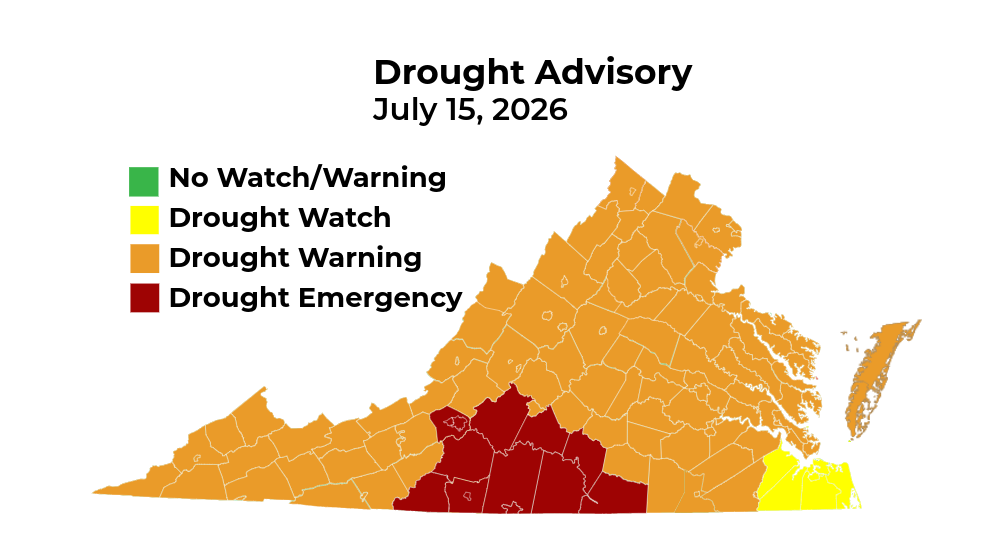
As a result of significant rainfall deficits over a sustained period of time, Virginia's Drought Monitoring Task Force (DMTF) has elevated the Roanoke Drought Evaluation Region to consider declaring a drought emergency. This area includes the following localities: Bedford, Campbell, Charlotte, Franklin, Halifax, Henry, Mecklenburg, Patrick, Pittsylvania, and Roanoke counties, and the cities of Danville, Martinsville, Roanoke, and Salem. The rest of the state remains either in a Drought Warning or Drought Watch. Governor Spanberger urged Virginians to increase commonsense water conservation efforts at a press conference at Smith Mountain Lake, where reservoir levels are currently 5.2 feet below normal levels. The Governor emphasized there are no state imposed mandatory water restrictions in the region for now but may be necessary if conditions do not improve.
When DMTF considers the conditions of the 13 drought evaluation regions across the Commonwealth, it looks into four key indicators: streamflows, groundwater well, precipitation and reservoir levels. DMFT discusses these indicators, among other data presented by interagency experts, to reach a scientifically-informed consensus on drought status.
In order to erase the precipitation deficit in the Roanoke River watershed, the area will need to make up a rainfall deficit of approximately 12 inches. Sustained rains benefit drought-stricken the most, as brief thunderstorms that produce large amounts of rain quickly elevate streamflows, but do not linger long enough to positively impact groundwater levels.
In response to drought indicators for the Roanoke Drought Evaluation Region, DEQ has developed and published the new Roanoke Drought Evaluation Region Dashboard on the Drought webpage. This dashboard summarizes water withdrawal data reported to DEQ by facilities within the region from 2021 through 2025. It includes a summary table, interactive charts, an interactive data table, and a map of all relevant facilities, providing key withdrawal information in a clear, digestible format to support understanding of water withdrawals and uses in the region.
DMTF met on July 28, and will have an update on the drought in the coming days.
For more information on the drought, you can read the Governor’s July 15 news release.
Food Waste Survey

In an ongoing effort to reduce food waste in the Commonwealth, DEQ is partnering with The Ohio State University Food Waste Collaborative to circulate a survey on household food waste. The intention of the survey is to understand the habits of consumers, the amount of food wasted and what kind of food is wasted.
Understanding the habits of consumers will inform outreach and help develop food waste reduction strategies.
We would greatly appreciate your participation in the survey. It takes approximately 10 minutes to complete. To learn more, visit DEQ’s Preventing Wasted Food webpage.
Wildfire Smoke and Air Quality Forecasts
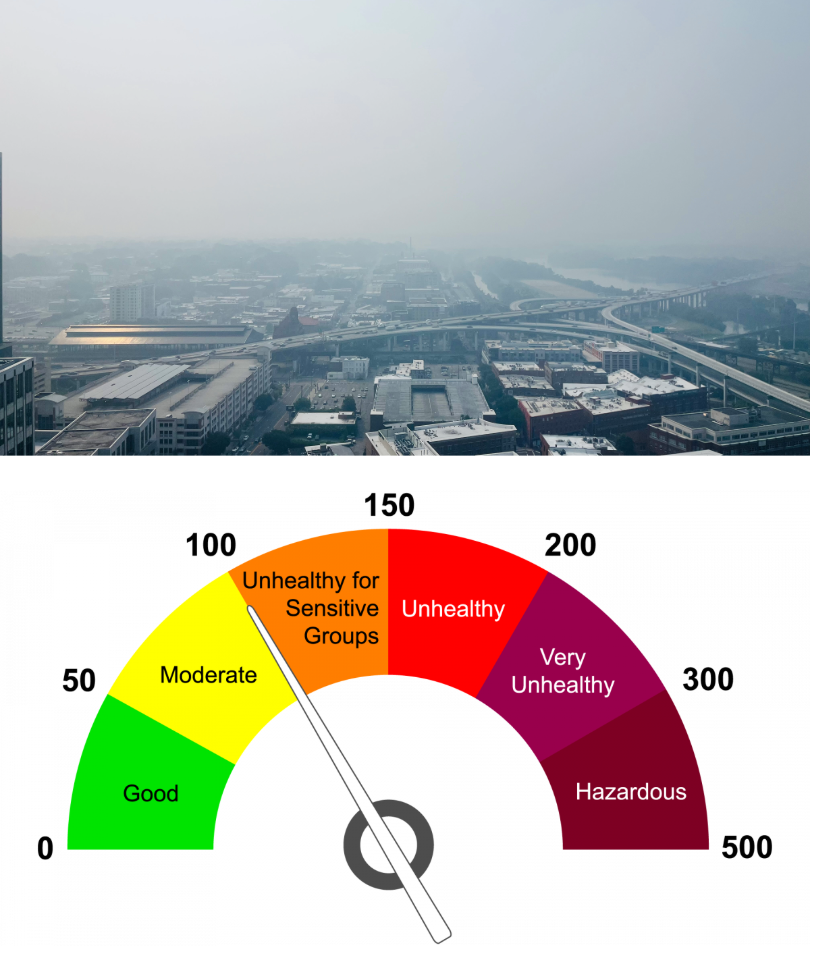
On July 17, Virginia had its smokiest day since air quality monitoring first began in 1999. Parts of Northern Virginia had particulate pollution, or PM2.5, levels that were four times that of Delhi, India — a city notorious for poor air quality. DEQ's Loudoun County air monitor measured particulate pollution at an average concentration of 170.8 micrograms per cubic meter, often shortened to ug/m3 (over a 24-hour average). To put this in context, the standard, or highest safe level of PM2.5 established by the U.S. Environmental Protection Agency, is 35.0 ug/m3. However, all of DEQ's air quality monitors throughout the state typically measure PM2.5 levels far below this.
On July 17, 17 of DEQ's air quality monitors measured PM2.5 levels above the 24-hour ug/m3 standard, and another six exceeded this level the following day. For context, in a typical year there may be exceedances in one or two parts of the state on July 4 due to fireworks pollution. Also on July 17, there were ozone pollution exceedances measured at seven of DEQ's monitors in Northern Virginia and the Tidewater area. Ground-level ozone pollution can also be exacerbated by wildfire smoke.
In addition to monitoring air quality in real-time, DEQ's meteorologists forecast air quality to help Virginians stay safe outdoors. DEQ issues daily weekday air quality forecasts for PM2.5 throughout the year as well as for ozone during the late spring and summer months. Thankfully, air quality is typically quite good throughout the state. To stay informed about air quality, we encourage you to sign up for color-coded air quality forecasts and/or health alerts to stay safe. DEQ only issues health alerts on rare occasions when outdoor activities could affect your health due to air quality.
For the Washington, DC metro area, download the Clean Air Partners’ app or sign up on Enviroflash to receive Air Quality Forecasts and Action Day Health Alert Notifications.
Environmental Justice Town Hall - July 29

DEQ is developing an updated draft of the Environmental Justice in the Permitting Process Guidance and is hosting the second of two public town hall meetings to discuss the guidance. We would particularly like to hear your ideas regarding how to assess the cumulative impacts of certain DEQ-issued permits, as well as recommendations for outreach strategies to engage communities potentially impacted by such permits.
Date/Time: July 29, 6 to 9 p.m.
Location: DEQ Tidewater Regional Office
5636 Southern Blvd.
Virginia Beach, VA 23462
The meeting will also be livestreamed, however comments will not be able to be submitted through the livestream option.
The draft guidance will be posted on the Environmental Justice Permitting Guidance webpage as soon as it is available. You may also access the presentation slides and a fact sheet for the town hall. Details for the first town hall, held on July 22 in Richmond, were previously announced on the Virginia Regulatory Town Hall website.
Advocates and Early Adopters of Alternatives to Styrofoam

The effort to divest from EPS, more commonly referred to as the brand Styrofoam, did not happen overnight in Virginia. Originally passed in 2021, it was not fully implemented until July 2026 due to administrative changes and general assembly delays.
Despite delays, the steadfast commitment to a cleaner future from several institutions and environmental environmental organizations made this ban a reality. Here are two organizations that played an important role in that effort.
Since 1995, Clean Virginia Waterways (CVW) has made reducing plastics such as EPS in our environment its number one priority. Leading the way on planning, education, advocacy, waterway cleanups, and research, CVW was an early champion of the EPS ban and recently directed its emphasis to informing business across the Commonwealth about the ban and foam-free alternatives.
Virginia Tech became an early adopter in divestment from EPS several years before the EPS ban. In 2020, after suffering from supply chain issues, poor product quality, and waste concerns, the Virginia Tech Dining Services team decided they would no longer use EPS in their cafeterias and would switch to a product that was made in the United States, was compostable, and contained no added PFAS.
In 2023, Virginia Tech onboarded a Virginia-based company called Terravive to provide compostable serviceware such as straws, cutlery, cups, takeout containers, bowls, plates, and bags. At a university where the cafeterias routinely serve 40,000 students daily, this simple change made a huge difference in the sustainability of the institution and protection of the environment.
While legislation can draw the framework for creating a more sustainable future for Virginians, it takes the bold actions of our greater environmental community to make that future a reality.
Apply for Stormwater Local Assistance Fund
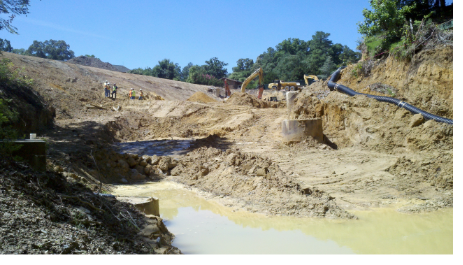
DEQ will open the fiscal year 2027 annual solicitation period for the Stormwater Local Assistance Fund (SLAF) grant program on Aug. 3. The SLAF program provides matching grants to localities for the planning, design and implementation of stormwater best management practices that address cost efficiency and commitments related to reducing water pollution. Additionally, the SLAF program can fund matching grants for the purchase of permanent, certified non-point source nutrient credits.
All local governments within the Commonwealth are eligible to apply. Eligible project types include:
• New stormwater BMPs
• Retrofits of stormwater BMPs and ponds
• Stream restorations
• Low impact development projects
• Buffer restoration
• Wetlands restoration
DEQ will accept SLAF applications Aug. 3 through Oct. 1. Completed applications must be submitted via the MyDEQ Portal no later than 11:59 p.m. on October 1. In addition to the online application submittal, applicants may be required to submit hard copies of certain documents associated with project types. For more information, visit the Stormwater Local Assistance Fund webpage.
AlexRenew Completes Largest Infrastructure Project in Alexandria's History
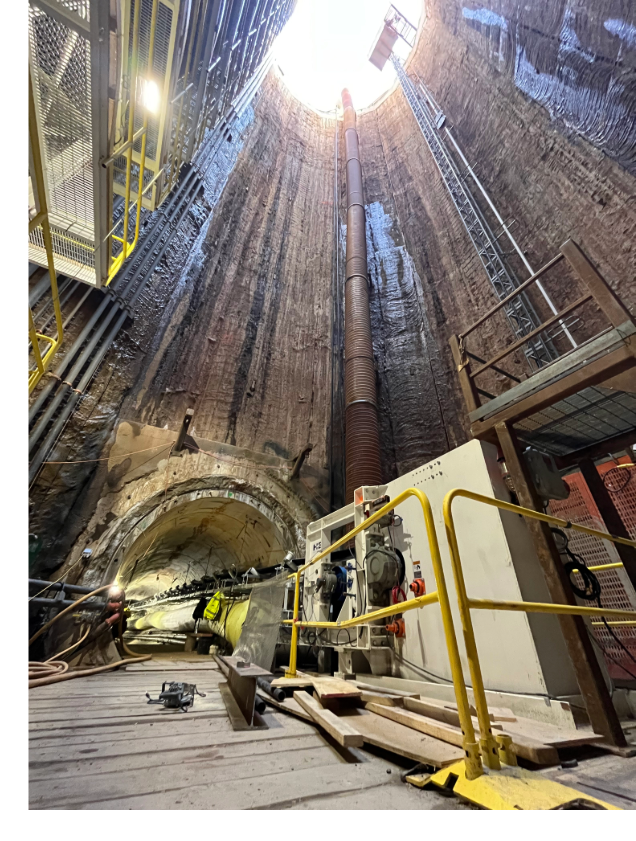
On July 1, AlexRenew held a ribbon cutting ceremony to celebrate the full activation of the Alexandria combined sewage overflow control program, known as RiverRenew. The system reached full operational status on June 29, marking the completion of an eight-year effort to prevent approximately 120 million gallons of combined sewage from entering Virginia’s waterways each year.
The RiverRenew project is a feat of engineering, perseverance, and community partnership. Marking the largest infrastructure project in Alexandria’s history, AlexRenew worked with the community to plan, design and construct a massive 130-foot-deep, 2.2-mile-long tunnel, along with a 6-foot-wide interceptor sewer, diversion facilities, wastewater plant upgrades, and a 12-story underground pumping station. All of this was completed while AlexRenew maintained continuous wastewater treatment services for its customers. Projects of this magnitude often exceed estimated timelines and projected budget, however AlexRenew delivered on time and on budget despite a global pandemic, unprecedented inflation, supply-chain disruptions, and international conflicts that threatened shipping and material availability.
Eastern Virginia Groundwater Supply Study Report Now Available
On July 24, DEQ published "Senate Joint Resolution No. 25 – Groundwater Supply East of Interstate 95." This 2024 General Assembly resolution directed DEQ to complete a study to include historical and current trends in groundwater levels and quality for the area, as well as future projections in light of newer industries such as data centers. The study also addresses topics related to the regulatory efficiency of the Groundwater Management Act of 1992 and provides recommendations for improvements. DEQ's report represents the most comprehensive effort to address the complex question of how much groundwater supply is available in this important region of the Commonwealth.
Some key points from the report include:
• Major uses of groundwater in this area are industrial (35%), private domestic (34%), and public water supply (26%).
• Private domestic (household) withdrawals are projected to increase in the area through 2050.
• Major withdrawals, especially at paper mills near Franklin and West Point have caused groundwater levels to decline below sea level.
• Groundwater salinity is increasing in some parts of Eastern Virginia and on the Eastern Shore.
• Groundwater levels throughout the Potomac aquifer are expected to enter a period of decline in the next five to ten years.
You can now read the full report on the DEQ Reports webpage.
DEQ and SCC Address Interconnection Facilities
DEQ and the State Corporation Commission’s (SCC) Memorandum of Agreement (MOA) clarifies the roles of both agencies when addressing interconnection facilities on small renewable energy projects. Interconnection facilities are infrastructure that connects an energy source to the main grid. This MOA is expected to increase efficiency by allowing for projects with off-site interconnection and substations to be approved by DEQ as a Permit By Rule (PBR), which is typically faster than the SCC process. For consumer, this should save money and reduce the cost of electricity.
Some key provisions of the agreement include:
• Dedicated interconnection facilities are expressly covered by the DEQ PBR.
• Interconnection facilities and substations may extend beyond the primary project site.
• The SCC will provide technical assistance during DEQ’s permit review.
• DEQ will provide interconnection documentation to the SCC.
If you would like to read more about the MOA, you can read the overview on DEQ’s Renewable Energy Permits webpage.