
Home for swifts at Glebe Farm, Pitney
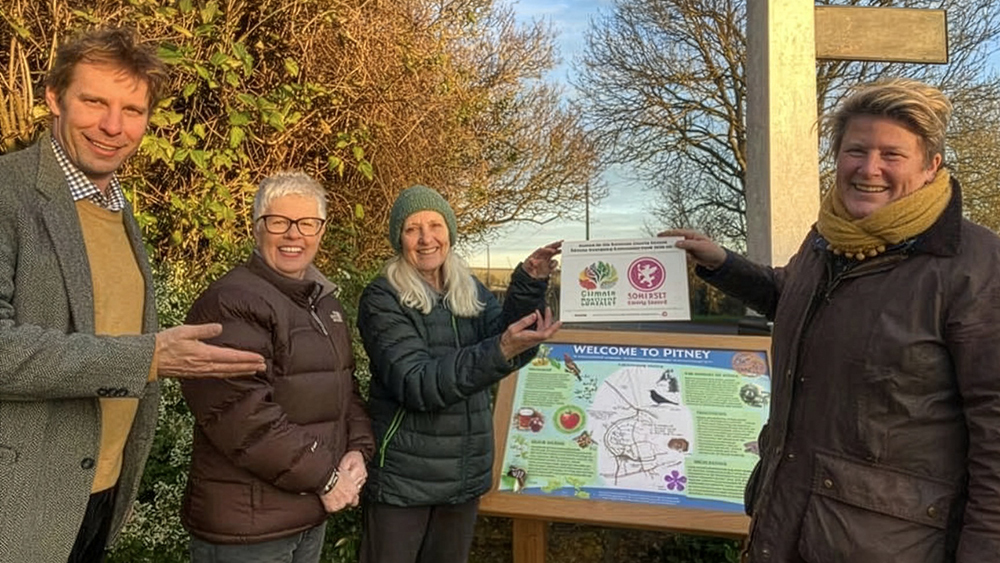 Credit: Cllr Wilkins (L) and Sarah Dyke MP (R), MP for Glastonbury and Somerton, with Pitney Biodiversity Working Group members
Submitted by Pitney Biodiversity Working Group.
Pitney Biodiversity Working Group was formed under the auspices of Pitney Parish Council. It’s a small group and our remit is to monitor and, where possible, enhance the local environment for biodiversity.
A new home for swifts
The Glebe Farm Swift Tower is our most recent project. Swifts have been visiting Pitney for as long as anyone can remember.
But, as is happening everywhere, old farm buildings are being converted and newer buildings provide fewer nesting opportunities. Retaining a healthy swift population seemed an obvious aim for the group and, over a cup of coffee in the wonderful Pitney Farm Café, the idea of a swift tower was born.
Our local organic farmers, Rob and Lizzie Walrond, were very excited by the idea and more than willing to provide a site, but the logistics of acquiring and erecting a suitable pole proved daunting. Appeals to National Grid for charitable assistance were unsuccessful and other options were being explored when fortune intervened.
A pole at the farm, just a few metres from the spot chosen for the tower, needed to be replaced, and we were able to acquire the old one. The pole was moved and erected with the help of local muscle and enthusiasm, and lifting equipment courtesy of a neighbouring farmer.
Attention then turned to a design for the house to go on top. After researching other projects and taking advice from the Swift Conservation website, we came up with a design, in collaboration with local resident Ray, that would provide 8 nest boxes and could be constructed economically from a single sheet of WPB plywood.
The house was constructed by Ray and consists of 8 separate chambers on 2 levels, each fitted with a shallow nesting cup and offering a summer residence for 1 pair of birds to raise their brood. It has a felted pitched roof and is treated externally with a UV-resistant finish.
The box was attached to the top of the pole at sunset one day in early spring, watched by an excited group of local adults and children.
This left one more thing to do to improve our chances of attracting residents to the tower.
Swifts don’t breed until they are 3 or 4 years old, but they will start to pair and investigate potential nesting sites before that. We procured and fitted a caller to the pole. This emits swift calls at appropriate times of day, alerting swifts in the locality to the presence of an ideal home.
Other biodiversity projects
Other projects undertaken by the biodiversity group include the restoration of what had become an overgrown rubbish tip into an attractive seasonal pond where aquatic plants, amphibians and invertebrates can thrive.
This project involved the cooperation and assistance of the landowner and, one Sunday in late August, the physical work of around 20 villagers, including those who turned up with cake and coffee.
With a grant from the Climate Emergency Fund, we have also designed and erected 3 information boards in the village: 1 at the Halfway House pub, 1 at the village hall and 1 at the farm shop.
These are intended to raise awareness of, and celebrate, biodiversity in Pitney Parish and have been admired by many, including Sarah Dyke, who came to view them in her role as environmental lead for Somerset County Council.
We have also been involved in planting local variety apple trees on a piece of land left after development, putting up house martin boxes on the village hall, and partially clearing a local copse to let more light reach the woodland floor, encouraging undergrowth and creating log-pile habitats and bird boxes.
Other activities include butterfly walks, glow-worm walks and wildflower walks.
Our dawn chorus walk in 2026 saw us record 35 different species of birds in a couple of hours.